Does it work?
Bakuchiol for Acne & Breakouts
What the research says about bakuchiol for acne & breakouts, how to use it at home and how to stay safe.
The short answer: Small, mostly open-label studies suggest benefit in mild acne, often in combination products; plausible anti-inflammatory and anti-sebum effects.
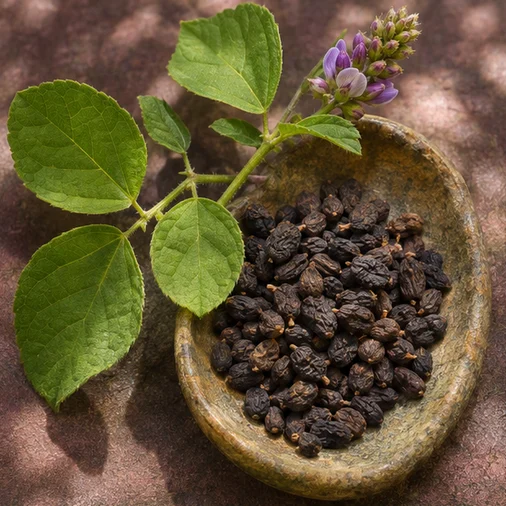
What it does
Bakuchiol is a single purified molecule from the seeds of babchi (Cullen corylifolium), a plant of Ayurveda and Chinese medicine. It is not a retinoid structurally, but in lab studies it switches on many of the same skin genes as retinol, and a small 12-week randomized trial found it improved wrinkles and pigmentation about as well as 0.5% retinol, with less stinging and peeling. It is a sensible option for people who cannot tolerate retinoids, as long as expectations stay realistic.
Why people reach for it
- Retinol-like smoothing. At 0.5% twice daily, bakuchiol reduced wrinkle surface area over 12 weeks in a small head-to-head trial with retinol, with no statistically significant difference between the two.
- Gentler on the barrier. In the same trial, retinol users reported more scaling and stinging. Bakuchiol is a reasonable first step for reactive skin or people who gave up on retinoids.
- Helps even out tone. Both bakuchiol and retinol reduced the appearance of hyperpigmentation in the comparison study; bakuchiol also shows some tyrosinase-related activity in the lab.
- Antioxidant and photostable. Unlike retinol, bakuchiol is not broken down quickly by light and has antioxidant activity of its own, which makes it easy to formulate and to use in the morning.
- Possible help for blemish-prone skin. Lab data show activity against Cutibacterium acnes and inflammatory pathways; human acne data are preliminary. See Acne & Breakouts.
How to use it
| Form | Typical use | Notes |
|---|---|---|
| Leave-on serum or cream | 0.5–1% bakuchiol (0.5% is the level studied) | Use once or twice daily. Because it is photostable it can go on in the morning, but daily SPF remains essential for any anti-aging routine. See Build a Routine That Works (Minimal & Evidence-Based). |
| Facial oil | 0.5–1% in a light carrier | Bakuchiol is oil-soluble; dissolve it in the oil phase, e.g. Squalane or jojoba, and add 0.2–0.5% vitamin E (tocopherol) as an antioxidant. |
| Paired with a retinoid | 0.5–1% bakuchiol alongside low-dose retinol | Some formulas combine them; there is lab data suggesting complementary effects, but little clinical evidence. If irritation appears, simplify. |
Recipes with Bakuchiol
Daily rituals with Bakuchiol
Use it safely
- Generally well tolerated. Mild irritation and occasional allergic contact dermatitis have been reported; patch test first (see How to Patch Test).
- Do not substitute babchi seed oil or whole seed extract. They contain psoralens and can cause severe phototoxic burns and pigment changes.
- Buy only purified, psoralen-free cosmetic grade bakuchiol from a supplier that provides a certificate of analysis.
- Bakuchiol is not a proven replacement for prescription tretinoin in acne or photoaging; see a dermatologist for moderate–severe acne or significant sun damage.
Pregnancy and breastfeeding: Often marketed as “pregnancy-safe retinol,” but there are no safety studies in pregnancy or breastfeeding. It is not a retinoid, and topical absorption is likely low, but the honest answer is “no data”; discuss with your clinician.
New to an ingredient? Patch test first.
When to see a doctor
- Deep, painful nodules or cysts, or any acne that is leaving scars (pitted, rolling or raised) — early treatment prevents permanent scarring.
- No meaningful improvement after 2–3 months of consistent over-the-counter treatment.
- Acne with irregular periods, excess facial or body hair, scalp hair thinning or rapid weight gain, which can point to polycystic ovary syndrome or another hormonal cause.
- Sudden, severe, ulcerating acne with fever, joint pain or feeling unwell (acne fulminans) — seek prompt care.
- Acne that started after a new medicine or supplement (e.g. corticosteroids, anabolic steroids, some anticonvulsants).
- Acne affecting your mood, sleep or confidence — this is a valid reason to seek treatment.
Other plants for Acne & Breakouts
| Ingredient | Grade | What the evidence shows |
|---|---|---|
| Tea Tree | B | Several small randomized trials of 5% tea tree oil gel show fewer inflammatory and total lesions than placebo, with slower onset but better tolerability than 5% benzoyl peroxide. |
| Green Tea | B | Small randomized trials of 2–3% green tea extract lotions reduced lesion counts and sebum in mild to moderate acne; effects are modest. |
| Aloe Vera | C | In one randomized trial, aloe gel combined with tretinoin improved results and tolerability versus tretinoin alone — useful as a soothing partner to retinoids. |
| Willow Bark | C | Contains salicin and other salicylates that may gently exfoliate and calm, but it is far weaker than salicylic acid and human data are limited. |
| Honey | C | Antimicrobial in the lab, but a randomized trial of medical-grade kanuka honey added to routine cleansing found no significant extra benefit. |
| Witch Hazel | D | Tannins are astringent and anti-inflammatory in vitro; there are no meaningful acne trials, and alcohol-based distillates can irritate. |
| Rhassoul Clay | D | Absorbs surface oil temporarily for a matte finish; no evidence it treats acne lesions. |