The ingredient encyclopedia · oil
Tea Tree
Melaleuca alternifolia · Myrtaceae
Fresh, herbal and clinically studied, tea tree oil is a gentle, patient answer to mild breakouts.
FR Arbre à thé (tea tree)ES Árbol del téAR شجرة الشاي
- How well proven
- BGood evidence
- Safety
- Use with care
- Sun-sensitive
- No
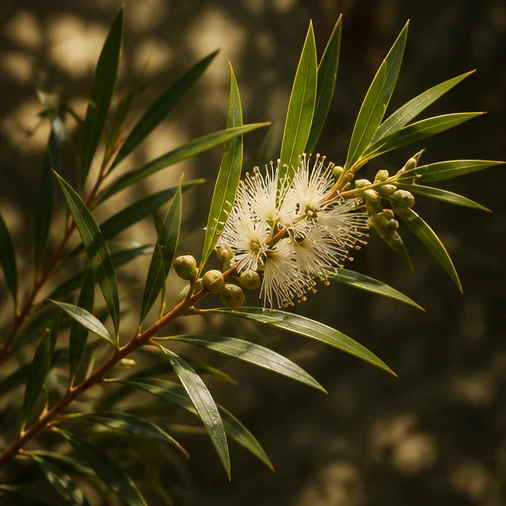
FR Arbre à thé (tea tree)ES Árbol del téAR شجرة الشاي
What the evidence says
Randomized trials show 5% tea tree oil reduces mild-to-moderate acne versus placebo and comparably to 5% benzoyl peroxide, and a placebo-controlled trial supports a 5% shampoo for dandruff.
- Best supported for
- Acne & Breakouts BDandruff & Itchy Scalp BOily Skin & Pores C
- How to use it
- Spot or acne gel · Up to 5% (the concentration used in trials), on blemishes only
- Watch out for
- Oxidized oil is a sensitizer.
Checked against 4 cited studies and our safety review · Updated 26 November 2026 · How we grade
Why you’ll love Tea Tree
Why you’ll love it
- Calms mild breakouts, backed by clinical trials
- Gentler on skin than benzoyl peroxide, if a little slower
- Helps keep dandruff in check in a tea tree shampoo
Best forOily, blemish-prone skin and flaky scalps, for people happy to go at a gentler pace.
Try it today
A targeted spot routine
- Choose a ready-made tea tree spot gel, or dilute the oil properly; never dab it on neat.
- Patch test first, then apply a tiny amount to blemishes only, once or twice a day.
- Give it 6–12 weeks, and keep the bottle cool, dark and away from children and pets.
Good to know: Toxic if swallowed and harsher once old, so store it well out of reach. Cystic or scarring acne needs a doctor, not tea tree.
At a glance
| Parts used | Leaves and terminal branches; steam-distilled essential oil |
|---|---|
| Key actives | Terpinen-4-ol, γ-Terpinene, α-Terpinene, 1,8‑Cineole, α-Terpineol, Terpinolene |
| INCI names | Melaleuca Alternifolia (Tea Tree) Leaf Oil Melaleuca Alternifolia (Tea Tree) Leaf Extract |
| Skin types | oily, combination |
| Hair & scalp | oily scalp |
| Pairs well with | Aloe VeraGreen TeaJojobaWitch Hazel |
| Evidence grade | BGood evidence Randomized trials show 5% tea tree oil reduces mild-to-moderate acne versus placebo and comparably to 5% benzoyl peroxide, and a placebo-controlled trial supports a 5% shampoo for dandruff. |
What it does for skin and hair
Treats mild-to-moderate acne
A 5% gel reduced inflamed and non-inflamed lesions comparably to 5% benzoyl peroxide over three months, and outperformed placebo in a separate trial. It acts more slowly than benzoyl peroxide.
Fewer side effects than benzoyl peroxide
In the head-to-head trial, dryness, itching and stinging were much less common with tea tree oil gel than with benzoyl peroxide lotion.
Reduces dandruff
A 5% tea tree oil shampoo improved dandruff severity significantly more than placebo over four weeks, consistent with its activity against Malassezia yeasts.
Broad antimicrobial activity
Terpinen-4-ol is active against bacteria (including C. acnes and S. aureus) and fungi in the lab, and also reduces inflammatory mediators.
How to use it
Start low, be consistent, and give it four to eight weeks. These are the amounts that work in real products and home recipes.
| Form | Typical use level | Notes |
|---|---|---|
| Spot or acne gel | Up to 5% (the concentration used in trials), on blemishes only | Apply once or twice daily to affected areas; expect results over 6–12 weeks. For whole-face leave-on products keep to about 1%. See Tea Tree Blemish Spot Gel and Essential Oil Dilution Calculator. |
| Shampoo for dandruff | 5% in a rinse-off shampoo | Lather into the scalp and leave 3–5 minutes before rinsing, daily or on alternate days. Use a solubilizer so the oil disperses evenly. |
| Cleanser or face wash | 0.5–1% | Rinse-off contact is short, so this is a gentler, lower-risk way to use tea tree on oily skin. |
Use it safely
Use with care
- Oxidized oil is a sensitizer. Buy small bottles, keep them tightly closed in the fridge or a cool dark place, and discard after about 6–12 months or if the smell turns harsh or turpentine-like.
- Never apply neat to skin, ears or mucous membranes; undiluted oil commonly causes irritation and allergic dermatitis. Patch test first (How to Patch Test).
- Toxic if swallowed: even small amounts have caused drowsiness, confusion and loss of coordination in children. Keep out of reach of children and pets — cats are especially sensitive, even to skin application.
- Tea tree oil appears in case reports of reversible prepubertal breast enlargement (with lavender); avoid frequent liberal use on young children.
- See a doctor for nodular, cystic or scarring acne — these need prescription treatment. See Acne & Breakouts.
- Pregnancy & breastfeeding
- Diluted topical use is generally considered acceptable in pregnancy and breastfeeding. Never take it orally, and keep it away from the nipple area if breastfeeding. Pregnancy guide
- Phototoxicity
- Not phototoxic at normal use levels.
- Declared fragrance allergens
- Limonene, Linalool
New to an ingredient? Patch test first. Stop and seek advice if you get burning, swelling, blistering or a spreading rash.
Make it at home: recipes with tea tree
Buying well
Sustainability
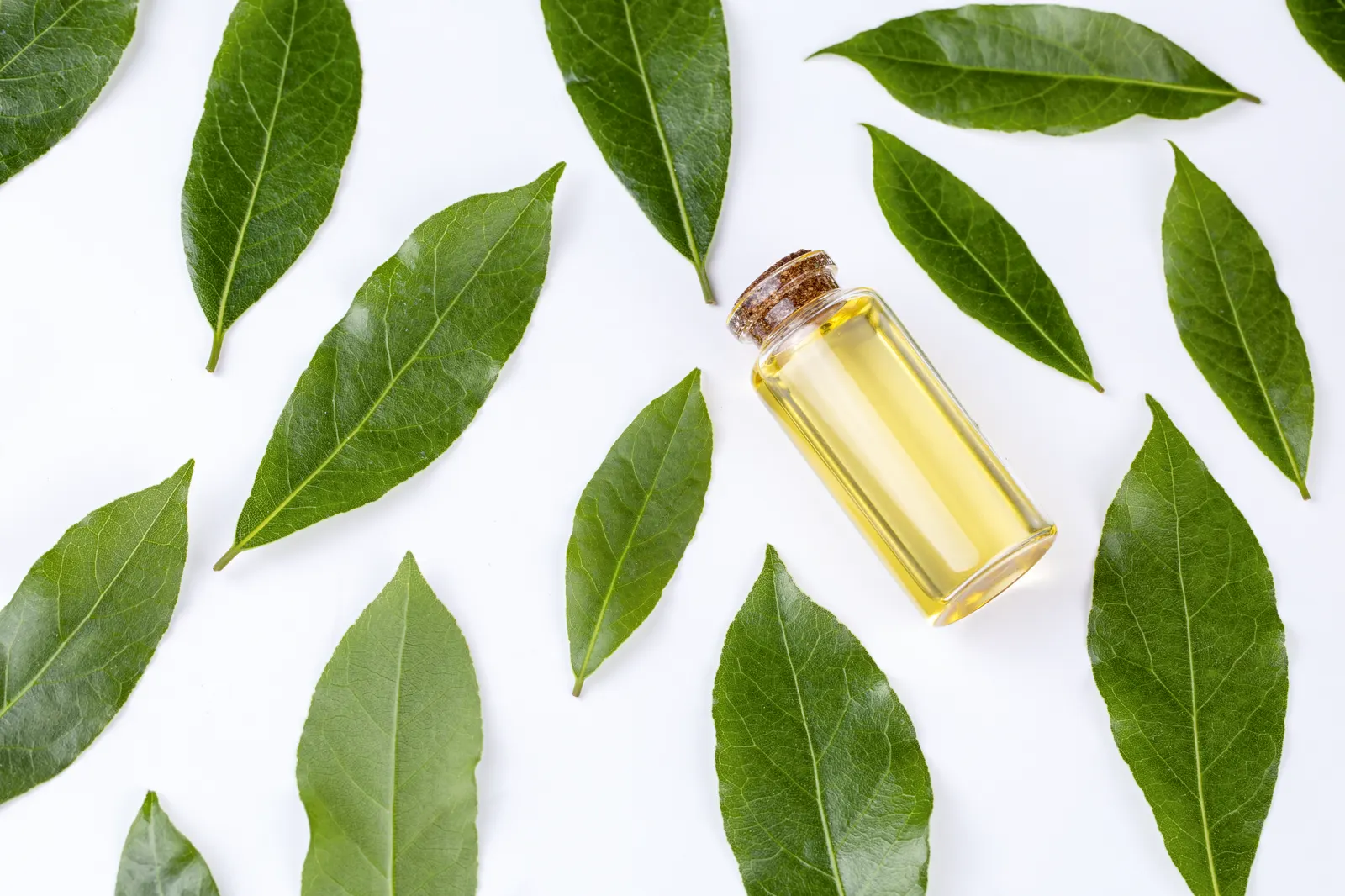
Most tea tree oil comes from plantations in New South Wales, Australia, where the trees are coppiced and regrow from the stump. Oils from other countries can be good, but adulteration — with other Melaleuca species, terpinen-4-ol-rich fractions or synthetic terpenes — is common. Insist on ISO 4730 compliance.
How to choose quality
Choose 100% Melaleuca alternifolia leaf oil with a GC report showing terpinen-4-ol ≥35% and 1,8‑cineole low (ideally under 5%). Dark glass, small volume, with a fill or distillation date. Ready-made 5% gels from pharmacies are a good, standardized alternative to DIY.
The research For professionals
The chemistry, the studies and the evidence by concern, for practitioners, formulators and the curious.
Tea tree oil is distilled from the leaves of an Australian paperbark. The international standard (ISO 4730) requires terpinen-4-ol at 35–48% and limits 1,8‑cineole to no more than 15%, with γ-terpinene, α-terpinene, terpinolene and α-terpineol making up much of the rest. Terpinen-4-ol is the main antimicrobial: it disrupts microbial membranes and is active against Cutibacterium acnes, Staphylococcus aureus and Malassezia yeasts in vitro, and it reduces inflammatory cytokine release from activated immune cells.
The landmark trial is Bassett et al. (Med J Aust, 1990): 124 people with mild-to-moderate acne used 5% tea tree oil gel or 5% benzoyl peroxide lotion for three months. Both significantly reduced inflamed and non-inflamed lesions; benzoyl peroxide acted faster and more strongly on inflamed lesions, but side effects were reported by 44% on tea tree versus 79% on benzoyl peroxide. A later double-blind trial (Enshaieh, 2007) in 60 patients found 5% gel several times more effective than placebo on lesion counts and severity over 45 days. For dandruff, a 5% shampoo improved severity by 41% versus 11% with placebo over four weeks (Satchell, 2002).
The safety story centers on oxidation. With air, light and heat, α-terpinene and other components oxidize into sensitizers such as ascaridole and 1,2,4‑trihydroxymenthane (Hausen, 1999). Fresh oil is a weak sensitizer; old oil is a meaningful one, and tea tree is a well-recognized cause of allergic contact dermatitis, often in people who applied it neat. Tea tree oil also appears alongside lavender in the case reports of prepubertal breast enlargement discussed on the lavender page — limited evidence, but a reason not to use it liberally on young children.
Evidence by concern
| Concern | Grade | What the evidence shows |
|---|---|---|
| Acne & Breakouts | B | Several small randomized trials of 5% tea tree oil gel show fewer inflammatory and total lesions than placebo, with slower onset but better tolerability than 5% benzoyl peroxide. |
| Oily Skin & Pores | C | Helpful for acne lesions on oily skin, but there is little evidence it reduces sebum itself. |
| Dandruff & Itchy Scalp | B | A randomized, placebo-controlled trial of 5% tea tree oil shampoo improved dandruff severity, itch and greasiness over four weeks. |
Key studies
124 people with mild-to-moderate acne: 5% tea tree oil gel and 5% benzoyl peroxide lotion both reduced lesions over 3 months; benzoyl peroxide was faster, tea tree had fewer side effects (44% vs 79%).
Bassett IB, et al. Med J Aust. 1990 Read it in the bibliography Find on PubMedDouble-blind trial in 60 people with mild-to-moderate acne: 5% tea tree oil gel was significantly more effective than placebo for lesion count and severity over 45 days.
Enshaieh S, et al. Indian J Dermatol Venereol Leprol. 2007 Read it in the bibliography Find on PubMed126 people with mild-to-moderate dandruff: 5% tea tree oil shampoo improved severity by 41% vs 11% with placebo over 4 weeks.
Satchell AC, et al. J Am Acad Dermatol. 2002 Read it in the bibliography Find on PubMedOxidation products of tea tree oil, including ascaridole and 1,2,4‑trihydroxymenthane, were identified as the main sensitizers.
Hausen BM, et al. Am J Contact Dermat. 1999 Read it in the bibliography Find on PubMed
MythDabbing neat tea tree oil on a pimple works faster.
EvidenceThe trials that showed benefit used 5% gels. Neat oil does not work better and is a leading cause of tea tree allergy, which can make every future use itchy and inflamed.
In tradition
The Bundjalung people of northern New South Wales used crushed tea tree leaves for coughs, colds and skin wounds. The oil’s antiseptic reputation spread in the 1920s–30s, and it was issued in Australian military first-aid kits during the Second World War.
From the first-edition dossier
From study to shelf
What tea tree oil studies say about blemishes and irritation.
On this page
What the studies found
Enshaieh et al. (2007) · Full report
- Study design
- All 60 participants aged 15 to 25 with mild to moderate facial acne completed a double-blind trial. They were randomized equally to a 5% tea tree oil gel or its carbomer base for 45 days. The products were rinsed after 20 minutes of contact.
- Result
- The authors reported greater improvement in total lesion count and acne severity with the active gel. Both groups reported some local adverse effects.
- Limitations
- The trial tested one formula with a short contact time. It cannot establish the benefit or tolerability of a 5% leave-on product. The manufacturer provided both gels.
SCCS/1681/25 (2025)
- Study design
- The EU Scientific Committee on Consumer Safety reviewed four adult cosmetic formats with composition and stability requirements for the oil.
- Result
- The committee identified tea tree oil as a moderate skin sensitizer. Its safety conclusions were specific to the assessed shampoo, shower gel, face wash and face cream at different concentrations.
- Limitations
- The opinion excludes sprays that could be inhaled. It is a safety assessment of specified exposures and does not establish efficacy or a home dilution.
A shampoo and a face cream have different safety assessments
The EU’s scientific opinion evaluated adult use in shampoo, shower gel, face wash and face cream under specific conditions. The maximum concentration considered in the opinion varied by product type, and sprays were outside its scope. Identify the actual format you are considering and follow that product’s directions.
Checks before you buy
- Look for Melaleuca Alternifolia Leaf Oil and check whether the formula is rinsed off or left on.
- Do not use the study concentration as a DIY target. Follow the instructions for a finished formula.
- Avoid swallowing tea tree oil. If it triggers irritation, stop using it. Seek clinical advice for painful, persistent or scarring acne.
Questions readers ask
Is the 5% trial gel evidence for a 5% face cream?
No. Contact time changes exposure. The trial used a gel rinsed off after 20 minutes.
Does an essential oil stay the same after opening?
Exposure to air and light can alter it. Follow storage instructions and avoid using a product after its stated shelf life.
Compare the preparations
A formulated gel, an essential oil and a tea tree face wash deliver different exposures. Storage and oxidation can matter for essential oil tolerability.
| Preparation | What to check |
|---|---|
| Tea tree leaf oil | Check the plant part or species declared and the manufacturer’s specification. |
| Prepared rinse-off or leave-on formula | Check whether the same preparation appears in the study or the formula you are comparing. |
The research
NCCIH describes a small body of research suggesting a possible benefit for acne. The result depends on the product studied. Look for the test concentration and whether a comparison was used before generalizing to a cosmetic.
Safety and tolerance
Tea tree oil can irritate skin and should never be swallowed. Avoid applying it neat. Ask a clinician about persistent or scarring acne.
What to look for on the label
Look for “Melaleuca Alternifolia (Tea Tree) Leaf Oil”. Check if the product is rinse-off and review the rest of the formula.
A real label example
United States ·
The Body Shop Tea Tree Oil for Face
- Aqua/Water/Eau
- Alcohol Denat.
- Melaleuca Alternifolia Leaf Oil/Melaleuca Alternifolia (Tea Tree) Leaf Oil
Despite the short product name, the US ingredient list describes a blend including water and denatured alcohol. It is not a bottle containing only tea tree oil.
Sources
Continue reading
First published in the original Herbs.Beauty atlas on 11 November 2026, with its sources as checked on that date.
Frequently asked questions
Does tea tree oil work for acne?
Can I put tea tree oil directly on a pimple?
Is tea tree oil good for dandruff?
Why did tea tree oil suddenly start irritating my skin?
Cite this page
Herbs.Beauty. Tea Tree (Melaleuca alternifolia): evidence-based monograph. Updated 26 November 2026. https://herbs.beauty/ingredients/tea-tree.html