Does it work?
Bakuchiol for Dark Spots & Hyperpigmentation
What the research says about bakuchiol for dark spots & hyperpigmentation, how to use it at home and how to stay safe.
The short answer: In a randomized trial against retinol for photoaging, 0.5% bakuchiol improved mottled pigmentation; it has not been properly tested in melasma.
What it does
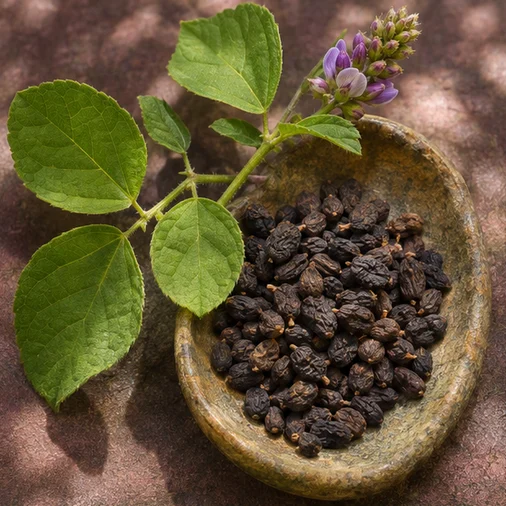
Bakuchiol is a single purified molecule from the seeds of babchi (Cullen corylifolium), a plant of Ayurveda and Chinese medicine. It is not a retinoid structurally, but in lab studies it switches on many of the same skin genes as retinol, and a small 12-week randomized trial found it improved wrinkles and pigmentation about as well as 0.5% retinol, with less stinging and peeling. It is a sensible option for people who cannot tolerate retinoids, as long as expectations stay realistic.
Why people reach for it
- Retinol-like smoothing. At 0.5% twice daily, bakuchiol reduced wrinkle surface area over 12 weeks in a small head-to-head trial with retinol, with no statistically significant difference between the two.
- Gentler on the barrier. In the same trial, retinol users reported more scaling and stinging. Bakuchiol is a reasonable first step for reactive skin or people who gave up on retinoids.
- Helps even out tone. Both bakuchiol and retinol reduced the appearance of hyperpigmentation in the comparison study; bakuchiol also shows some tyrosinase-related activity in the lab.
- Antioxidant and photostable. Unlike retinol, bakuchiol is not broken down quickly by light and has antioxidant activity of its own, which makes it easy to formulate and to use in the morning.
- Possible help for blemish-prone skin. Lab data show activity against Cutibacterium acnes and inflammatory pathways; human acne data are preliminary. See Acne & Breakouts.
How to use it
| Form | Typical use | Notes |
|---|---|---|
| Leave-on serum or cream | 0.5–1% bakuchiol (0.5% is the level studied) | Use once or twice daily. Because it is photostable it can go on in the morning, but daily SPF remains essential for any anti-aging routine. See Build a Routine That Works (Minimal & Evidence-Based). |
| Facial oil | 0.5–1% in a light carrier | Bakuchiol is oil-soluble; dissolve it in the oil phase, e.g. Squalane or jojoba, and add 0.2–0.5% vitamin E (tocopherol) as an antioxidant. |
| Paired with a retinoid | 0.5–1% bakuchiol alongside low-dose retinol | Some formulas combine them; there is lab data suggesting complementary effects, but little clinical evidence. If irritation appears, simplify. |
Recipes for Dark Spots & Hyperpigmentation with Bakuchiol
Daily rituals with Bakuchiol
Use it safely
- Generally well tolerated. Mild irritation and occasional allergic contact dermatitis have been reported; patch test first (see How to Patch Test).
- Do not substitute babchi seed oil or whole seed extract. They contain psoralens and can cause severe phototoxic burns and pigment changes.
- Buy only purified, psoralen-free cosmetic grade bakuchiol from a supplier that provides a certificate of analysis.
- Bakuchiol is not a proven replacement for prescription tretinoin in acne or photoaging; see a dermatologist for moderate–severe acne or significant sun damage.
Pregnancy and breastfeeding: Often marketed as “pregnancy-safe retinol,” but there are no safety studies in pregnancy or breastfeeding. It is not a retinoid, and topical absorption is likely low, but the honest answer is “no data”; discuss with your clinician.
New to an ingredient? Patch test first.
When to see a doctor
- Any spot that is changing in size, shape or color, has irregular borders or several colors, is larger than about 6 mm, itches, bleeds or crusts (the ABCDE warning signs of melanoma).
- A new dark streak in a fingernail or toenail, or a dark spot on the palm, sole or mucosa.
- Widespread, unexplained darkening of the skin, gums or skin creases, especially with fatigue, weight loss or dizziness.
- New or changing pigmentation in pregnancy that worries you — most is harmless melasma, but a changing mole should always be checked.
- Pigmentation that does not improve after 3 months of strict sun protection and treatment, or if you want prescription options.
- A dark patch that started after a new medicine (e.g. minocycline, some antimalarials or chemotherapy).
Other plants for Dark Spots & Hyperpigmentation
| Ingredient | Grade | What the evidence shows |
|---|---|---|
| Licorice Root | B | Glabridin and liquiritin inhibit tyrosinase and disperse melanin; small controlled trials of liquiritin and licorice-extract creams improved melasma and PIH. |
| Aloe Vera | C | Aloesin inhibits tyrosinase in the lab, and small human studies of aloe-based products suggest mild lightening, including a small trial in pregnancy melasma. |
| Green Tea | C | EGCG reduces melanin production in the lab and protects against UV-induced inflammation; clinical depigmenting data are limited. |
| Turmeric | C | Curcuminoids inhibit tyrosinase in vitro, and a small study of a turmeric-extract cream reported modest reduction of facial spots. Raw turmeric stains and can irritate. |
| Rosehip Oil | D | Often marketed for dark marks, but its trans-retinoic acid content is unproven and human data for pigmentation are lacking; useful as a light emollient. |