The ingredient encyclopedia · oil
Bakuchiol
Cullen corylifolium (syn. Psoralea corylifolia, babchi) · Fabaceae
Bakuchiol offers retinol-like smoothing with a softer touch, plant-derived and, in a small trial, gentler than retinol.
FR BakuchiolES BakuchiolAR باكوتشيولBabchi / Bakuchi (Hindi, Sanskrit); Bu gu zhi (TCM)
- How well proven
- BGood evidence
- Safety
- Low topical risk
- Sun-sensitive
- No
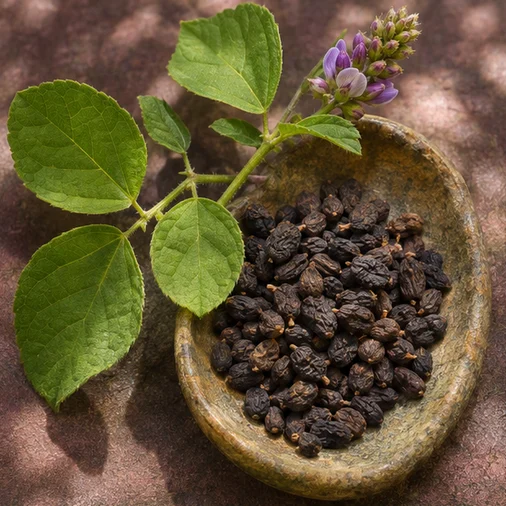
Also known as Cullen corylifolium (syn. Psoralea corylifolia, babchi)
FR BakuchiolES BakuchiolAR باكوتشيولBabchi / Bakuchi (Hindi, Sanskrit); Bu gu zhi (TCM)
What the evidence says
One well-designed but small double-blind RCT (44 people, 12 weeks) plus an earlier open-label study support anti-aging effects at 0.5%; larger, longer trials are still missing.
- Best supported for
- Aging & Photoaging BAcne & Breakouts CDark Spots & Hyperpigmentation C
- How to use it
- Leave-on serum or cream · 0.5–1% bakuchiol (0.5% is the level studied)
- Watch out for
- Generally well tolerated.
Checked against 2 cited studies and our safety review · Updated 26 November 2026 · How we grade
Why you’ll love Bakuchiol
Why you’ll love it
- Smoother-looking skin, with less irritation than retinol in a clinical trial
- Helps even out skin tone over time
- Stable in daylight, so it can go on in the morning
Best forRetinol-curious or sensitive skin wanting gentle smoothing and a more even tone.
Try it today
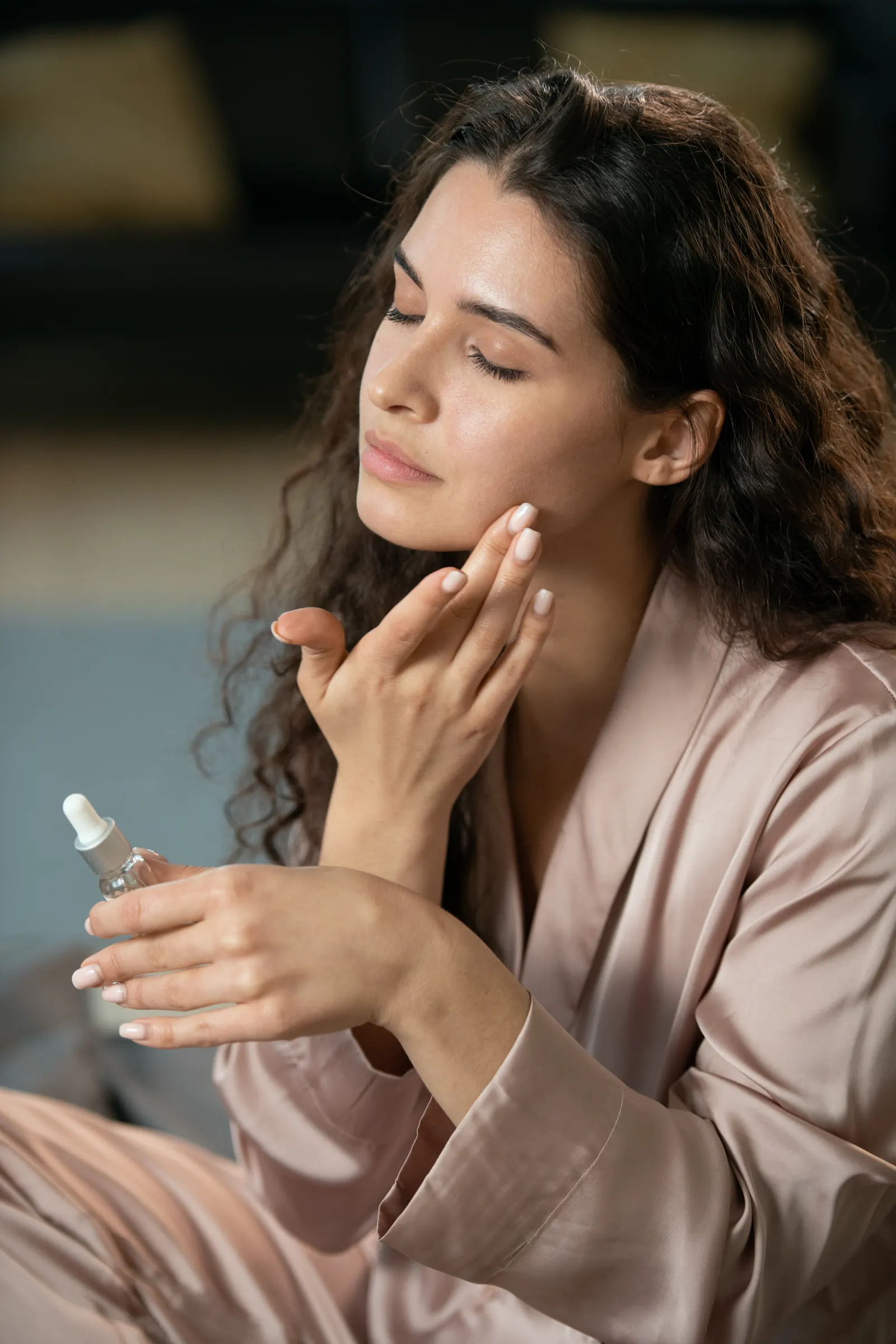
A gentle smoothing routine
- Patch test a 0.5–1% bakuchiol serum on your inner arm first.
- Apply a few drops to clean, dry skin, morning or evening.
- In the morning, finish with broad-spectrum sunscreen; every anti-aging routine needs it.
Good to know: Choose purified, psoralen-free bakuchiol, never babchi seed oil, which can cause severe sun burns. Pregnant? Ask your clinician first.
At a glance
| Parts used | Seed; purified bakuchiol (an oily, amber liquid isolated from the seed) |
|---|---|
| Key actives | Bakuchiol (meroterpene phenol) |
| INCI names | Bakuchiol Psoralea Corylifolia Seed Extract |
| Skin types | sensitive, mature, combination, normal |
| Pairs well with | SqualaneRosehip OilCentella Asiatica (Cica)Jojoba |
| Evidence grade | BGood evidence One well-designed but small double-blind RCT (44 people, 12 weeks) plus an earlier open-label study support anti-aging effects at 0.5%; larger, longer trials are still missing. |
What it does for skin and hair
Retinol-like smoothing
At 0.5% twice daily, bakuchiol reduced wrinkle surface area over 12 weeks in a small head-to-head trial with retinol, with no statistically significant difference between the two.
Gentler on the barrier
In the same trial, retinol users reported more scaling and stinging. Bakuchiol is a reasonable first step for reactive skin or people who gave up on retinoids.
Helps even out tone
Both bakuchiol and retinol reduced the appearance of hyperpigmentation in the comparison study; bakuchiol also shows some tyrosinase-related activity in the lab.
Antioxidant and photostable
Unlike retinol, bakuchiol is not broken down quickly by light and has antioxidant activity of its own, which makes it easy to formulate and to use in the morning.
Possible help for blemish-prone skin
Lab data show activity against Cutibacterium acnes and inflammatory pathways; human acne data are preliminary. See Acne & Breakouts.
How to use it
Start low, be consistent, and give it four to eight weeks. These are the amounts that work in real products and home recipes.
| Form | Typical use level | Notes |
|---|---|---|
| Leave-on serum or cream | 0.5–1% bakuchiol (0.5% is the level studied) | Use once or twice daily. Because it is photostable it can go on in the morning, but daily SPF remains essential for any anti-aging routine. See Build a Routine That Works (Minimal & Evidence-Based). |
| Facial oil | 0.5–1% in a light carrier | Bakuchiol is oil-soluble; dissolve it in the oil phase, e.g. Squalane or jojoba, and add 0.2–0.5% vitamin E (tocopherol) as an antioxidant. |
| Paired with a retinoid | 0.5–1% bakuchiol alongside low-dose retinol | Some formulas combine them; there is lab data suggesting complementary effects, but little clinical evidence. If irritation appears, simplify. |
Use it safely
Low topical risk
- Generally well tolerated. Mild irritation and occasional allergic contact dermatitis have been reported; patch test first (see How to Patch Test).
- Do not substitute babchi seed oil or whole seed extract. They contain psoralens and can cause severe phototoxic burns and pigment changes.
- Buy only purified, psoralen-free cosmetic grade bakuchiol from a supplier that provides a certificate of analysis.
- Bakuchiol is not a proven replacement for prescription tretinoin in acne or photoaging; see a dermatologist for moderate–severe acne or significant sun damage.
- Pregnancy & breastfeeding
- Often marketed as “pregnancy-safe retinol,” but there are no safety studies in pregnancy or breastfeeding. It is not a retinoid, and topical absorption is likely low, but the honest answer is “no data”; discuss with your clinician. Pregnancy guide
- Phototoxicity
- Not phototoxic at normal use levels.
- Declared fragrance allergens
- None expected
New to an ingredient? Patch test first. Stop and seek advice if you get burning, swelling, blistering or a spreading rash.
Make it at home: recipes with bakuchiol
Buying well
Sustainability
Cullen corylifolium is cultivated and wild-collected mainly in India and China. Purified bakuchiol requires solvent extraction and chromatography; ask suppliers about solvent residues and seed origin. It is not a threatened species. See Sustainable & Ethical Botanical Sourcing.
How to choose quality
Look for “Bakuchiol” on the INCI list at a disclosed or plausible level (0.5–1%), ideally in an airless or opaque pack. Red flags: “bakuchi oil” or “babchi oil” sold as a bakuchiol alternative, or products listing the seed oil without a psoralen-free specification. Raw bakuchiol should be a clear, amber, viscous liquid with a certificate of analysis showing purity (typically ≥95%) and psoralen limits.
The research For professionals
The chemistry, the studies and the evidence by concern, for practitioners, formulators and the curious.
Bakuchiol is a meroterpene: a phenol ring attached to a terpene chain. It shares no structural features with retinoic acid and does not bind the retinoic acid receptors in the classic way, yet gene-expression profiling in skin models showed it regulates a set of genes (collagen types I and IV, extracellular-matrix and retinoid-pathway genes) that overlaps strongly with retinol. That is why it is called a “functional analogue” rather than a retinoid. It is also an antioxidant and has anti-inflammatory activity in vitro.
The key human study is Dhaliwal and colleagues (2019): 44 adults were randomized, double-blind, to 0.5% bakuchiol cream twice daily or 0.5% retinol cream once daily for 12 weeks. Both groups showed significant decreases in wrinkle surface area and hyperpigmentation on standardized photographs, with no statistically significant difference between them; the retinol group reported more facial scaling and stinging. It is a genuinely useful study, but it is small, short, used different dosing frequencies, and was not powered as a formal non-inferiority trial, so “as good as retinol” overstates it. Prescription retinoids (tretinoin) have decades of RCT evidence that bakuchiol does not.
An important distinction: purified bakuchiol is not the same as babchi seed oil. Whole seed extracts and oils contain furanocoumarins (psoralen and isopsoralen/angelicin) that are strongly phototoxic; babchi has been used with sunlight to repigment vitiligo precisely because of them. Cosmetic-grade bakuchiol is purified to remove these compounds, and reputable suppliers specify a psoralen-free (trace-limit) grade.
Evidence by concern
| Concern | Grade | What the evidence shows |
|---|---|---|
| Acne & Breakouts | C | Small, mostly open-label studies suggest benefit in mild acne, often in combination products; plausible anti-inflammatory and anti-sebum effects. |
| Dark Spots & Hyperpigmentation | C | In a randomized trial against retinol for photoaging, 0.5% bakuchiol improved mottled pigmentation; it has not been properly tested in melasma. |
| Aging & Photoaging | B | A randomized, double-blind trial found 0.5% bakuchiol twice daily comparable to 0.5% retinol for wrinkles and pigmentation over 12 weeks, with less stinging; it is not a true retinoid and is less studied. |
Key studies
Randomized, double-blind trial in 44 adults: 0.5% bakuchiol twice daily vs 0.5% retinol once daily for 12 weeks. Both reduced wrinkle surface area and hyperpigmentation with no significant difference; retinol caused more scaling and stinging.
Dhaliwal S, et al. Br J Dermatol. 2019 Read it in the bibliography Find on PubMedGene-expression profiling showed retinol-like regulation in skin models; a small 12-week open-label study of 0.5% bakuchiol reported improvements in lines, wrinkles, elasticity and pigmentation.
Chaudhuri RK, Bojanowski K. Int J Cosmet Sci. 2014 Read it in the bibliography Find on PubMed
MythBakuchiol is a natural retinol that works exactly the same way.
EvidenceIt produces some retinol-like effects in skin models and one small trial, but it is a different molecule acting through different routes. Evidence is promising but thin compared with retinoids.
In tradition
The seeds (bakuchi, avalguja) are used in Ayurveda and as bu gu zhi in Chinese medicine, notably for vitiligo and skin conditions; those traditional preparations are whole-seed and phototoxic, unlike modern purified bakuchiol.
From the first-edition dossier
From study to shelf
The plant-derived compound behind the “natural retinol” claim.
- What was tested
- A 12-week trial with 44 participants assigned to 0.5% bakuchiol twice daily or 0.5% retinol once daily.
- What was found
- Fine-line area and pigmentation improved from baseline in both groups.
- What applies to a product
- Two specific creams and routines studied for visible signs of photoageing.
- Main limitation
- Application schedules differed. The trial did not establish equivalence.
On this page
What the studies found
Dhaliwal et al. (2019) · Full report
- Study design
- A single-center, 12-week randomized double-blind trial allocated 44 people to 0.5% bakuchiol cream twice daily or 0.5% retinol cream once daily. Seven withdrew. All 44 were included in the analysis.
- Result
- The measured area of fine lines and pigmentation improved in both groups, with no statistically significant difference between groups for those outcomes. The retinol group had more observed scaling and reported more stinging.
- Limitations
- The trial used different schedules and no cream-only group. It was designed to detect a difference in wrinkle severity and did not establish equivalence. The authors disclose funding from UC Davis Dermatology and one author’s consulting and advisory roles.
Raison-Peyron & Dereure (2020) PubMed
- Study design
- The publisher record identifies a case of contact dermatitis linked to bakuchiol in a cosmetic cream.
- Result
- This is a reported example of possible contact allergy to bakuchiol in cosmetic use.
- Limitations
- The accessible publisher record does not provide the complete case methods. An individual case cannot estimate how often this reaction occurs.
Check the outcome before comparing products
The trial used high-resolution facial photographs at baseline and weeks four, eight and twelve. The analysis quantified visible wrinkle area and pigmentation. The tolerability questionnaire captured a separate experience. When a product cites this study, check whether its promise concerns appearance, tolerability or another outcome such as acne.
Dhaliwal et al. (2019) · Full report
Checks before you buy
- Look for Bakuchiol on the label. Babchi oil contains a mixture of plant compounds.
- Ask whether the manufacturer discloses the concentration and has data from the product you are considering.
- If you are pregnant or breastfeeding, ask your clinician about the whole formula. The comparison trial offers no pregnancy safety evidence.
Questions readers ask
Is “natural retinol” the ingredient name?
No. It is a marketing description. Bakuchiol and retinol are different molecules.
Does the trial establish that bakuchiol suits every sensitive skin type?
In this trial, less scaling was observed and less stinging was reported in the bakuchiol group. An individual can still react to the ingredient or the finished formula.
Compare the preparations
Bakuchiol is a compound isolated from plants including babchi. Babchi seed oil and whole seed extracts contain other compounds and have a different safety profile.
| Preparation | What to check |
|---|---|
| Bakuchiol, a named compound | Check whether the manufacturer gives the concentration of bakuchiol itself. |
| Bakuchi seed oil or extract | Ask whether the concentration of bakuchiol in the seed preparation is characterized. |
The research
A randomized double-blind trial of 44 participants compared 0.5% bakuchiol twice daily with 0.5% retinol once daily. Both groups showed improvement in measured wrinkle area and pigmentation. People using retinol reported more stinging and scaling. The study was small, with different schedules and no cream-only control.
Safety and tolerance
Cases of allergic contact dermatitis from bakuchiol cosmetics have been reported. Stop if irritation develops. The trial provides no evidence about use in pregnancy or breastfeeding.
What to look for on the label
Look for “Bakuchiol” in the ingredient list. Check whether the brand reports the concentration, application frequency and any additional actives.
A real label example
Spain ·
Paula’s Choice Clinical 0.3% Retinol + 2% Bakuchiol Treatment
- Bakuchiol
- Retinol
The Spanish-market listing names both bakuchiol and retinol. A bakuchiol product is not necessarily a retinol-free product; match the full variant name.
Sources
- Dhaliwal et al. (2019) · Randomized facial photoageing trial PubMed
- Raison-Peyron and Dereure (2020) · Contact dermatitis case PubMed
Continue reading
First published in the original Herbs.Beauty atlas on 11 November 2026, with its sources as checked on that date.
Frequently asked questions
Is bakuchiol as effective as retinol?
Is bakuchiol safe during pregnancy?
Can I use bakuchiol with retinol or vitamin C?
Does bakuchiol make skin sensitive to the sun?
Cite this page
Herbs.Beauty. Bakuchiol (Cullen corylifolium): evidence-based monograph. Updated 26 November 2026. https://herbs.beauty/ingredients/bakuchiol.html