Safety · 7 min read · Everyone
How to Patch Test (and Read the Result)
A step-by-step at-home patch test (ROAT), how to tell irritation from allergy, and when you need proper dermatologist patch testing.
What you’ll take away
- Test the product exactly as you will use it (never an undiluted essential oil), on the inner forearm, twice a day for at least 7 days.
- Read the site daily, and look especially carefully 48–96 hours after the first application, when allergic reactions typically appear.
- Irritation is usually quick, stinging and stays in place; allergy is delayed, very itchy and can spread beyond the test area.
- Recurring rashes, eyelid or hand eczema, or reactions to many products deserve formal patch testing by a dermatologist.
- A negative result lowers the risk but never guarantees you won’t react later, on another body site, or to a reformulated product.
- Plants in this guide
- Chamomile C
Guides explain how things work; the grade for each plant is on its own page. How we grade
Why patch test — and what it can and can’t do
Two different kinds of reaction cause most cosmetic problems. Irritant contact dermatitis is direct damage to the skin by something harsh — it can happen to anyone at a high enough dose. Allergic contact dermatitis is an immune reaction to a specific substance in people who have become sensitized to it. Fragrance ingredients (including essential oil constituents), preservatives, hair-dye chemicals and some plant extracts are the usual suspects.
An at-home test is a practical screen for both. It is especially worth doing if you have Sensitive Skin & Redness or eczema-prone skin, if you have reacted to cosmetics before, or if the product is rich in botanicals, essential oils or acids. It cannot predict breakouts reliably, does not test how your skin behaves in sunlight, and cannot diagnose which ingredient is the problem.
The at-home method: a repeat open application test
Dermatologists use a structured version of this called the repeat open application test (ROAT). It mimics real use better than a single dab.
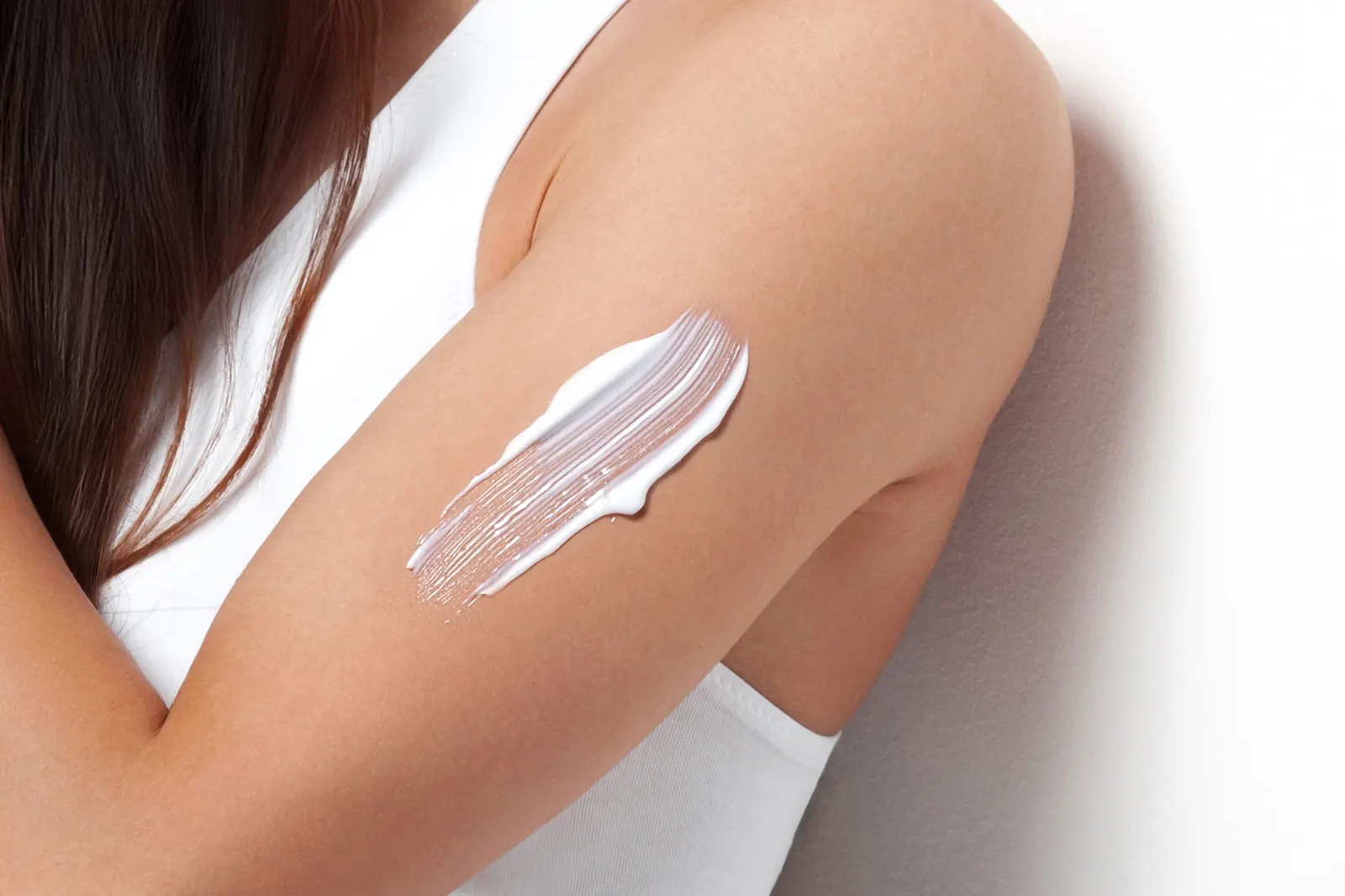
- Choose the site. The inner forearm just below the elbow crease is standard: thin, sensitive and easy to watch. For facial products, once the arm is clear, add a second test on a small patch along the jawline or behind the ear.
- Prepare the product as used. Leave-on products go on as they are. Essential oils must be diluted to the strength you will actually use — never test them neat (see Essential Oil Safety: The Complete Guide). For rinse-off products, apply, leave for the normal contact time, then rinse.
- Apply a thin layer to an area of a few centimeters across, twice daily for 7 days. Extend to 14 days for a product you plan to use daily on your face, or if you have reacted to similar products before.
- Don’t cover it with a plaster unless the product is designed to be occluded — covering increases irritation and makes results harder to read.
- Read daily, looking especially closely at 48 and 96 hours after the first application, when delayed allergic reactions usually appear. Photograph the site in the same light each day.
- Test one new product at a time, and keep a short log: product, batch number, dates, findings.
Stop immediately and wash the area with water and a gentle cleanser if you notice burning, marked itch, swelling or blisters.
Reading the result
| What you see | Timing | Likely meaning | What to do |
|---|---|---|---|
| Nothing, or faint pinkness that fades within an hour | Any | Negative | Introduce gradually on the intended area |
| Stinging, burning, dryness or a sharply outlined red patch | Minutes to hours, often worse with repeated use | Irritation | Stop; consider a gentler product or lower concentration |
| Very itchy redness, small bumps or tiny blisters, possibly spreading beyond the test site | Typically 24–96 hours, sometimes later | Possible allergy | Stop and avoid; keep the label; consider dermatologist testing |
| Raised wheals (hives) or swelling | Within minutes to an hour | Contact urticaria | Stop; seek medical advice; urgent help if lips, eyes or breathing are affected |
| Redness or blistering only after sun exposure | Hours to days after light exposure | Phototoxic or photoallergic reaction | Stop; check for citrus oils or other photosensitizers |
To calm a mild reaction: wash off, apply a cool compress and a plain, fragrance-free emollient. Persistent, spreading or blistering reactions need a doctor.
Irritant or allergic? The difference matters
Irritant reactions are the majority of contact dermatitis cases. They are dose-dependent: a 10% acid stings where a 2% one may not; a strong oil blend burns where a 1% dilution doesn’t. They usually settle within days once the trigger stops, and you may tolerate the same ingredient later at a lower strength or less often.
Allergic reactions are a delayed (type IV) immune response. The first exposures sensitize silently; later exposures, even at tiny concentrations, trigger a rash 1–4 days afterward. Sensitization is usually lifelong, so you will need to avoid that substance from then on — including under other names. Cross-reactions are common: people allergic to balsam of Peru (Myroxylon pereirae) may react to cinnamon or vanilla-related compounds, and those allergic to the daisy (Compositae) family may react to chamomile, calendula or arnica.
When to see a dermatologist for formal patch testing
Ask for a referral if you have recurrent or persistent eczema, eyelid or facial dermatitis, hand eczema, reactions to several products, or a reaction to hair dye, tattoos or temporary “black henna” (which often contains the hair-dye chemical PPD and can cause severe, permanent sensitization).
Clinical patch testing is different from the home test. Small amounts of standardized allergens are applied in chambers taped to your back for 48 hours, then read at around day 2 and again at day 3 or 4, ideally with a further reading around day 7 because some allergens react late. In Europe, clinics start with the European baseline series maintained by the European Society of Contact Dermatitis. It covers the commonest culprits, including fragrance mixes, balsam of Peru, oxidized limonene and linalool, the preservatives methylisothiazolinone and formaldehyde, lanolin alcohols, colophonium, propolis and Compositae mixes. Extra cosmetic, fragrance or plant series — and your own products — are added as needed.
Before testing you will usually be asked to avoid sunbathing and strong topical steroids on your back, and to mention any oral steroids or immune-suppressing medicines. Ordinary antihistamines don’t usually interfere with delayed reactions, but follow your clinic’s instructions.
What a negative result does — and doesn’t — mean
A clean forearm after a week is good news: it makes an obvious irritant or established allergy to that product unlikely. But it is not a guarantee:
- Sensitization can develop later after weeks or months of regular use, especially with fragrance and essential oils.
- Body sites differ. Eyelids, lips and the neck are far more reactive than the forearm.
- Formulas change. Re-test when a product is reformulated or when you switch to a new batch of a natural product, whose composition varies.
- Oxidation matters. An old bottle of tea tree or citrus oil can sensitize when a fresh one did not.
- It says nothing about long-term effects such as clogged pores or pigmentation.
If a product you have used happily for months suddenly causes a rash, don’t rule it out because it “never bothered you before” — that is exactly how allergy behaves.
Frequently asked questions
How long should a patch test last?
Where is the best place to patch test skincare?
Can I patch test an essential oil?
I reacted to a natural product — am I allergic to the whole plant family?
Keep reading
 No. 003
ChamomileMatricaria chamomillaThe flower in your bedtime tea can calm warm, flushed skin too, with a soft, apple-sweet scent.