Does it work?
Frankincense for Scars, Wounds & Stretch Marks
What the research says about frankincense for scars, wounds & stretch marks, how to use it at home and how to stay safe.
The short answer: Small human studies of boswellic-acid creams (photoaging, radiation dermatitis) plus solid lab data on mechanism; the essential oil itself has little skin evidence.
Our Scars, Wounds & Stretch Marks guide does not rank Frankincense for this use yet, so this is the overall grade for Frankincense.
What it does
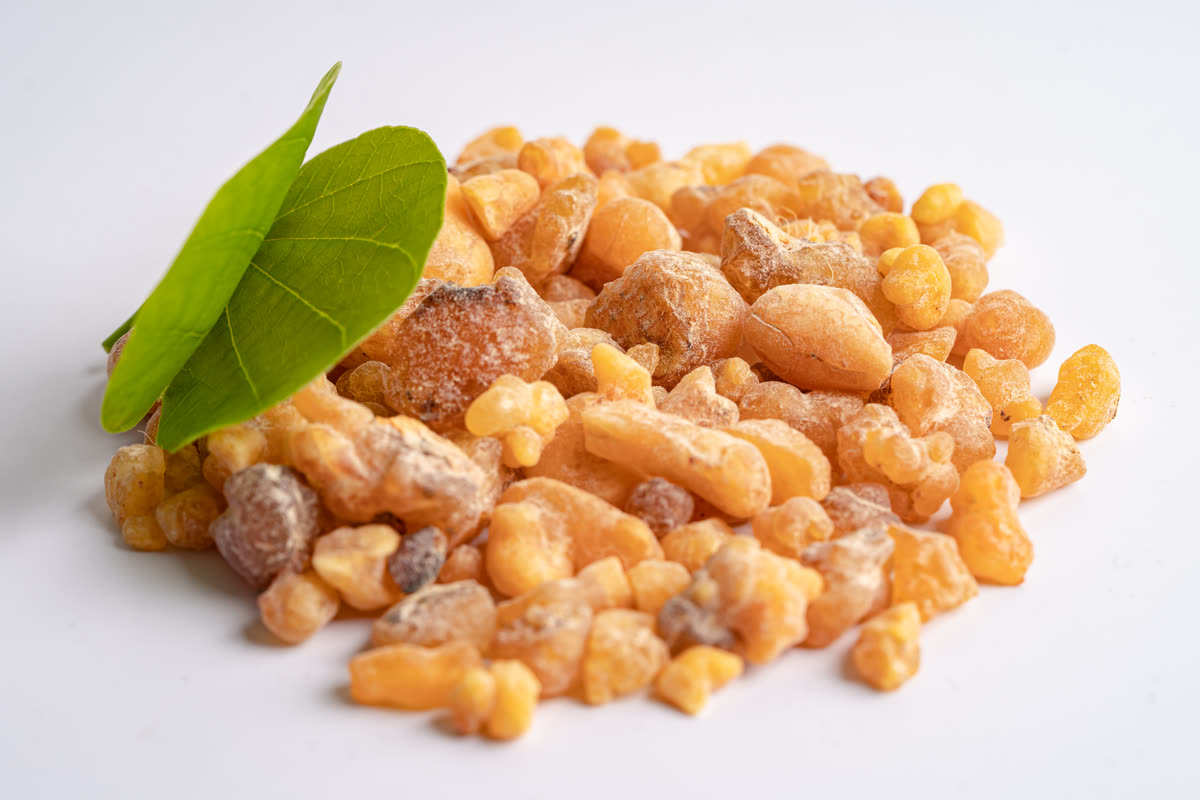
Frankincense is the aromatic resin tapped from Boswellia trees in Arabia, the Horn of Africa and India. Its anti-inflammatory boswellic acids are heavy, non-volatile molecules found in resin extracts, not in the steam-distilled essential oil most people buy. Small trials suggest boswellic acid creams may help photoaged and irritated skin; the essential oil is mainly a fragrance ingredient. Some wild populations, especially B. papyrifera, are in serious decline.
Why people reach for it
- Anti-inflammatory resin acids. Boswellic acids, especially AKBA, inhibit 5-lipoxygenase and other inflammatory pathways in the lab, a plausible basis for calming redness.
- Smoother photoaged skin. In a small split-face study, a cream with 0.5% boswellic acids improved fine lines and skin roughness compared with the base cream.
- Support during radiotherapy. A placebo-controlled trial in women receiving breast radiotherapy found a Boswellia cream reduced the intensity of skin redness.
- Warm, grounding fragrance. The essential oil’s resinous, citrus-pine scent makes it a favorite in facial oils and balms, where it functions mainly as fragrance.
How to use it
| Form | Typical use | Notes |
|---|---|---|
| Boswellia resin extract (standardized) | 0.5–2% in creams and serums | Choose an extract specifying boswellic acid content; the clinical study used 0.5% boswellic acids. |
| Essential oil in facial oil or balm | 0.5–1% on the face, up to 2% on the body | Use fresh oil and add vitamin E; discard oil that smells sharp or turpentine-like. See Essential Oil Safety: The Complete Guide. |
| Resin-infused oil | 5–20% of an oil or balm | Warm-infusing ground resin in a carrier extracts some resin acids along with aroma; strain carefully. |
Use it safely
- Fresh frankincense oil is rarely irritating, but oxidized oil can cause allergic contact dermatitis. Store cold, tightly closed, and use within about a year of opening.
- Patch test before using on sensitive or eczema-prone skin (see How to Patch Test).
- Oral boswellia supplements can interact with medicines; topical use is not known to.
- It is not a treatment for skin cancer or any cancer, despite online claims; see a doctor for any changing mole or lesion.
Pregnancy and breastfeeding: The essential oil at ≤1% is generally considered acceptable; there are no pregnancy data for concentrated boswellic acid extracts, so keep to fragrance-level use unless your clinician agrees.
New to an ingredient? Patch test first.
When to see a doctor
- Signs of infection: spreading redness or warmth, red streaks, increasing pain or swelling, pus, a bad smell, or fever.
- Deep, gaping or long cuts, wounds on the face, hands or joints, or bleeding that does not stop with 10 minutes of firm pressure — stitches work best within hours.
- Animal or human bites, puncture wounds, dirty wounds, or if your tetanus vaccination is not up to date.
- Burns larger than your palm, or any burn on the face, hands, feet, genitals or over joints, or with white, leathery or charred skin.
- Wounds not healing within two weeks, especially if you have diabetes, poor circulation or a weakened immune system.
- A scar that keeps growing beyond its edges, is painful or itchy (possible keloid), or an old scar that ulcerates, bleeds or changes.
- New, wide purple stretch marks together with weight gain, a rounded face, easy bruising or muscle weakness.
Other plants for Scars, Wounds & Stretch Marks
| Ingredient | Grade | What the evidence shows |
|---|---|---|
| Honey | B | Systematic reviews suggest sterile, medical-grade honey dressings heal partial-thickness burns faster than some conventional dressings, though trial quality varies; kitchen honey is not for open wounds. |
| Aloe Vera | B | Several trials and a systematic review suggest aloe preparations may shorten healing time of superficial burns; evidence for surgical wounds is inconclusive. |
| Centella Asiatica (Cica) | B | Asiaticoside and madecassoside promote collagen organization; small trials (mostly of combination creams) support use for stretch-mark prevention and scar appearance. |
| Calendula | C | Small trials suggest benefit for skin reactions to radiotherapy and minor wounds; daisy-family allergy is possible. |
| Rosehip Oil | C | A small controlled study suggested rosehip oil improved the color and appearance of post-surgical scars after the wound had closed. |
| Helichrysum (Immortelle) | D | Popular in aromatherapy for scars, but evidence is anecdotal or from lab studies; as an essential oil it must be diluted and never used on open wounds. |
| Olive Oil | D | Trials of massaging plain oils, including olive oil, in pregnancy have not shown clear prevention of stretch marks; massage itself is harmless and pleasant. |