Does it work?
Frankincense for Sensitive Skin & Redness
What the research says about frankincense for sensitive skin & redness, how to use it at home and how to stay safe.
The short answer: Small human studies of boswellic-acid creams (photoaging, radiation dermatitis) plus solid lab data on mechanism; the essential oil itself has little skin evidence.
Our Sensitive Skin & Redness guide does not rank Frankincense for this use yet, so this is the overall grade for Frankincense.
What it does
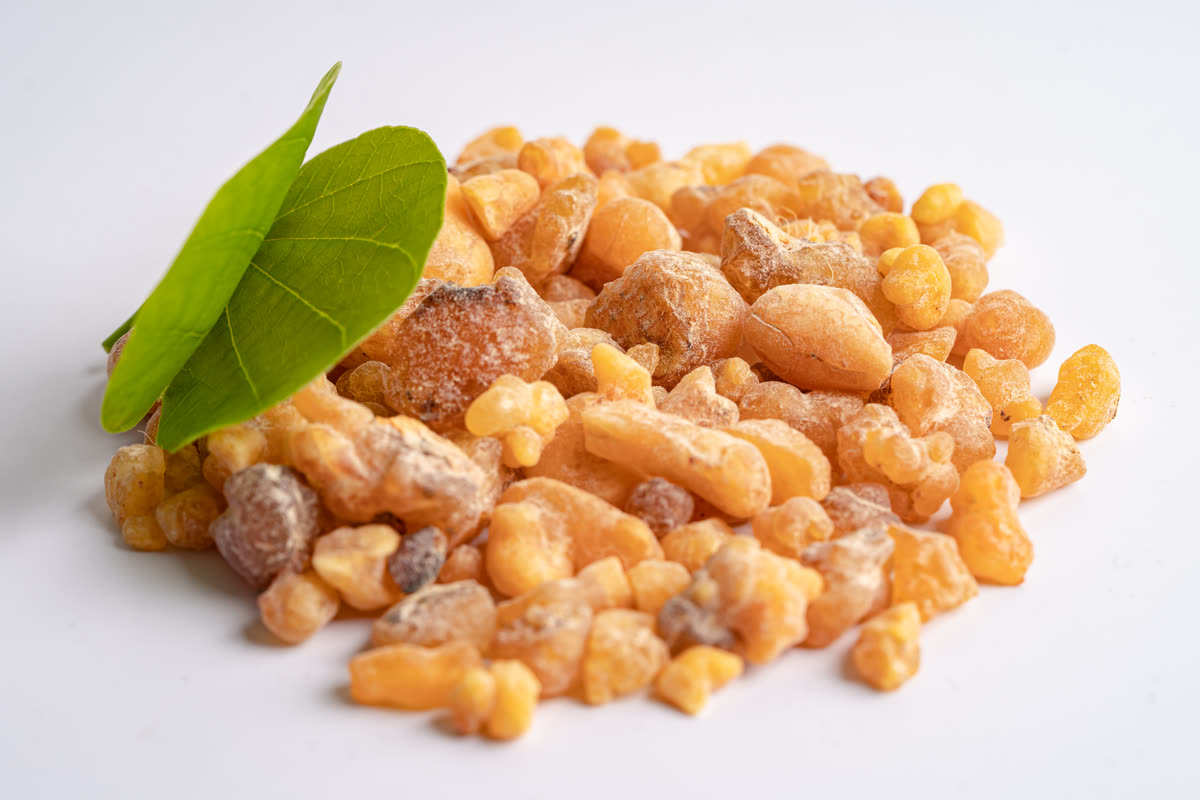
Frankincense is the aromatic resin tapped from Boswellia trees in Arabia, the Horn of Africa and India. Its anti-inflammatory boswellic acids are heavy, non-volatile molecules found in resin extracts, not in the steam-distilled essential oil most people buy. Small trials suggest boswellic acid creams may help photoaged and irritated skin; the essential oil is mainly a fragrance ingredient. Some wild populations, especially B. papyrifera, are in serious decline.
Why people reach for it
- Anti-inflammatory resin acids. Boswellic acids, especially AKBA, inhibit 5-lipoxygenase and other inflammatory pathways in the lab, a plausible basis for calming redness.
- Smoother photoaged skin. In a small split-face study, a cream with 0.5% boswellic acids improved fine lines and skin roughness compared with the base cream.
- Support during radiotherapy. A placebo-controlled trial in women receiving breast radiotherapy found a Boswellia cream reduced the intensity of skin redness.
- Warm, grounding fragrance. The essential oil’s resinous, citrus-pine scent makes it a favorite in facial oils and balms, where it functions mainly as fragrance.
How to use it
| Form | Typical use | Notes |
|---|---|---|
| Boswellia resin extract (standardized) | 0.5–2% in creams and serums | Choose an extract specifying boswellic acid content; the clinical study used 0.5% boswellic acids. |
| Essential oil in facial oil or balm | 0.5–1% on the face, up to 2% on the body | Use fresh oil and add vitamin E; discard oil that smells sharp or turpentine-like. See Essential Oil Safety: The Complete Guide. |
| Resin-infused oil | 5–20% of an oil or balm | Warm-infusing ground resin in a carrier extracts some resin acids along with aroma; strain carefully. |
Use it safely
- Fresh frankincense oil is rarely irritating, but oxidized oil can cause allergic contact dermatitis. Store cold, tightly closed, and use within about a year of opening.
- Patch test before using on sensitive or eczema-prone skin (see How to Patch Test).
- Oral boswellia supplements can interact with medicines; topical use is not known to.
- It is not a treatment for skin cancer or any cancer, despite online claims; see a doctor for any changing mole or lesion.
Pregnancy and breastfeeding: The essential oil at ≤1% is generally considered acceptable; there are no pregnancy data for concentrated boswellic acid extracts, so keep to fragrance-level use unless your clinician agrees.
New to an ingredient? Patch test first.
When to see a doctor
- Swelling of the lips, eyelids, tongue or throat, or difficulty breathing after using a product — this is an emergency.
- Persistent facial redness, visible vessels, flushing or bumps (possible rosacea), or burning, gritty, red eyes with facial redness (ocular rosacea).
- An itchy rash that spreads beyond where a product was applied or appears 1–3 days later (possible allergic contact dermatitis — ask about patch testing).
- A butterfly-shaped rash across the cheeks with joint pain, fatigue or sun sensitivity.
- Redness or stinging that continues despite a stripped-back routine for 4–6 weeks.
Other plants for Sensitive Skin & Redness
| Ingredient | Grade | What the evidence shows |
|---|---|---|
| Colloidal Oatmeal | B | Avenanthramides are anti-inflammatory and anti-itch; clinical studies support oatmeal products for irritated, itchy and reactive skin. |
| Licorice Root | B | Several small, mostly manufacturer-funded trials of licochalcone A products reduced facial redness, including in mild rosacea. |
| Centella Asiatica (Cica) | C | Madecassoside and asiaticoside reduce inflammation and support barrier repair in the lab; small human studies of centella creams show improved redness and comfort. |
| Green Tea | C | EGCG is anti-inflammatory and reduces UV-induced redness; a small trial suggested benefit in papulopustular rosacea. |
| Aloe Vera | C | Soothing and cooling with small supportive studies; choose stabilized gels without alcohol or fragrance, as some products irritate. |
| Chamomile | C | Bisabolol and chamazulene are anti-inflammatory, but chamomile is in the daisy family and can cause allergy in sensitized people. |