The ingredient encyclopedia · resin
Frankincense
Boswellia sacra (syn. B. carteri; also B. serrata (Indian), B. papyrifera (Ethiopia/Eritrea/Sudan), B. frereana) · Burseraceae
Warm, resinous and grounding, frankincense brings an ancient incense calm to your evening skincare.
FR Encens (oliban)ES Incienso (olíbano)AR اللبانLuban, kundur (Arabic); Shallaki (Sanskrit, B. serrata)
- How well proven
- CPromising
- Safety
- Low topical risk
- Sun-sensitive
- No
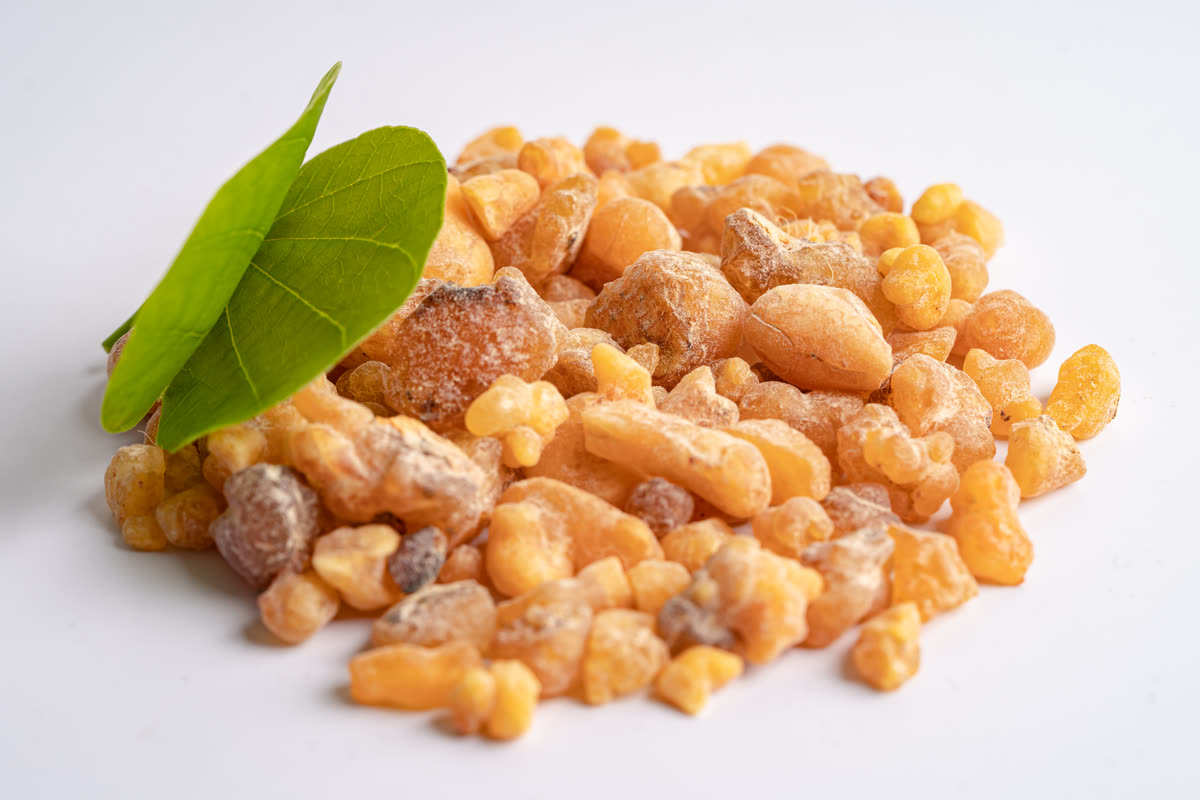
Also known as Boswellia sacra (syn. B. carteri; also B. serrata (Indian), B. papyrifera (Ethiopia/Eritrea/Sudan), B. frereana)
FR Encens (oliban)ES Incienso (olíbano)AR اللبانLuban, kundur (Arabic); Shallaki (Sanskrit, B. serrata)
What the evidence says
Small human studies of boswellic-acid creams (photoaging, radiation dermatitis) plus solid lab data on mechanism; the essential oil itself has little skin evidence.
- Best supported for
- Aging & Photoaging C
- How to use it
- Boswellia resin extract (standardized) · 0.5–2% in creams and serums
- Watch out for
- Fresh frankincense oil is rarely irritating, but oxidized oil can cause allergic contact dermatitis.
Checked against 3 cited studies and our safety review · Updated 26 November 2026 · How we grade
Why you’ll love Frankincense
Why you’ll love it
- A warm, grounding scent that feels like slowing down
- Resin extracts show calming effects in small skin studies
- Feels quietly luxurious in a simple facial oil
Best forMature or sun-weathered skin, and anyone who loves warm, woody, resinous scents.
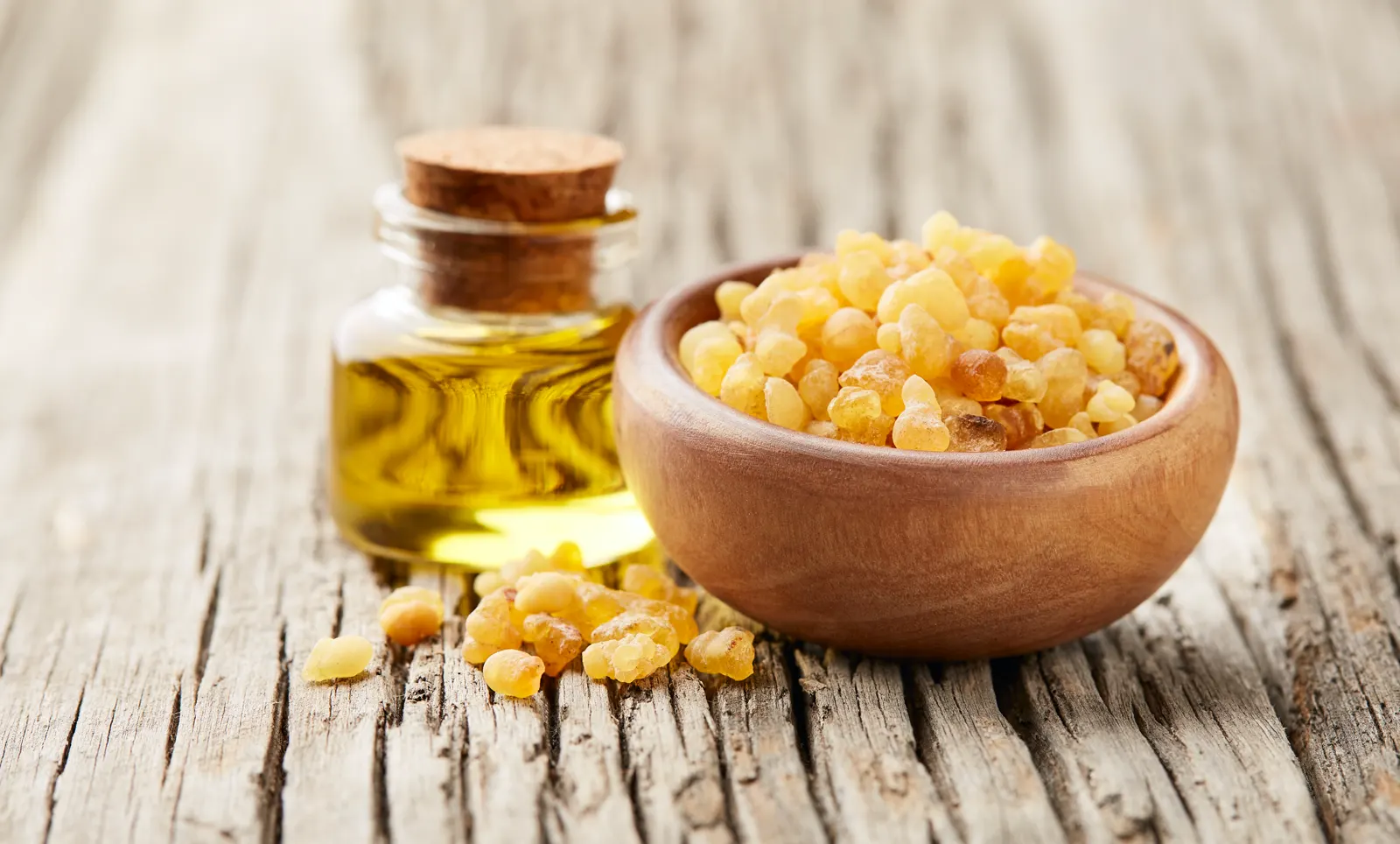
Try it today
A resin-scented night oil
- Patch test first, then add frankincense essential oil at 0.5–1% to a light facial oil.
- Warm a few drops between your palms and press them into clean skin at night.
- Keep the bottle cold and tightly closed, and use it within about a year.
Good to know: Fresh oil is rarely irritating; old, oxidized oil can be. Wild Boswellia trees are declining, so buy thoughtfully and use every drop.
At a glance
| Parts used | Oleo-gum resin; essential oil (steam-distilled); resin extracts; CO₂ extract |
|---|---|
| Key actives | Boswellic acids (AKBA, KBA, β-boswellic acid) — resin extracts, α-Pinene, Limonene, α-Thujene, Octyl acetate (B. papyrifera oil) |
| INCI names | Boswellia Carterii Oil Boswellia Carterii Resin Extract Boswellia Serrata Resin Extract |
| Skin types | mature, normal, dry |
| Pairs well with | Rosehip OilHelichrysum (Immortelle)JojobaLavender |
| Evidence grade | CPromising Small human studies of boswellic-acid creams (photoaging, radiation dermatitis) plus solid lab data on mechanism; the essential oil itself has little skin evidence. |
What it does for skin and hair
Anti-inflammatory resin acids
Boswellic acids, especially AKBA, inhibit 5-lipoxygenase and other inflammatory pathways in the lab, a plausible basis for calming redness.
Smoother photoaged skin
In a small split-face study, a cream with 0.5% boswellic acids improved fine lines and skin roughness compared with the base cream.
Support during radiotherapy
A placebo-controlled trial in women receiving breast radiotherapy found a Boswellia cream reduced the intensity of skin redness.
Warm, grounding fragrance
The essential oil’s resinous, citrus-pine scent makes it a favorite in facial oils and balms, where it functions mainly as fragrance.
How to use it
Start low, be consistent, and give it four to eight weeks. These are the amounts that work in real products and home recipes.
| Form | Typical use level | Notes |
|---|---|---|
| Boswellia resin extract (standardized) | 0.5–2% in creams and serums | Choose an extract specifying boswellic acid content; the clinical study used 0.5% boswellic acids. |
| Essential oil in facial oil or balm | 0.5–1% on the face, up to 2% on the body | Use fresh oil and add vitamin E; discard oil that smells sharp or turpentine-like. See Essential Oil Safety: The Complete Guide. |
| Resin-infused oil | 5–20% of an oil or balm | Warm-infusing ground resin in a carrier extracts some resin acids along with aroma; strain carefully. |
Use it safely
Low topical risk
- Fresh frankincense oil is rarely irritating, but oxidized oil can cause allergic contact dermatitis. Store cold, tightly closed, and use within about a year of opening.
- Patch test before using on sensitive or eczema-prone skin (see How to Patch Test).
- Oral boswellia supplements can interact with medicines; topical use is not known to.
- It is not a treatment for skin cancer or any cancer, despite online claims; see a doctor for any changing mole or lesion.
- Pregnancy & breastfeeding
- The essential oil at ≤1% is generally considered acceptable; there are no pregnancy data for concentrated boswellic acid extracts, so keep to fragrance-level use unless your clinician agrees. Pregnancy guide
- Phototoxicity
- Not phototoxic at normal use levels.
- Declared fragrance allergens
- Limonene, Linalool
New to an ingredient? Patch test first. Stop and seek advice if you get burning, swelling, blistering or a spreading rash.
Buying well
Sustainability
Frankincense is almost entirely wild-harvested by tapping. Over-tapping, cattle grazing, fire and beetle attack mean many B. papyrifera stands have almost no young trees, and harvests are projected to fall sharply. Prefer suppliers that can name the species and region and that support community-managed, sustainably tapped trees. See Sustainable & Ethical Botanical Sourcing.
How to choose quality
Ask for the exact species, since oils differ markedly. For anti-inflammatory claims, look for a resin extract standardized for boswellic acids rather than the essential oil. Red flags: “frankincense oil rich in boswellic acids,” no species given, or suspiciously cheap oil (often cut or synthetic).
The research For professionals
The chemistry, the studies and the evidence by concern, for practitioners, formulators and the curious.
Frankincense resin is roughly 60–85% resin (including pentacyclic triterpenic acids), 6–30% gum (polysaccharides) and a few percent volatile oil, depending on species and grade. The boswellic acids, such as 3-acetyl-11-keto-β-boswellic acid (AKBA), are large, non-volatile triterpenes. Steam distillation does not carry them over, so frankincense essential oil contains essentially none; you need a resin extract (often from B. serrata, standardized for boswellic acids) to get them. B. frereana resin contains little or no boswellic acid at all.
The essential oil is a mix of monoterpenes whose profile depends on species: α-pinene dominates in B. sacra/carteri, octyl acetate and octanol in B. papyrifera, α-thujene in many B. serrata oils. Like other monoterpene-rich oils, it oxidizes on air exposure, and oxidized terpenes are more likely to sensitize skin.
Human skin data are modest. Calzavara-Pinton and colleagues (2010) reported that a 0.5% boswellic acid cream improved photoaging signs in a small split-face study in 15 women, and Togni and colleagues (2015) found a Boswellia-based cream reduced erythema in women undergoing breast radiotherapy. Claims that frankincense oil “heals scars” or treats cancer are unsupported.
Evidence by concern
| Concern | Grade | What the evidence shows |
|---|---|---|
| Aging & Photoaging | C | One small trial of a Boswellia serrata extract cream reported improvement in photoaging signs; needs replication. |
Key studies
Small split-face study in 15 women with photoaging: a cream with 0.5% boswellic acids for 30 days improved fine lines and roughness compared with the vehicle.
Calzavara-Pinton P, et al. Dermatol Ther. 2010 Read it in the bibliography Find on PubMedRandomized, placebo-controlled study in about 110 women receiving breast radiotherapy: a Boswellia-based cream reduced erythema intensity and the need for topical steroids.
Togni S, et al. Eur Rev Med Pharmacol Sci. 2015 Read it in the bibliography Find on PubMedSurvey of Boswellia papyrifera populations across its range found poor regeneration in most and projected frankincense production could halve within 20 years.
Bongers F, et al. Nature Sustainability. 2019 Read it in the bibliography Find on PubMed
MythFrankincense essential oil is full of boswellic acids.
EvidenceBoswellic acids are too heavy to distill. The essential oil contains virtually none; you need a resin extract to get them.
In tradition
Burned as luban across the Arab world and in churches for millennia, and chewed in Oman and Yemen; Indian frankincense (shallaki) is used in Ayurveda for joints and skin.
Frequently asked questions
Is frankincense oil good for wrinkles?
Can I put frankincense oil directly on my face?
Which frankincense species is best for skin?
Is frankincense endangered?
Cite this page
Herbs.Beauty. Frankincense (Boswellia sacra): evidence-based monograph. Updated 26 November 2026. https://herbs.beauty/ingredients/frankincense.html