Does it work?
St. John’s Wort for Scars, Wounds & Stretch Marks
Midsummer flowers steeped in oil until it glows ruby red: a Mediterranean comfort for healed scars and chapped skin.
The short answer: Small randomized trials support a hyperforin-rich cream in atopic dermatitis and an ointment for cesarean-section wound healing, alongside lab and animal data; trials of the traditional red oil itself are lacking.
Our Scars, Wounds & Stretch Marks guide does not rank St. John’s Wort for this use yet, so this is the overall grade for St. John’s Wort.
What St. John’s Wort can do for Scars, Wounds & Stretch Marks
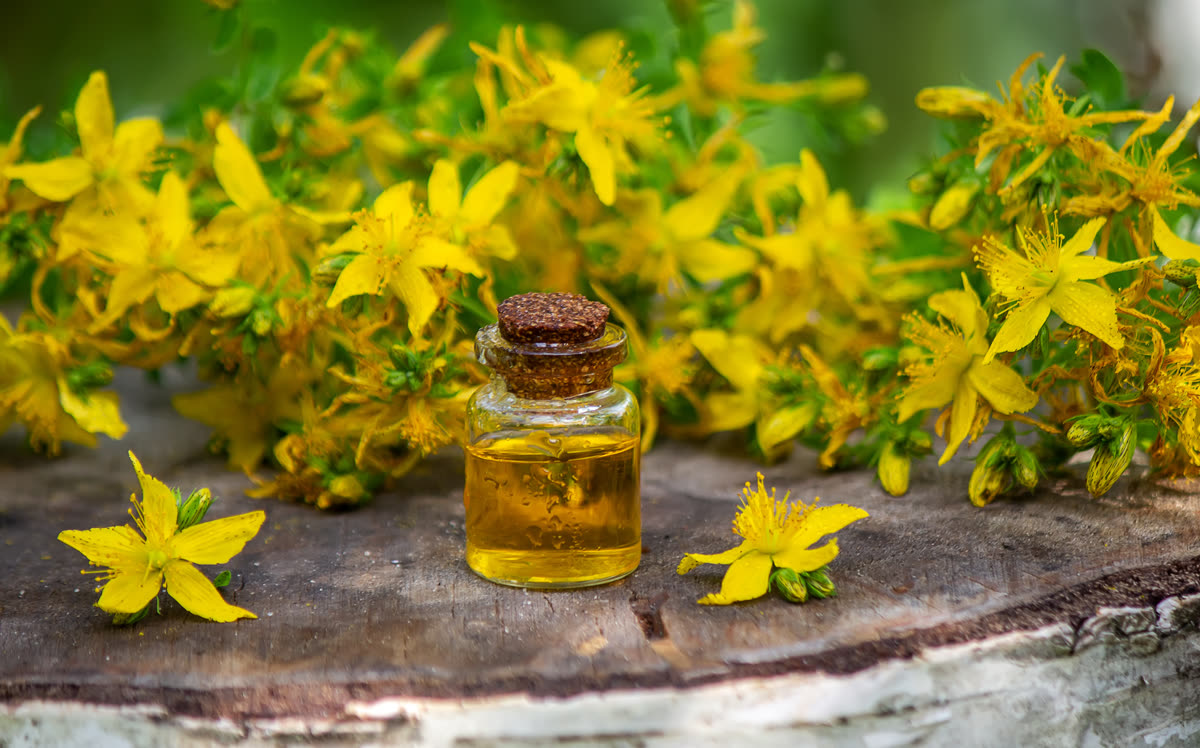
St. John’s wort is a yellow-flowered Mediterranean and European meadow plant whose flowers, steeped in oil, turn it a deep ruby red — the traditional red oil for minor burns, scars and sore skin. Small trials support creams made from it for eczema and wound healing. Its red pigment, hypericin, is a photosensitizer, and the plant taken by mouth seriously interferes with many medicines; topical use is a much smaller concern, as explained below.
Why people reach for it
- Supports healing of minor wounds and scars. In a randomized trial after cesarean section, St. John’s wort ointment improved wound healing and reduced scar symptoms compared with placebo. Its traditional red oil remains a European folk remedy for minor burns and healed scars (Scars, Wounds & Stretch Marks).
- May calm eczema-prone skin. A small placebo-controlled half-side study found a cream with hyperforin-rich extract improved atopic dermatitis more than the plain cream, possibly by reducing inflammation and Staphylococcus aureus on the skin (Eczema-Prone Skin).
- Antibacterial and anti-inflammatory compounds. Hyperforin is antibacterial against gram-positive bacteria in the lab and anti-inflammatory in skin cells, while flavonoids add antioxidant activity. These are the likely contributors to its traditional reputation.
How to use it
Try it today
An evening red-oil ritual
- Patch test first, especially if your skin is eczema-prone.
- In the evening, smooth a few drops onto a small area of healed scar or dry, chapped skin.
- Keep treated skin out of strong sun and tanning beds, and protect pale fabrics from stains.
| Form | Typical use | Notes |
|---|---|---|
| Red (infused) oil, neat | A few drops on a small area of intact, healed skin, once or twice daily, preferably in the evening | Use on minor burns once cooled and closed, on healed scars and on dry, chapped patches. Avoid strong sun or tanning on treated skin. The red color can stain fabric. Do not use on deep, infected or open wounds. |
| Red oil in balms and body oils | 10–30% of a balm or massage oil | Blend with calendula-infused oil and shea butter for a classic comfort balm (see Infused Oils, Hydrosols & Extracts). Add vitamin E and store dark and cool; red oil is prone to rancidity. |
| Standardized extract in creams | As supplied; the eczema trial used a cream standardized to 1.5% hyperforin | Hyperforin degrades quickly, so finished creams need protective packaging (airless or opaque) and a realistic shelf life. Patch test first on eczema-prone skin (How to Patch Test). |
Use it safely
- Photosensitizer: hypericin can make skin more sensitive to sunlight. Apply in the evening, keep treated areas out of strong sun, and avoid it before tanning beds or UV phototherapy and alongside photosensitizing medicines.
- Oral St. John’s wort has serious drug interactions (hormonal contraceptives, ciclosporin and tacrolimus, warfarin, digoxin, HIV medicines, some chemotherapy, antidepressants and many more). Never start it by mouth without checking with a doctor or pharmacist. Topical interactions are not established, but keep use small if you take critical medicines.
- Contact allergy is uncommon; patch test before wider use, especially on eczema.
- Not for deep, infected or large burns or wounds — seek medical care for those.
Pregnancy and breastfeeding: Do not take St. John’s wort by mouth during pregnancy or breastfeeding. Topical red oil on small areas is traditional, but safety data are limited; ask your midwife or doctor before regular use.
Sun sensitivity: This plant can make skin react to sunlight. Follow the limits in the full monograph.
New to an ingredient? Patch test first.
When to see a doctor
- Signs of infection: spreading redness or warmth, red streaks, increasing pain or swelling, pus, a bad smell, or fever.
- Deep, gaping or long cuts, wounds on the face, hands or joints, or bleeding that does not stop with 10 minutes of firm pressure — stitches work best within hours.
- Animal or human bites, puncture wounds, dirty wounds, or if your tetanus vaccination is not up to date.
- Burns larger than your palm, or any burn on the face, hands, feet, genitals or over joints, or with white, leathery or charred skin.
- Wounds not healing within two weeks, especially if you have diabetes, poor circulation or a weakened immune system.
- A scar that keeps growing beyond its edges, is painful or itchy (possible keloid), or an old scar that ulcerates, bleeds or changes.
- New, wide purple stretch marks together with weight gain, a rounded face, easy bruising or muscle weakness.
Other plants for Scars, Wounds & Stretch Marks
| Ingredient | Grade | What the evidence shows |
|---|---|---|
| Honey | B | Systematic reviews suggest sterile, medical-grade honey dressings heal partial-thickness burns faster than some conventional dressings, though trial quality varies; kitchen honey is not for open wounds. |
| Aloe Vera | B | Several trials and a systematic review suggest aloe preparations may shorten healing time of superficial burns; evidence for surgical wounds is inconclusive. |
| Centella Asiatica (Cica) | B | Asiaticoside and madecassoside promote collagen organization; small trials (mostly of combination creams) support use for stretch-mark prevention and scar appearance. |
| Calendula | C | Small trials suggest benefit for skin reactions to radiotherapy and minor wounds; daisy-family allergy is possible. |
| Rosehip Oil | C | A small controlled study suggested rosehip oil improved the color and appearance of post-surgical scars after the wound had closed. |
| Helichrysum (Immortelle) | D | Popular in aromatherapy for scars, but evidence is anecdotal or from lab studies; as an essential oil it must be diluted and never used on open wounds. |
| Olive Oil | D | Trials of massaging plain oils, including olive oil, in pregnancy have not shown clear prevention of stretch marks; massage itself is harmless and pleasant. |