The ingredient encyclopedia · flower
St. John’s Wort
Hypericum perforatum L. · Hypericaceae
Midsummer flowers steeped in oil until it glows ruby red: a Mediterranean comfort for healed scars and chapped skin.
FR Millepertuis perforéES Hipérico (hierba de San Juan)AR العَرَن المثقوب (حشيشة القلب)Johanniskraut (German); sarı kantaron, with its red oil kantaron yağı (Turkish); iperico (Italian)
- How well proven
- CPromising
- Safety
- Use with care
- Sun-sensitive
- Yes
FR Millepertuis perforéES Hipérico (hierba de San Juan)AR العَرَن المثقوب (حشيشة القلب)Johanniskraut (German); sarı kantaron, with its red oil kantaron yağı (Turkish); iperico (Italian)
What the evidence says
Small randomized trials support a hyperforin-rich cream in atopic dermatitis and an ointment for cesarean-section wound healing, alongside lab and animal data; trials of the traditional red oil itself are lacking.
- What it does
- Supports healing of minor wounds and scars. In a randomized trial after cesarean section, St.
- How to use it
- Red (infused) oil, neat · A few drops on a small area of intact, healed skin, once or twice daily, preferably in the evening
- Watch out for
- Photosensitizer: hypericin can make skin more sensitive to sunlight.
Checked against 4 cited studies and our safety review · Updated 26 November 2026 · How we grade
Why you’ll love St. John’s Wort
Why you’ll love it
- A traditional comfort oil for healed scars and chapped patches
- Its deep ruby color makes every balm feel special
- Small trials support creams made from it for eczema-prone skin
Best forHealed scars, cooled minor burns and dry patches, on small areas of intact skin.
Try it today
An evening red-oil ritual
- Patch test first, especially if your skin is eczema-prone.
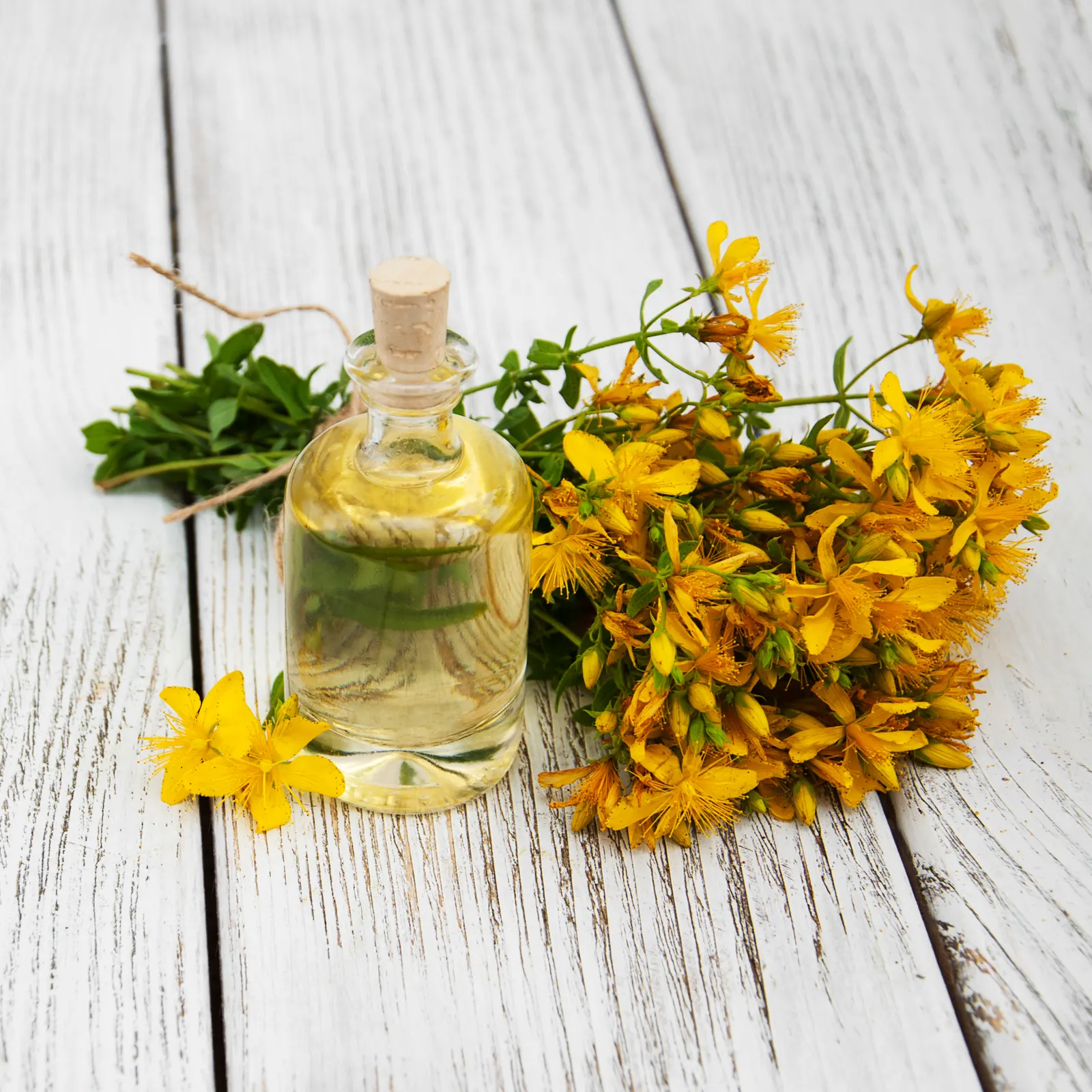
- In the evening, smooth a few drops onto a small area of healed scar or dry, chapped skin.
- Keep treated skin out of strong sun and tanning beds, and protect pale fabrics from stains.
Good to know: Red oil can make skin more sun-sensitive. Never take St. John’s wort by mouth without asking a pharmacist: it interacts with many medicines.
At a glance
| Parts used | Flowering tops, macerated fresh in oil to make the traditional red oil, or extracted with alcohol or CO₂ |
|---|---|
| Key actives | Hypericin and pseudohypericin (naphthodianthrones; red, photosensitizing), Hyperforin (phloroglucinol; unstable), Flavonoids (hyperoside, rutin, quercetin), Biflavones (amentoflavone), Tannins and essential oil |
| INCI names | Hypericum Perforatum Flower/Leaf/Stem Extract Hypericum Perforatum Extract Hypericum Perforatum Oil |
| Skin types | dry, normal, sensitive |
| Pairs well with | CalendulaOlive OilArnicaShea Butter |
| Evidence grade | CPromising Small randomized trials support a hyperforin-rich cream in atopic dermatitis and an ointment for cesarean-section wound healing, alongside lab and animal data; trials of the traditional red oil itself are lacking. |
What it does for skin and hair
Supports healing of minor wounds and scars
In a randomized trial after cesarean section, St. John’s wort ointment improved wound healing and reduced scar symptoms compared with placebo. Its traditional red oil remains a European folk remedy for minor burns and healed scars (Scars, Wounds & Stretch Marks).
May calm eczema-prone skin
A small placebo-controlled half-side study found a cream with hyperforin-rich extract improved atopic dermatitis more than the plain cream, possibly by reducing inflammation and Staphylococcus aureus on the skin (Eczema-Prone Skin).
Antibacterial and anti-inflammatory compounds
Hyperforin is antibacterial against gram-positive bacteria in the lab and anti-inflammatory in skin cells, while flavonoids add antioxidant activity. These are the likely contributors to its traditional reputation.
How to use it
Start low, be consistent, and give it four to eight weeks. These are the amounts that work in real products and home recipes.
| Form | Typical use level | Notes |
|---|---|---|
| Red (infused) oil, neat | A few drops on a small area of intact, healed skin, once or twice daily, preferably in the evening | Use on minor burns once cooled and closed, on healed scars and on dry, chapped patches. Avoid strong sun or tanning on treated skin. The red color can stain fabric. Do not use on deep, infected or open wounds. |
| Red oil in balms and body oils | 10–30% of a balm or massage oil | Blend with calendula-infused oil and shea butter for a classic comfort balm (see Infused Oils, Hydrosols & Extracts). Add vitamin E and store dark and cool; red oil is prone to rancidity. |
| Standardized extract in creams | As supplied; the eczema trial used a cream standardized to 1.5% hyperforin | Hyperforin degrades quickly, so finished creams need protective packaging (airless or opaque) and a realistic shelf life. Patch test first on eczema-prone skin (How to Patch Test). |
Use it safely
Use with care
- Photosensitizer: hypericin can make skin more sensitive to sunlight. Apply in the evening, keep treated areas out of strong sun, and avoid it before tanning beds or UV phototherapy and alongside photosensitizing medicines.
- Oral St. John’s wort has serious drug interactions (hormonal contraceptives, ciclosporin and tacrolimus, warfarin, digoxin, HIV medicines, some chemotherapy, antidepressants and many more). Never start it by mouth without checking with a doctor or pharmacist. Topical interactions are not established, but keep use small if you take critical medicines.
- Contact allergy is uncommon; patch test before wider use, especially on eczema.
- Not for deep, infected or large burns or wounds — seek medical care for those.
- Pregnancy & breastfeeding
- Do not take St. John’s wort by mouth during pregnancy or breastfeeding. Topical red oil on small areas is traditional, but safety data are limited; ask your midwife or doctor before regular use. Pregnancy guide
- Phototoxicity
- Yes. Avoid sun and UV on treated skin for 12–18 hours or use a bergapten-free (FCF) grade.
- Declared fragrance allergens
- None expected
New to an ingredient? Patch test first. Stop and seek advice if you get burning, swelling, blistering or a spreading rash.
Buying well
Sustainability
Hypericum perforatum is abundant across Europe, North Africa and western Asia and has become an invasive weed in North America and Australia, where it is toxic to livestock; it is not threatened. Quality is the main issue: standardized oral extracts have been found adulterated with synthetic dyes to mimic hypericin’s color, and red oils vary with flower freshness and maceration method. Buy from herbal suppliers that state plant part, solvent and harvest date.
How to choose quality
For red oil, look for oil made from fresh flowering tops (dried flowers give a weaker, browner oil), a named carrier oil, a deep red color and a recent harvest date; store dark and cool and use within a year. For creams, prefer products with a stated extract and protective packaging. Avoid any product promoting topical St. John’s wort as a treatment for mood or depression — that is an oral use with serious interactions.
The research For professionals
The chemistry, the studies and the evidence by concern, for practitioners, formulators and the curious.
Hold a St. John’s wort leaf up to the light and you see tiny translucent dots — oil glands that give the species its name, perforatum. Black dots along the petal edges hold the red naphthodianthrones hypericin and pseudohypericin. The flowers also contain hyperforin, a prenylated phloroglucinol that is antibacterial and anti-inflammatory but very unstable in light and air, plus flavonoids, biflavones and tannins. In the traditional red oil — fresh flowers steeped in olive or sunflower oil for several weeks, often in the sun — hypericin and related pigments color the oil, while much of the hyperforin degrades within weeks. Composition therefore differs a great deal between red oils, alcoholic extracts and standardized creams.
Skin evidence. In a 21-patient, double-blind, half-side study, a cream containing St. John’s wort extract standardized to 1.5% hyperforin improved atopic dermatitis more than its vehicle over four weeks (Schempp, Phytomedicine, 2003). In a randomized trial after cesarean delivery, St. John’s wort ointment improved wound healing and reduced scar pain and itching compared with placebo and no treatment (Samadi, J Altern Complement Med, 2010). Lab and animal studies support wound-healing, antibacterial and anti-inflammatory effects. Trials of homemade-style red oil are lacking.
Photosensitivity. Hypericin absorbs visible and UVA light and generates reactive oxygen species, which is how grazing animals that eat large amounts develop severe sunburn-like reactions (hypericism). In humans, phototoxicity from normal oral doses is uncommon and topical reactions are rarely reported, partly because red oils contain little hypericin. Still, a photosensitizer applied to skin and then exposed to strong sun is a sensible thing to avoid: use it at night, on small areas, and keep treated skin out of strong sun, tanning beds and UV phototherapy.
Why oral use is different. Taken by mouth, hyperforin activates the pregnane X receptor (Moore, PNAS, 2000), switching on the liver and gut enzyme CYP3A4 and other enzymes and the drug pump P-glycoprotein. This speeds removal of many drugs and has caused serious harm: transplant rejection with ciclosporin (Ruschitzka, Lancet, 2000), breakthrough bleeding and unplanned pregnancy with hormonal contraceptives, reduced levels of HIV drugs, anticoagulants, digoxin, some chemotherapy and methadone, and serotonin syndrome with antidepressants. Applied to skin, absorption is very small and no clinically important interactions from topical use are established — but data are limited, so anyone on critical medicines should keep topical use small and short and mention it to their doctor or pharmacist.
Key studies
Randomized, double-blind, half-side comparison in 21 people with mild-to-moderate atopic dermatitis: a cream with St. John’s wort extract (1.5% hyperforin) improved skin lesions more than the vehicle over 4 weeks.
Schempp CM, et al. Phytomedicine. 2003 Read it in the bibliography Find on PubMedRandomized trial in women after cesarean section: St. John’s wort ointment improved wound healing and reduced scar pain and itching compared with placebo and no treatment.
Samadi S, et al. J Altern Complement Med. 2010 Read it in the bibliography Find on PubMedMechanistic study showing hyperforin activates the pregnane X receptor, which induces CYP3A4 — the basis of St. John’s wort’s oral drug interactions.
Moore LB, et al. Proc Natl Acad Sci USA. 2000 Read it in the bibliography Find on PubMedCase report of acute heart-transplant rejection in two patients after oral St. John’s wort lowered their ciclosporin levels.
Ruschitzka F, et al. Lancet. 2000 Read it in the bibliography Find on PubMed
MythBecause it is applied to the skin, St. John’s wort oil is as risky for drug interactions as the pills.
EvidenceThe serious interactions come from swallowing it: hyperforin in the gut and liver switches on drug-clearing enzymes. Skin absorption from a small amount of red oil is very low and no clinically important interactions are established. Even so, people on critical medicines (transplant drugs, anticoagulants, HIV drugs) should keep use small and tell their pharmacist.
In tradition
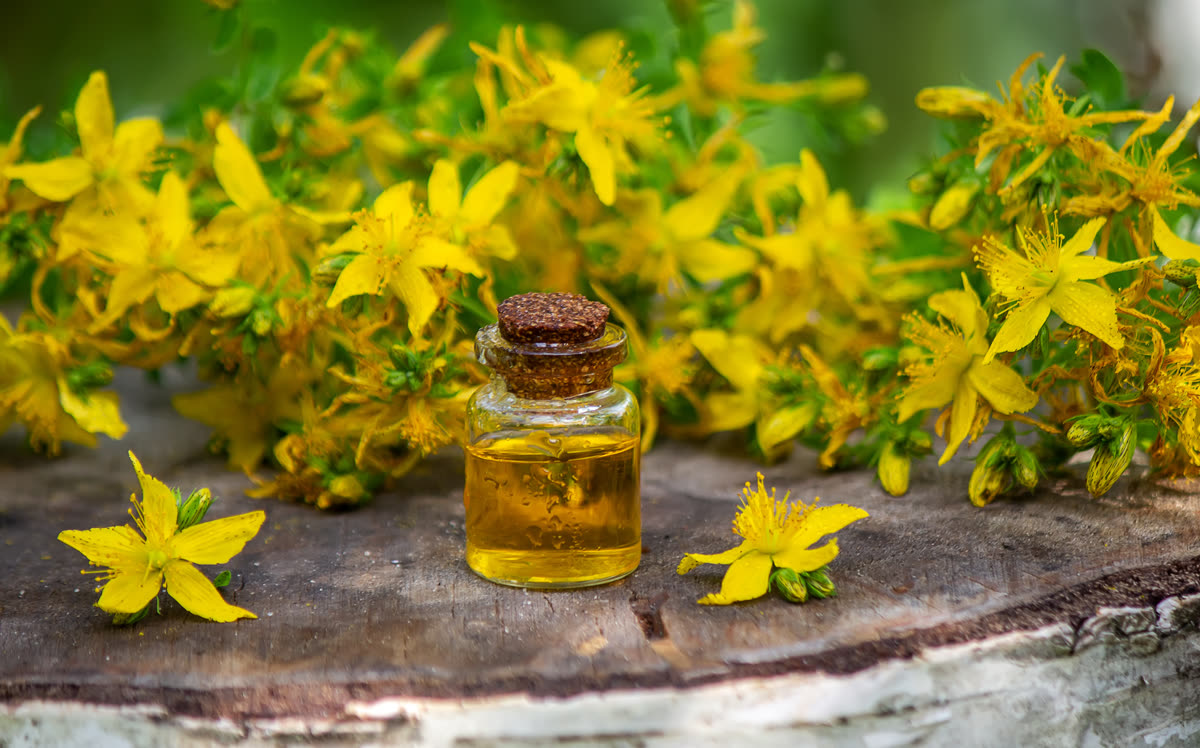
The plant flowers around Midsummer and St. John’s Day (24 June), when it was traditionally gathered and hung over doors. The red oil — linked in legend to the saint’s blood — is a household remedy for burns and wounds from Spain and Italy to Turkey, where kantaron yağı is still made at home in glass jars set in the sun.
Frequently asked questions
What is St. John’s wort oil good for on skin?
Does St. John’s wort oil make you sensitive to the sun?
Can topical St. John’s wort interact with birth control or other medicines?
How do you make St. John’s wort red oil?
Cite this page
Herbs.Beauty. St. John’s Wort (Hypericum perforatum L.): evidence-based monograph. Updated 26 November 2026. https://herbs.beauty/ingredients/st-johns-wort.html