The ingredient encyclopedia · flower
Chamomile
Matricaria chamomilla (syn. Matricaria recutita, Chamomilla recutita (German chamomile); Roman chamomile is Chamaemelum nobile) · Asteraceae
The flower in your bedtime tea can calm warm, flushed skin too, with a soft, apple-sweet scent.
FR Camomille allemande (matricaire)ES ManzanillaAR البابونجBabounj (Darija)
- How well proven
- CPromising
- Safety
- Low topical risk
- Sun-sensitive
- No
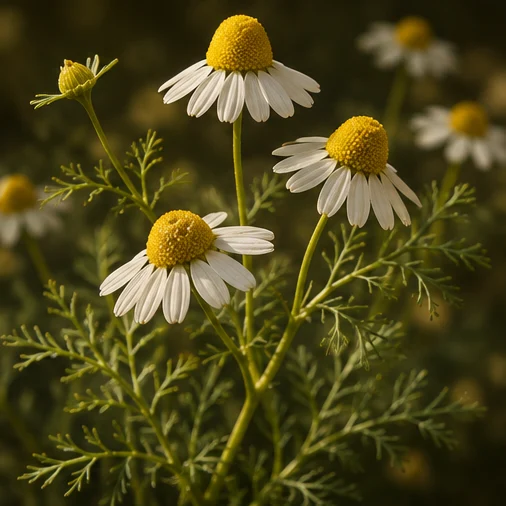
Also known as Matricaria chamomilla (syn. Matricaria recutita, Chamomilla recutita (German chamomile); Roman chamomile is Chamaemelum nobile)
FR Camomille allemande (matricaire)ES ManzanillaAR البابونجBabounj (Darija)
What the evidence says
Mechanisms are well established in the lab, but human trials are few, small and mostly decades old, with results ranging from modest benefit to no difference from comparators.
- Best supported for
- Sensitive Skin & Redness CEczema-Prone Skin C
- How to use it
- Chamomile extract (glycerin or water-based) · 1–5% in creams, toners and masks
- Watch out for
- Daisy-family cross-reactivity: chamomile is part of the Compositae patch-test mix.
Checked against 3 cited studies and our safety review · Updated 26 November 2026 · How we grade
Why you’ll love Chamomile
Why you’ll love it
- Takes the heat out of red, irritated skin
- A gentle partner for oat in calming masks
- A cool tea compress feels like a pause button for skin
Best forSensitive, reactive or eczema-prone skin that loves gentle, calming care.
Try it today
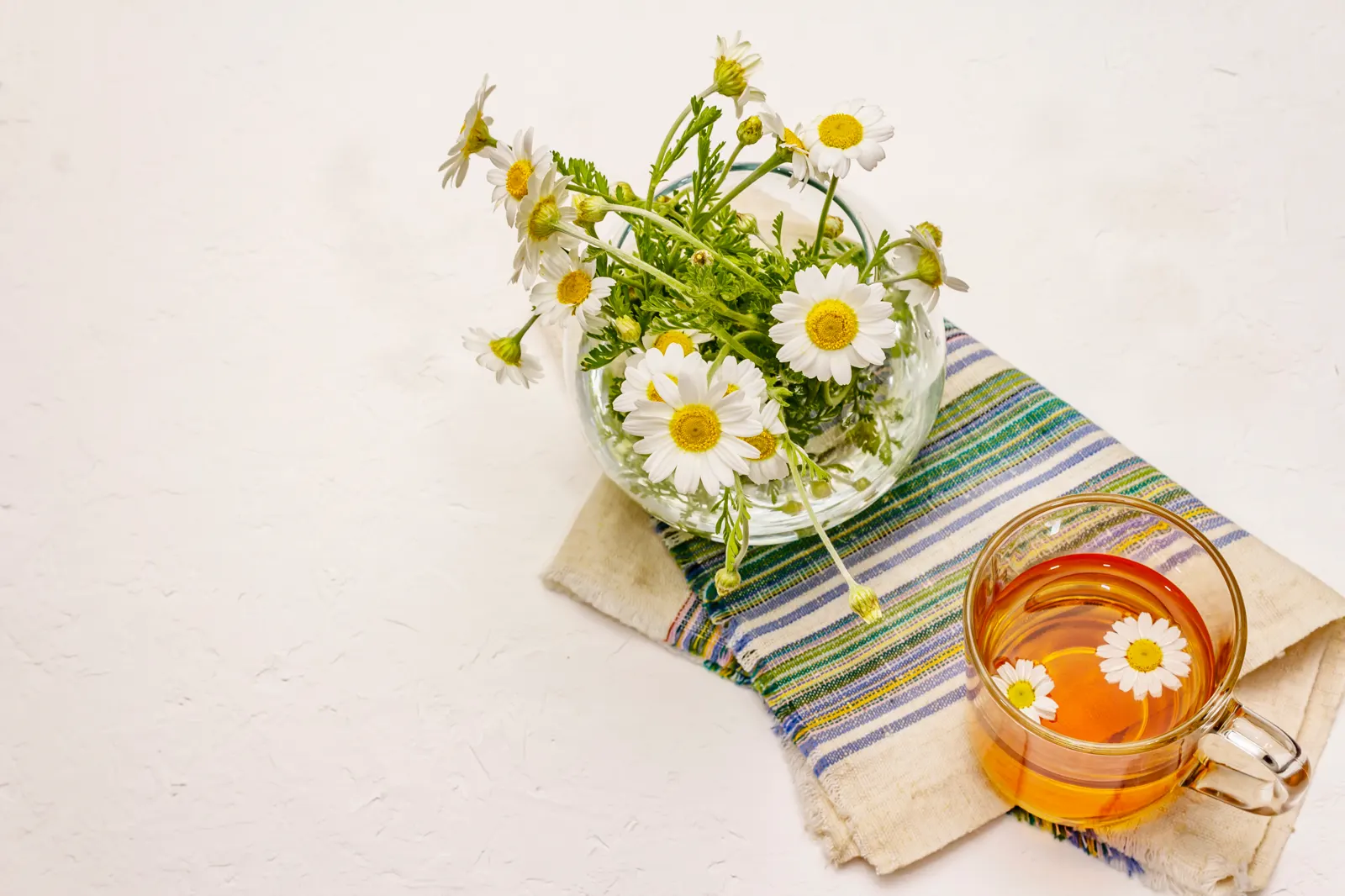
A chamomile tea compress
- Steep two tea bags in 250 ml just-boiled water for 10 minutes, then let it cool completely.
- Soak a clean cloth and rest it on your cheeks and neck for a few minutes, away from the eyes.
- Pour away whatever is left: a fresh infusion spoils within hours.
Good to know: Part of the daisy family: with ragweed or chrysanthemum allergies, patch test first. Never use chamomile tea in or on the eyes.
At a glance
| Parts used | Flower heads; water and glycerin extracts, hydrosol, steam-distilled essential oil (blue), CO₂ extract |
|---|---|
| Key actives | (−)-α-Bisabolol, Chamazulene (formed on distillation), Apigenin and apigenin-7-glucoside, Bisabolol oxides, En-yn-dicycloethers |
| INCI names | Chamomilla Recutita (Matricaria) Flower Extract Chamomilla Recutita (Matricaria) Flower Oil Chamomilla Recutita (Matricaria) Flower Water Anthemis Nobilis Flower Oil Bisabolol |
| Skin types | sensitive, dry, normal |
| Pairs well with | Colloidal OatmealCalendulaAloe VeraHoney |
| Evidence grade | CPromising Mechanisms are well established in the lab, but human trials are few, small and mostly decades old, with results ranging from modest benefit to no difference from comparators. |
What it does for skin and hair
Calms redness and irritation
Bisabolol and apigenin reduce inflammatory signaling in lab models, and chamomile extracts are a staple of products for reactive, easily flushed skin.
Comfort for eczema-prone skin
In an older half-side trial, a chamomile cream performed slightly better than 0.5% hydrocortisone in moderate atopic eczema, though only marginally better than its own base cream. It can complement, not replace, prescribed care.
Supports a comfortable skin barrier
Chamomile extracts and bisabolol are frequently used to reduce the sting of active ingredients such as acids and retinoids.
Golden tone for fair hair
Strong chamomile rinses can lend light blonde hair a subtle golden warmth through flavonoid pigments. It does not bleach or lighten darker hair.
How to use it
Start low, be consistent, and give it four to eight weeks. These are the amounts that work in real products and home recipes.
| Form | Typical use level | Notes |
|---|---|---|
| Chamomile extract (glycerin or water-based) | 1–5% in creams, toners and masks | Pairs well with oat in calming masks — see Calming Oat & Chamomile Mask. Aqueous products need a broad-spectrum preservative. |
| Bisabolol (isolated) | 0.1–1% | Oil-soluble; add to the oil phase or cool-down. Natural (−)-α-bisabolol is generally preferred over synthetic racemic bisabolol. |
| German chamomile essential oil | 0.1–0.5% on the face; up to 1% on the body | Very potent and stains fabrics blue. Respect overall essential-oil limits (Essential Oil Safety: The Complete Guide). |
| Cooled infusion or hydrosol | Fresh compress, used the same day | Steep 2 tea bags or 2 tablespoons of flowers in 250 ml just-boiled water for 10 minutes, cool, and apply on a clean cloth. Discard leftovers. |
Use it safely
Low topical risk
- Daisy-family cross-reactivity: chamomile is part of the Compositae patch-test mix. People allergic to ragweed, chrysanthemum, arnica, feverfew, marigold or mugwort pollen may react to chamomile on skin or in tea; anaphylaxis to chamomile tea is rare but reported.
- Chamomile tea used as an eyewash or eye compress has caused allergic conjunctivitis. Do not put it in the eye, and avoid eye compresses if you have hay fever to Asteraceae pollen.
- Roman chamomile is more allergenic than German chamomile because of its sesquiterpene lactones.
- Homemade infusions spoil within hours at room temperature — make fresh each time.
- Pregnancy & breastfeeding
- Topical chamomile and moderate chamomile tea are generally considered compatible with pregnancy and breastfeeding. Use essential oil only at low dilution and avoid concentrated oral supplements. Pregnancy guide
- Phototoxicity
- Not phototoxic at normal use levels.
- Declared fragrance allergens
- None expected
New to an ingredient? Patch test first. Stop and seek advice if you get burning, swelling, blistering or a spreading rash.
Make it at home: recipes with chamomile
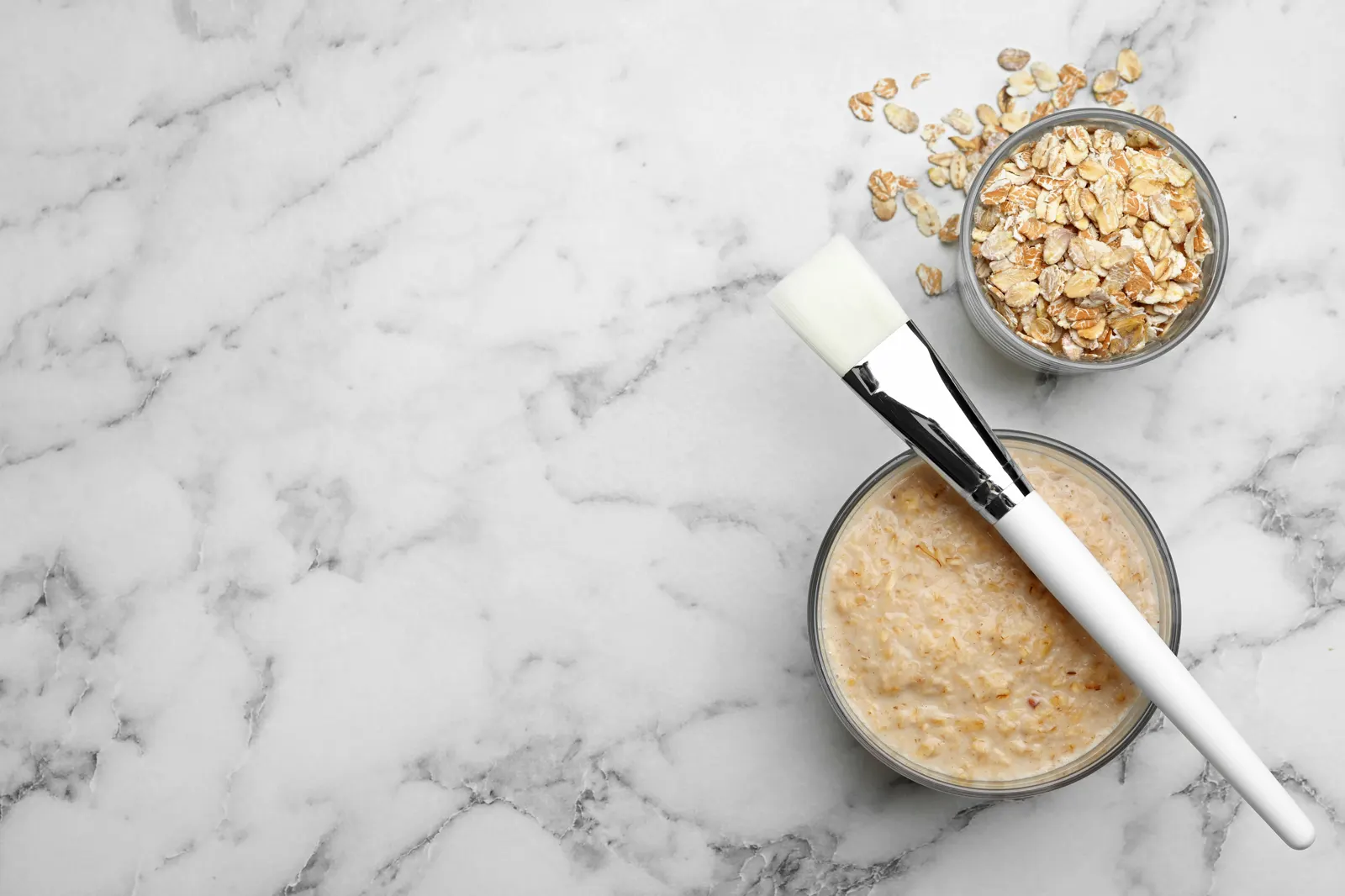 Mask · BeginnerCalming Oat & Chamomile MaskA soothing single-use paste of colloidal oatmeal, cooled chamomile tea, honey and aloe for skin that feels hot, tight or reactive.
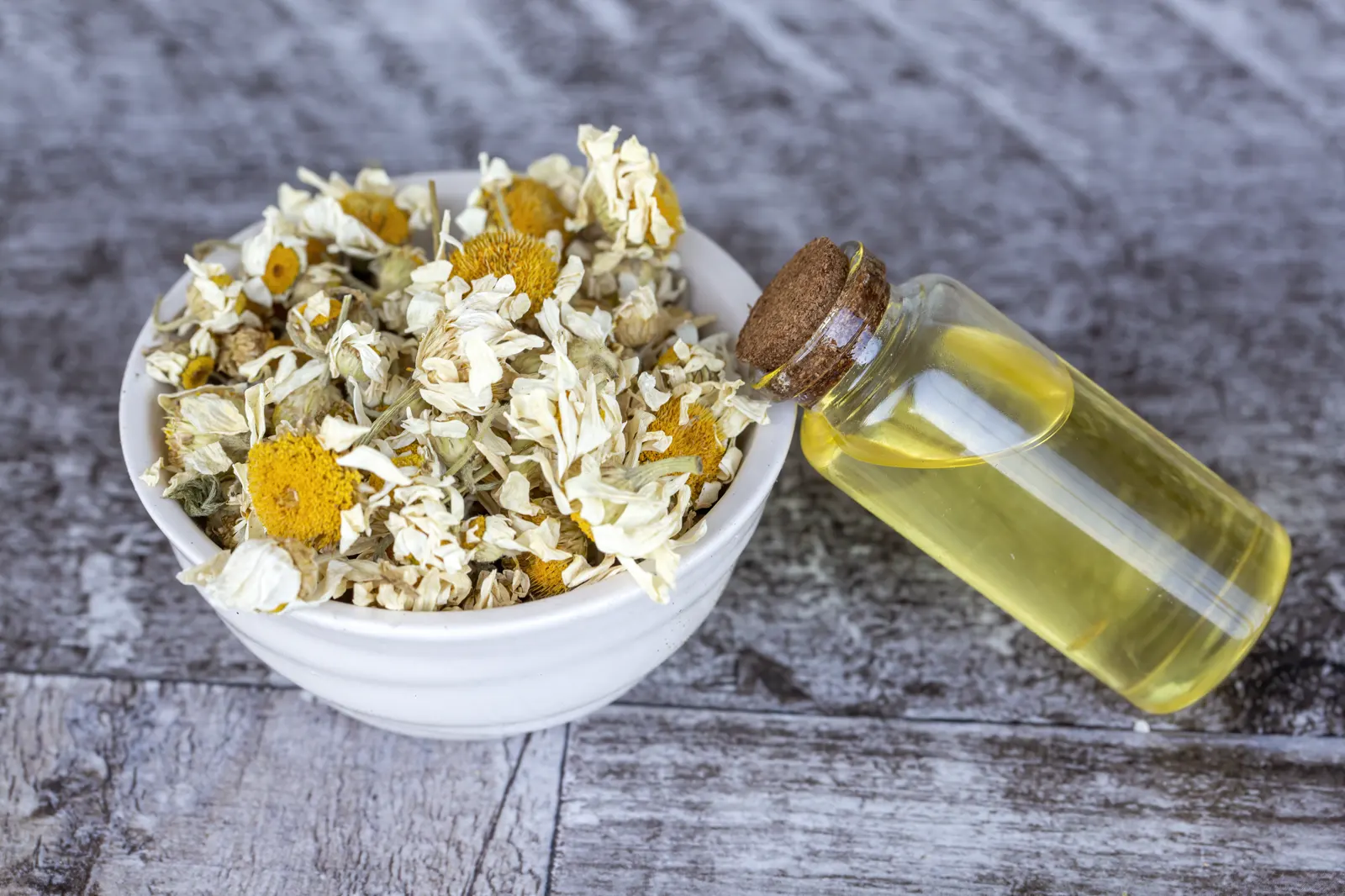 Hair care · BeginnerChamomile Tea Rinse for Fair HairA strong chamomile infusion used as a final rinse to add soft golden warmth and shine to blonde and light-brown hair. Gentle, gradual, fresh.
Buying well
Sustainability
Most cosmetic chamomile is cultivated in Egypt, Eastern Europe and Spain, and the plant is not threatened. Quality varies: “chamomile” tea dust may contain stems and low-grade material, and some cheaper essential oils are adulterated or mislabelled (for example, Moroccan “chamomile” oil is Cladanthus mixtus, a different plant).
How to choose quality
Look for whole, intact flower heads with a sweet, apple-like scent and the botanical name on the label. For essential oil, German chamomile should be deep blue; check whether you are buying German or Roman. For bisabolol, prefer natural (−)-α-bisabolol with a stated purity. Store flowers and oils cool, dark and airtight.
The research For professionals
The chemistry, the studies and the evidence by concern, for practitioners, formulators and the curious.
German chamomile flowers contain a volatile fraction rich in (−)-α-bisabolol, bisabolol oxides A and B, and matricin, a colorless sesquiterpene that converts to blue chamazulene during steam distillation — the reason German chamomile oil is ink-blue. The water-soluble fraction carries flavonoids, chiefly apigenin and its glucosides, which penetrate into deeper skin layers in human skin studies. Roman chamomile (Chamaemelum nobile) is chemically different, dominated by esters such as isobutyl angelate, and contains more sesquiterpene lactones.
In the lab, bisabolol and chamazulene inhibit pro-inflammatory enzymes and leukotriene formation, while apigenin dampens NF-κB signaling and histamine release. These are plausible routes to reduced redness and itch, and bisabolol in particular is widely used as a pure ingredient (often sourced from the Brazilian candeia tree, or made synthetically as a less active racemate).
Human evidence is limited. In a partially blinded half-side comparison in moderate atopic eczema (Patzelt-Wenczler, 2000), a commercial chamomile cream performed slightly better than 0.5% hydrocortisone and only marginally better than its vehicle. An older trial in about 50 women having radiotherapy found chamomile cream no better than almond ointment for skin reactions (Maiche, 1991). Chamomile is recognized by the European Medicines Agency as a traditional herbal medicine for minor skin inflammation — a judgment based on long use, not strong trials.
Evidence by concern
| Concern | Grade | What the evidence shows |
|---|---|---|
| Sensitive Skin & Redness | C | Bisabolol and chamazulene are anti-inflammatory, but chamomile is in the daisy family and can cause allergy in sensitized people. |
| Eczema-Prone Skin | C | An older half-side study found a chamomile cream modestly effective versus low-strength hydrocortisone, but daisy-family allergy is a real risk on eczematous skin. |
Key studies
Half-side comparison in moderate atopic eczema: chamomile cream was slightly superior to 0.5% hydrocortisone and only marginally better than its vehicle cream.
Patzelt-Wenczler R, Ponce-Pöschl E. Eur J Med Res. 2000 Read it in the bibliography Find on PubMedAbout 50 women receiving breast radiotherapy: chamomile cream did not prevent skin reactions better than almond ointment.
Maiche AG, et al. Acta Oncol. 1991 Read it in the bibliography Find on PubMedNarrative review of chamomile chemistry and pharmacology, noting robust lab data but few rigorous human trials.
Srivastava JK, et al. Mol Med Rep. 2010 Read it in the bibliography Find on PubMed
MythChamomile tea bags on the eyes get rid of dark circles.
EvidenceA cool, damp compress can briefly reduce puffiness — mostly from the cold. Dark circles caused by pigment, thin skin or hollows will not change. Tea bags near the eyes also risk allergic conjunctivitis in people with daisy-family allergy.
In tradition
Manzanilla is Spain’s cup-for-everything, and in Morocco babounj is steeped for upset stomachs and calming washes. Across Europe, strong chamomile rinses were the traditional way to brighten fair hair.
From the first-edition dossier
From study to shelf
Identify the species and the form before interpreting a calming claim.
On this page
What the studies found
EMA · Matricaria oil
- Study design
- The EMA assessed specified medicines made from distilled essential oil of Matricaria recutita flower heads, used as a bath additive.
- Result
- The EMA records a traditional use as an adjunct for certain skin irritation, after a clinician rules out serious causes. The observational evidence was too limited to establish efficacy.
- Limitations
- The conclusion applies to the defined medicinal bath preparations. A facial serum, floral water and Roman chamomile are different preparations or species.
NCCIH · Chamomile safety
- Study design
- NCCIH reviews available evidence and safety reports on chamomile.
- Result
- Reactions can occur. People allergic to related plants such as ragweed, chrysanthemums, marigolds or daisies are more likely to have an allergic reaction.
- Limitations
- This safety information does not estimate the risk of any one cosmetic or diagnose an individual reaction.
Why German chamomile has several names
Kew accepts Matricaria chamomilla for German chamomile and lists Matricaria recutita and Chamomilla recutita as synonyms. The EMA uses Matricaria recutita. Roman chamomile is Chamaemelum nobile, also called Anthemis nobilis. Read the species and whether the ingredient is a flower extract, distilled oil or flower water.
Kew · German chamomile names and synonyms
Checks before you buy
- Read the botanical name and plant part before judging the formula.
- Check whether chamomile appears as an oil, extract or flower water.
- Discuss products with a clinician if you have a known allergy to related plants.
Questions readers ask
Is Roman chamomile another name for German chamomile?
They are different species. Check for the botanical name and the preparation.
Does a chamomile serum qualify as a traditional medicine?
The EMA monograph covers defined medicinal preparations and uses. The word chamomile on a cosmetic label does not establish that status.
Compare the preparations
German chamomile and Roman chamomile are different species. Flower extract, essential oil and floral water are also distinct.
| Preparation | What to check |
|---|---|
| German chamomile flower extract or oil | Check the plant part or species declared and the manufacturer’s specification. |
| Roman chamomile flower oil | Check whether the same preparation appears in the study or the formula you are comparing. |
| Bisabolol, a named compound | Read this term separately and check the rest of the ingredient list. |
The research
The EMA’s matricaria oil assessment concerns particular herbal medicinal preparations. NCCIH notes limitations in the broader evidence. A soothing sensation from a cosmetic may depend on the entire formula.
Safety and tolerance
Chamomile may cause allergic reactions, especially if you are allergic to related plants such as ragweed, chrysanthemums or daisies. Seek individual guidance for a known allergy.
What to look for on the label
Look for “Chamomilla Recutita (Matricaria) Flower Extract” or “Flower Oil”. “Anthemis Nobilis” commonly refers to Roman chamomile.
A real label example
Spain ·
Weleda Skin Food
- Chamomilla Recutita (Matricaria) Flower Extract
This label specifies a matricaria flower extract. Keep the botanical name and plant part when comparing it with another chamomile product.
Sources
Continue reading
First published in the original Herbs.Beauty atlas on 11 November 2026, with its sources as checked on that date.
Frequently asked questions
Is chamomile good for sensitive skin and rosacea?
Can I be allergic to chamomile?
Does chamomile lighten hair naturally?
German or Roman chamomile — which is better for skin?
Cite this page
Herbs.Beauty. Chamomile (Matricaria chamomilla): evidence-based monograph. Updated 26 November 2026. https://herbs.beauty/ingredients/chamomile.html