Does it work?
Licorice Root for Sensitive Skin & Redness
What the research says about licorice root for sensitive skin & redness, how to use it at home and how to stay safe.
The short answer: Several small, mostly manufacturer-funded trials of licochalcone A products reduced facial redness, including in mild rosacea.
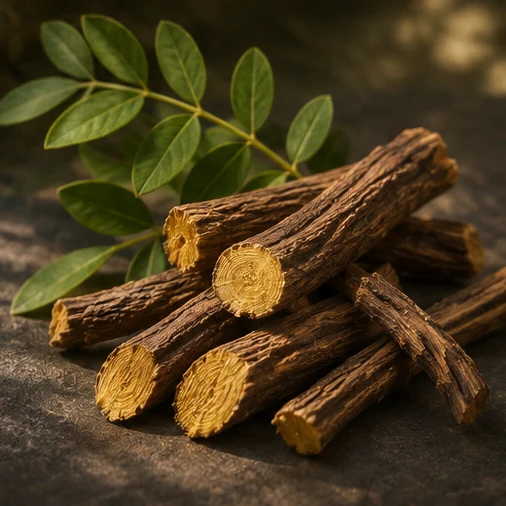
What it does
Licorice root is a mainstay of brightening and anti-redness skin care. Its oil-soluble isoflavan glabridin inhibits melanin production, liquiritin helps disperse existing pigment, and glycyrrhetinic acid and its salts are soothing. Human evidence is small but encouraging. Topical use is very low-risk; the well-known blood-pressure problems belong to eating large amounts of licorice.
Why people reach for it
- Brightens dark spots and uneven tone. Glabridin inhibits tyrosinase, the key enzyme in melanin production, and reduced UV-induced pigmentation in animal skin. A small trial of topical liquiritin improved melasma.
- Calms redness and irritation. Glycyrrhetinic acid and dipotassium glycyrrhizate reduce inflammatory signaling and are widely used to soothe sensitive and post-procedure skin.
- Supports anti-inflammatory treatments. Glycyrrhetinic acid inhibits the skin enzyme that inactivates cortisol, and enhanced the effect of topical hydrocortisone in a classic study.
- Gentle enough to combine. Licorice extracts pair well with niacinamide, vitamin C and azelaic acid in brightening routines, and are a common hydroquinone-free option.
How to use it
| Form | Typical use | Notes |
|---|---|---|
| Glabridin-standardized (oil-soluble) extract | Typically 0.1–0.5%, per supplier’s standardization | Dissolve in the oil phase or a suitable solvent (e.g. a glycol); use with daily sunscreen. See Licorice & Niacinamide Brightening Serum. |
| Water-soluble licorice root extract | 1–5% | Gentler, soothing and lightly brightening; suits toners and gels. Preserve aqueous formulas. |
| Dipotassium glycyrrhizate | 0.1–0.5% | A water-soluble soothing agent for sensitive skin, aftershaves and formulas with acids or retinoids. |
Recipes with Licorice Root
Daily rituals with Licorice Root
 Window Light, Screens and Your Skin: A Two-Minute CheckDo you need sunscreen indoors in winter? Window glass lets through UVA; screens are a minor issue. A quick check of where you sit tells you.
 The Autumn Equinox Skin ResetSummer’s over, the sunscreen stays. A twenty-minute equinox reset: check skin and moles, swap textures, and bring back actives slowly.
Use it safely
- Topical vs oral are different stories. Eating large amounts of licorice (glycyrrhizin) can cause high blood pressure, low potassium and fluid retention, and interacts with diuretics, digoxin and corticosteroids. Normal topical use is not considered to deliver meaningful systemic glycyrrhizin.
- Allergic contact dermatitis to licorice extracts is rare but reported. Patch test, especially on sensitive skin (How to Patch Test).
- Brightening ingredients only work with daily broad-spectrum sunscreen; see a dermatologist for new, changing or irregular dark spots.
Pregnancy and breastfeeding: Topical licorice extracts are generally regarded as a gentle brightening option in pregnancy. Avoid eating large amounts of licorice or taking licorice supplements while pregnant, as heavy consumption has been linked to adverse pregnancy outcomes.
New to an ingredient? Patch test first.
When to see a doctor
- Swelling of the lips, eyelids, tongue or throat, or difficulty breathing after using a product — this is an emergency.
- Persistent facial redness, visible vessels, flushing or bumps (possible rosacea), or burning, gritty, red eyes with facial redness (ocular rosacea).
- An itchy rash that spreads beyond where a product was applied or appears 1–3 days later (possible allergic contact dermatitis — ask about patch testing).
- A butterfly-shaped rash across the cheeks with joint pain, fatigue or sun sensitivity.
- Redness or stinging that continues despite a stripped-back routine for 4–6 weeks.
Other plants for Sensitive Skin & Redness
| Ingredient | Grade | What the evidence shows |
|---|---|---|
| Colloidal Oatmeal | B | Avenanthramides are anti-inflammatory and anti-itch; clinical studies support oatmeal products for irritated, itchy and reactive skin. |
| Centella Asiatica (Cica) | C | Madecassoside and asiaticoside reduce inflammation and support barrier repair in the lab; small human studies of centella creams show improved redness and comfort. |
| Green Tea | C | EGCG is anti-inflammatory and reduces UV-induced redness; a small trial suggested benefit in papulopustular rosacea. |
| Aloe Vera | C | Soothing and cooling with small supportive studies; choose stabilized gels without alcohol or fragrance, as some products irritate. |
| Chamomile | C | Bisabolol and chamazulene are anti-inflammatory, but chamomile is in the daisy family and can cause allergy in sensitized people. |