The ingredient encyclopedia · oil
Sandalwood
Santalum album L. (East Indian or Mysore sandalwood. Also traded: Western Australian sandalwood (Santalum spicatum), Pacific species (S. austrocaledonicum, S. paniculatum). “West Indian sandalwood” is Amyris balsamifera, an unrelated tree) · Santalaceae
Creamy, woody and long-lasting: a trace of true sandalwood turns a simple oil into an evening ritual.
FR Santal blanc (bois de santal)ES Sándalo (sándalo blanco)AR الصَّندلChandan, candana चन्दन (Hindi, Sanskrit); srigandha (Kannada)
- How well proven
- CPromising
- Safety
- Use with care
- Sun-sensitive
- No
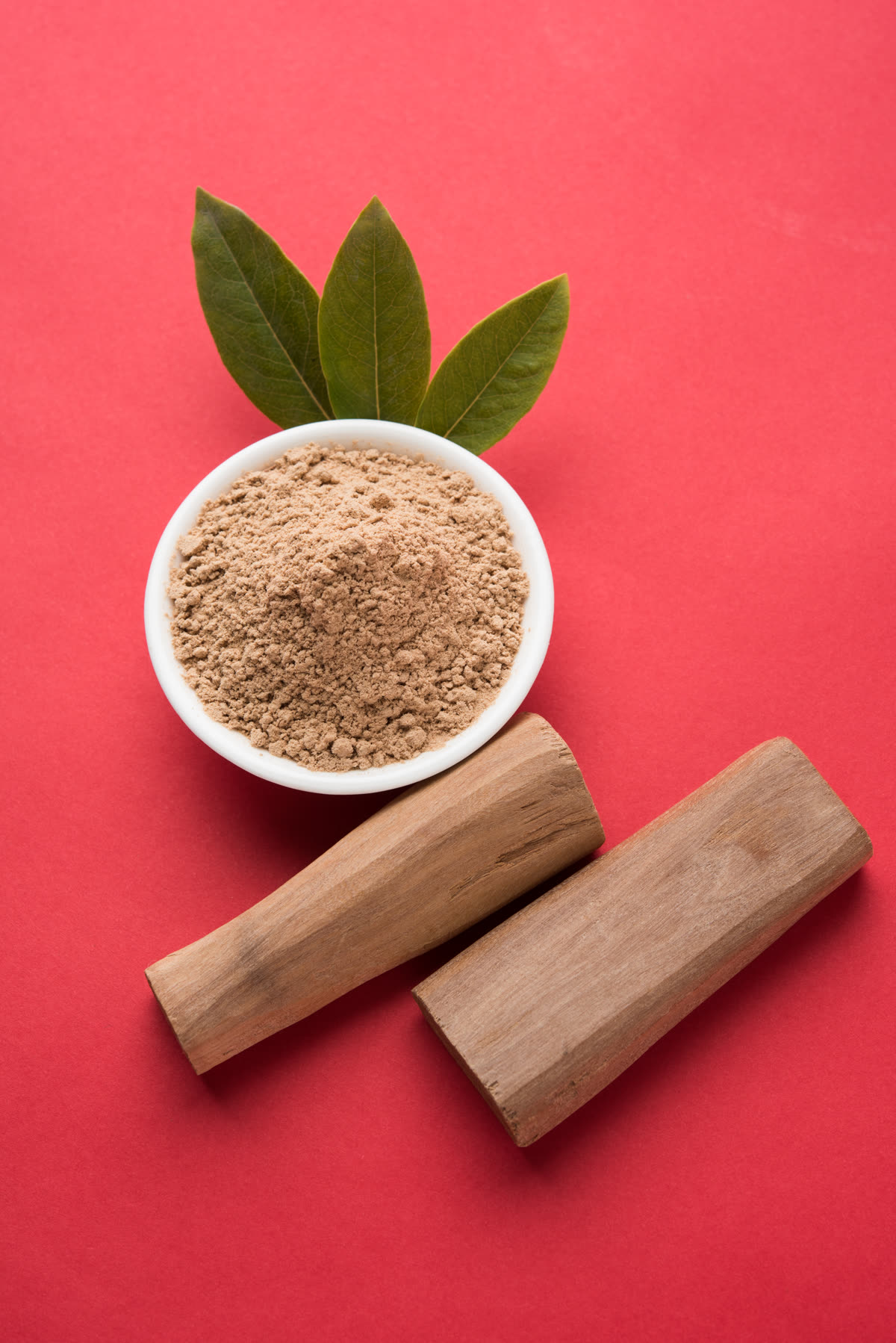
Also known as Santalum album L. (East Indian or Mysore sandalwood. Also traded: Western Australian sandalwood (Santalum spicatum), Pacific species (S. austrocaledonicum, S. paniculatum). “West Indian sandalwood” is Amyris balsamifera, an unrelated tree)
FR Santal blanc (bois de santal)ES Sándalo (sándalo blanco)AR الصَّندلChandan, candana चन्दन (Hindi, Sanskrit); srigandha (Kannada)
What the evidence says
Anti-inflammatory and antimicrobial effects are documented in lab and animal studies, and small open-label pilot studies (mostly industry-sponsored) report benefits in acne and other conditions, but controlled trials are lacking.
- What it does
- A grounding, long-lasting fragrance. Sandalwood is one of perfumery’s great base notes: soft, creamy, woody and long-lasting.
- How to use it
- Sandalwood essential oil in face products · Up to 0.5–1% of a face oil, serum or cream
- Watch out for
- Sandalwood oil and santalol are recognized contact allergens.
Checked against 2 cited studies and our safety review · Updated 26 November 2026 · How we grade
Why you’ll love Sandalwood
Why you’ll love it
- A soft, creamy, long-lasting scent that deepens any blend
- A little goes a long way in oils and balms
- Rooted in Ayurveda’s cooling rituals and Gulf perfumery
Best forNatural perfume lovers, body oils and balms, and slow evening rituals.
Try it today
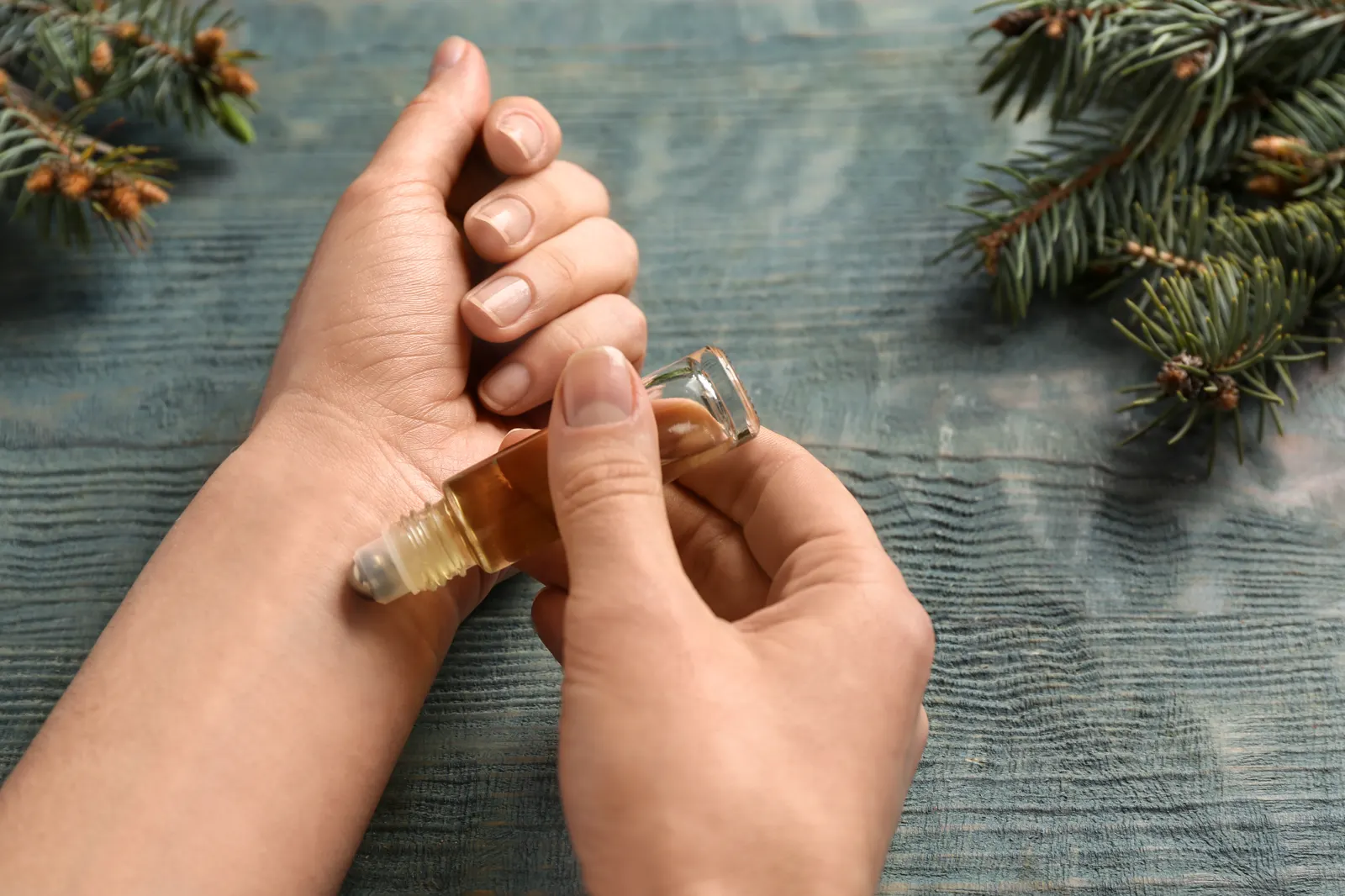
A pulse-point sandalwood oil
- Blend sandalwood into a carrier oil at 1–2% for body use; a dilution calculator makes it easy.
- Patch test on your inner arm first: it is an uncommon but known allergen.
- Dab a little on wrists and the base of your throat, skipping broken or sunburnt skin.
Good to know: True sandalwood is Santalum album and costly; “West Indian sandalwood” (amyris) is not sandalwood. The tree is Vulnerable, so buy with care.
At a glance
| Parts used | Heartwood and roots, steam-distilled into essential oil; heartwood powder for traditional pastes; wood extracts |
|---|---|
| Key actives | (Z)-α-Santalol, (Z)-β-Santalol, epi-β-Santalol, Santalenes and bergamotene, Farnesol and α-bisabolol (notably in S. spicatum) |
| INCI names | Santalum Album (Sandalwood) Oil Santalum Album (Sandalwood) Wood Extract Santalum Spicatum Wood Oil |
| Skin types | normal, oily, combination, mature |
| Pairs well with | Damask RoseFrankincenseTurmericOrange Blossom (Neroli) |
| Evidence grade | CPromising Anti-inflammatory and antimicrobial effects are documented in lab and animal studies, and small open-label pilot studies (mostly industry-sponsored) report benefits in acne and other conditions, but controlled trials are lacking. |
What it does for skin and hair
A grounding, long-lasting fragrance
Sandalwood is one of perfumery’s great base notes: soft, creamy, woody and long-lasting. A trace in a face oil, balm or body oil adds depth and fixes lighter notes.
Anti-inflammatory activity in the lab
α-Santalol and sandalwood oil reduce inflammatory signaling in cell and animal models, which underpins interest in its use for inflamed, blemish-prone skin. Human evidence is still preliminary.
A traditional cooling paste
In India, sandalwood powder mixed with water or rose water is a centuries-old cooling face pack for heat and blemishes — framed today as a traditional ritual rather than a proven treatment for Acne & Breakouts.
How to use it
Start low, be consistent, and give it four to eight weeks. These are the amounts that work in real products and home recipes.
| Form | Typical use level | Notes |
|---|---|---|
| Sandalwood essential oil in face products | Up to 0.5–1% of a face oil, serum or cream | A little goes a long way. Patch test first; it is a known, though uncommon, contact allergen. Use the Essential Oil Dilution Calculator and our Essential Oil Safety: The Complete Guide guide. |
| Body oil, balm or natural perfume | Body: 1–2%; solid or oil perfume: up to 5–10% of the fragrance blend for small-area use | Pairs beautifully with Damask rose, frankincense and orange blossom (neroli). Keep perfume use to pulse points, not large areas of skin. |
| Sandalwood powder face pack (traditional) | 1–2 teaspoons powder mixed to a paste with water or rose water; rinse after 10–15 minutes | Make fresh for each use and discard leftovers. Genuine S. album powder is scarce; much sold online is other wood dust or spent wood after distillation. Not for broken skin. |
Use it safely
Use with care
- Sandalwood oil and santalol are recognized contact allergens. Reactions are uncommon but can be persistent; perfume-allergic people should patch test (How to Patch Test).
- Western Australian oil contains farnesol, an EU-labeled fragrance allergen. Sandalwood constituents also appear on the EU’s expanded fragrance-allergen labeling list.
- Keep essential oil out of reach of children and never take it internally.
- Not phototoxic, but avoid applying any fragrance oil to sunburnt, broken or freshly exfoliated skin.
- Pregnancy & breastfeeding
- Low-level use in cosmetics and perfume is generally considered acceptable in pregnancy and breastfeeding; avoid high-concentration blends and patch test, as skin can be more reactive (Skincare in Pregnancy & Breastfeeding). Pregnancy guide
- Phototoxicity
- Not phototoxic at normal use levels.
- Declared fragrance allergens
- Santalol, Farnesol
New to an ingredient? Patch test first. Stop and seek advice if you get burning, swelling, blistering or a spreading rash.
Make it at home: recipes with sandalwood
Buying well
Sustainability
Santalum album is listed as Vulnerable on the IUCN Red List after decades of overharvesting, smuggling and disease in India, where for much of modern history the trees were state property and wild stocks collapsed. Today much legal S. album comes from plantations, notably in northern Western Australia, while S. spicatum is harvested and planted in Western Australia under state licensing. Choose plantation-grown or certified oil with documented origin, and treat cheap “Mysore” oil as a red flag (Sustainable & Ethical Botanical Sourcing).
How to choose quality
Check the botanical name: Santalum album (East Indian), S. spicatum (Australian, cheaper, different scent) or S. austrocaledonicum (New Caledonia/Vanuatu). “Amyris” or “West Indian sandalwood” is not sandalwood. Ask for a GC report showing santalols within the ISO range, and expect true S. album to be expensive. Store tightly sealed, cool and dark; sandalwood oil ages well.
The research For professionals
The chemistry, the studies and the evidence by concern, for practitioners, formulators and the curious.
Sandalwood trees are hemiparasites: their roots tap neighboring plants for water and nutrients. Fragrant oil accumulates in the heartwood and roots only as the tree matures, typically after fifteen years or more, which is why traditional harvesting uproots the whole tree. Steam distillation yields an oil whose quality is defined mainly by its santalols. The international standard for East Indian oil (ISO 3518) specifies roughly 41–55% (Z)-α-santalol and 16–24% (Z)-β-santalol; β-santalol carries much of the classic creamy odor. Western Australian sandalwood (S. spicatum) has considerably lower santalol and more farnesol and α-bisabolol, giving a drier, sharper scent. Amyris (“West Indian sandalwood”, family Rutaceae) contains no santalols at all; its woody character comes from valerianol, elemol and eudesmols.
In laboratory work, α-santalol and sandalwood oil suppress the production of inflammatory cytokines and show antibacterial and antifungal activity; in mouse skin carcinogenesis models, α-santalol reduced tumor development, an observation that remains experimental. An intriguing line of research found that keratinocytes carry an olfactory receptor, OR2AT4, activated by a synthetic sandalwood-type odorant, which promoted keratinocyte proliferation and migration in vitro (Busse, J Invest Dermatol, 2014); a later study linked the same receptor to hair-follicle growth in organ culture. These used synthetic odorants, not natural sandalwood oil, and do not show a clinical effect.
Human evidence comes mainly from small, open-label pilot studies of East Indian sandalwood oil in acne, psoriasis, warts and other conditions, many funded by an oil producer and summarized in a 2017 review (Moy and Levenson, J Clin Aesthet Dermatol). The results are encouraging but uncontrolled. Sandalwood’s cosmetic role today is therefore best described as a fine fragrance material with plausible soothing activity.
Adulteration is the defining practical problem. With genuine Indian oil scarce and expensive, commercial “sandalwood” may be Australian or Pacific oil, amyris, cheaper oils cut with santalol-free fractions, or synthetic sandalwood aroma chemicals. Gas chromatography against the ISO santalol ranges, plus chiral analysis, is the only reliable check.
Key studies
Review of East Indian sandalwood oil in dermatology: lab anti-inflammatory and antimicrobial data plus small open-label pilot studies in acne, psoriasis, warts and other conditions; controlled trials are needed. Authors had commercial ties to an oil producer.
Moy RL, Levenson C. J Clin Aesthet Dermatol. 2017 Read it in the bibliography Find on PubMedHuman keratinocytes express the olfactory receptor OR2AT4; a synthetic sandalwood-type odorant activated it and accelerated keratinocyte proliferation and migration in vitro. A lab finding with a synthetic odorant, not a clinical trial of sandalwood oil.
Busse D, et al. J Invest Dermatol. 2014 Read it in the bibliography Find on PubMed
Myth“West Indian sandalwood” is just a cheaper type of sandalwood.
EvidenceIt is Amyris balsamifera, a Caribbean shrub in the citrus family with no santalols at all. It has a pleasant woody scent and is a legitimate oil in its own right, but labeling it “sandalwood” — or blending it into sandalwood oil — is misleading.
In tradition
In Ayurveda, sandalwood (chandana) is the classic cooling herb, ground on a stone into a paste for the skin and for the forehead mark in Hindu and Buddhist worship. The old princely state of Mysore was the heart of the trade, distilling sandalwood oil in a state-run factory founded in 1916, and Kannauj’s traditional attars are still distilled into a sandalwood base. Sandalwood is also prized in Arab and Gulf perfumery, alongside oud and rose.
Frequently asked questions
Is sandalwood good for acne?
How can I tell if sandalwood oil is real?
Is sandalwood endangered?
Can I put sandalwood oil directly on my skin?
Cite this page
Herbs.Beauty. Sandalwood (Santalum album L.): evidence-based monograph. Updated 26 November 2026. https://herbs.beauty/ingredients/sandalwood.html