The ingredient encyclopedia · root
Turmeric
Curcuma longa · Zingiberaceae
Golden turmeric, stirred fresh into honey, makes a joyful kitchen mask with centuries of tradition behind it.
FR CurcumaES CúrcumaAR الكركمKharkoum (Darija); Haldi (Hindi)
- How well proven
- CPromising
- Safety
- Use with care
- Sun-sensitive
- No
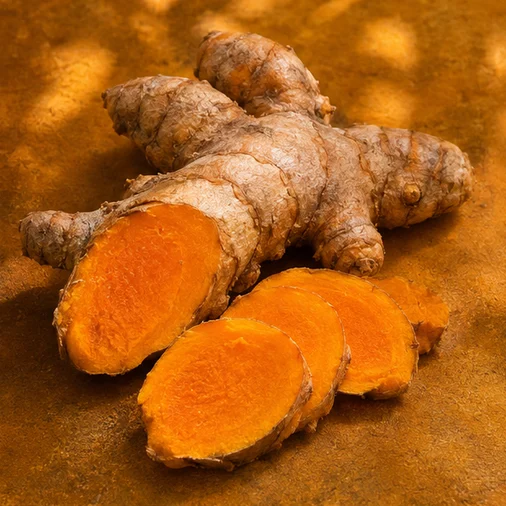
FR CurcumaES CúrcumaAR الكركمKharkoum (Darija); Haldi (Hindi)
What the evidence says
Strong in-vitro anti-inflammatory and antioxidant data, but human skin studies are few, small and inconsistent, and curcumin’s chemistry makes lab results hard to translate.
- Best supported for
- Dark Spots & Hyperpigmentation C
- How to use it
- Powder in a fresh mask · 1–3% of the mask (about a pinch to ¼ teaspoon per use)
- Watch out for
- Contact allergy: curcumin and turmeric oleoresin cause allergic contact dermatitis, including in people who handle turmeric at work.
Checked against 3 cited studies and our safety review · Updated 26 November 2026 · How we grade
Why you’ll love Turmeric
Why you’ll love it
- A warm, golden mask ritual straight from the kitchen
- Rich in antioxidant compounds that are well studied in the lab
- Pairs beautifully with honey, yogurt or chickpea flour
Best forKitchen-beauty lovers who enjoy an occasional fresh, traditional glow mask.
Try it today
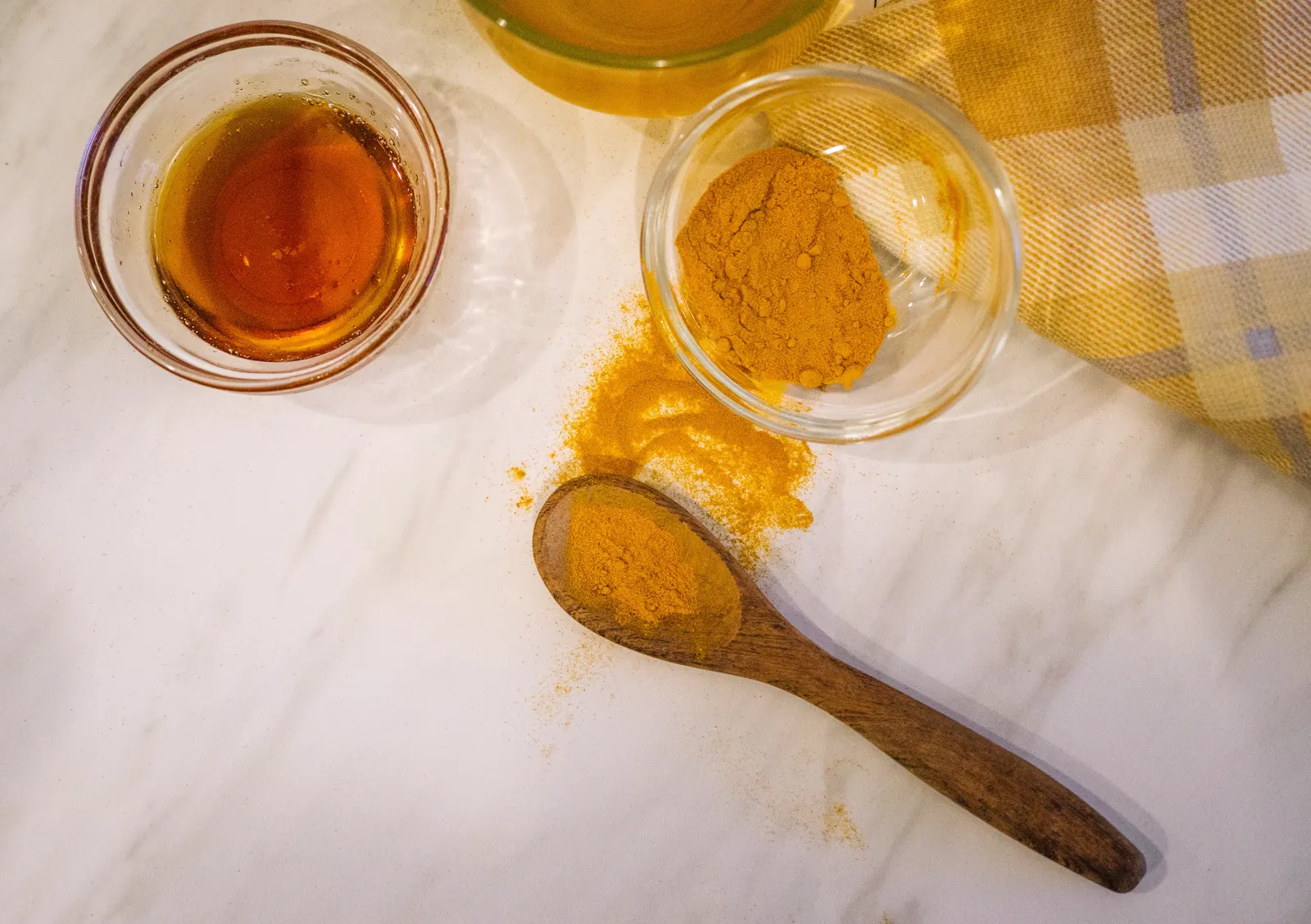
A golden honey mask
- Patch test on your inner arm before your first full-face mask: twice daily for 7 days, read at 48 and 96 hours.
- Mix a pinch to a quarter teaspoon of turmeric with honey or yogurt, just enough for one use.
- Leave 10 minutes, loosen any tint with a little oil, then rinse well and skip the sun afterward.
Good to know: Turmeric stains towels, nails and grout, and some powders have been adulterated with lead. Buy from reputable, tested sources.
At a glance
| Parts used | Rhizome; powder, oleoresin and extracts, CO₂ extract and essential oil, purified curcuminoids and colorless tetrahydrocurcumin |
|---|---|
| Key actives | Curcumin, Demethoxycurcumin, Bisdemethoxycurcumin, ar-Turmerone and turmerones, Tetrahydrocurcumin (derivative) |
| INCI names | Curcuma Longa (Turmeric) Root Extract Curcuma Longa (Turmeric) Root Powder Curcuma Longa (Turmeric) Root Oil Curcumin Tetrahydrodiferuloylmethane |
| Skin types | normal, oily, combination |
| Pairs well with | HoneyNeemColloidal Oatmeal |
| Evidence grade | CPromising Strong in-vitro anti-inflammatory and antioxidant data, but human skin studies are few, small and inconsistent, and curcumin’s chemistry makes lab results hard to translate. |
What it does for skin and hair
Anti-inflammatory and antioxidant
Curcumin inhibits NF-κB signaling and scavenges free radicals in the lab, which underlies interest in turmeric for redness and blemishes. Human topical evidence is limited.
A traditional glow mask
Mixed with chickpea flour, yogurt or honey, turmeric masks are a cherished South Asian beauty ritual. The visible “glow” is partly the yellow tint and gentle exfoliation.
Colorless brightening derivative
Tetrahydrocurcumin, a hydrogenated curcumin, inhibits tyrosinase and is an antioxidant without the staining, making it the more practical form in serums.
How to use it
Start low, be consistent, and give it four to eight weeks. These are the amounts that work in real products and home recipes.
| Form | Typical use level | Notes |
|---|---|---|
| Powder in a fresh mask | 1–3% of the mask (about a pinch to ¼ teaspoon per use) | Mix with honey, yogurt or chickpea flour; leave 10 minutes, then rinse with a little oil first if needed to lift stains. Make fresh and discard leftovers. See Turmeric & Honey Glow Mask. |
| Tetrahydrocurcumin | 0.1–1% | Colorless, non-staining antioxidant for leave-on serums; dissolve in a glycol or the oil phase. |
| Turmeric CO₂ extract or root oil | ≤0.5–1% | Contains turmerones and some curcumin; can still tint formulas. Respect overall essential-oil limits. |
Use it safely
Use with care
- Contact allergy: curcumin and turmeric oleoresin cause allergic contact dermatitis, including in people who handle turmeric at work. Patch test on the inner arm before a full-face mask, as in our guide: twice daily for 7 days, read at 48 and 96 hours.
- Staining: turmeric tints skin, nails, towels, grout and nail beds yellow; a smaller dose, a short contact time, and an oil cleanse help. It stains fabric permanently.
- Adulteration: some turmeric has been found adulterated with lead chromate to brighten color. Buy from reputable, tested sources.
- Curcumin is a photosensitizer in lab conditions; rinse masks thoroughly and avoid applying before sun exposure.
- Oral supplements (not cosmetic use) can interact with anticoagulants and have been linked to rare liver injury; talk to a doctor before taking them.
- Pregnancy & breastfeeding
- Culinary turmeric and occasional topical masks are considered safe in pregnancy. Avoid high-dose curcumin supplements in pregnancy and breastfeeding. Pregnancy guide
- Phototoxicity
- Not phototoxic at normal use levels.
- Declared fragrance allergens
- None expected
New to an ingredient? Patch test first. Stop and seek advice if you get burning, swelling, blistering or a spreading rash.
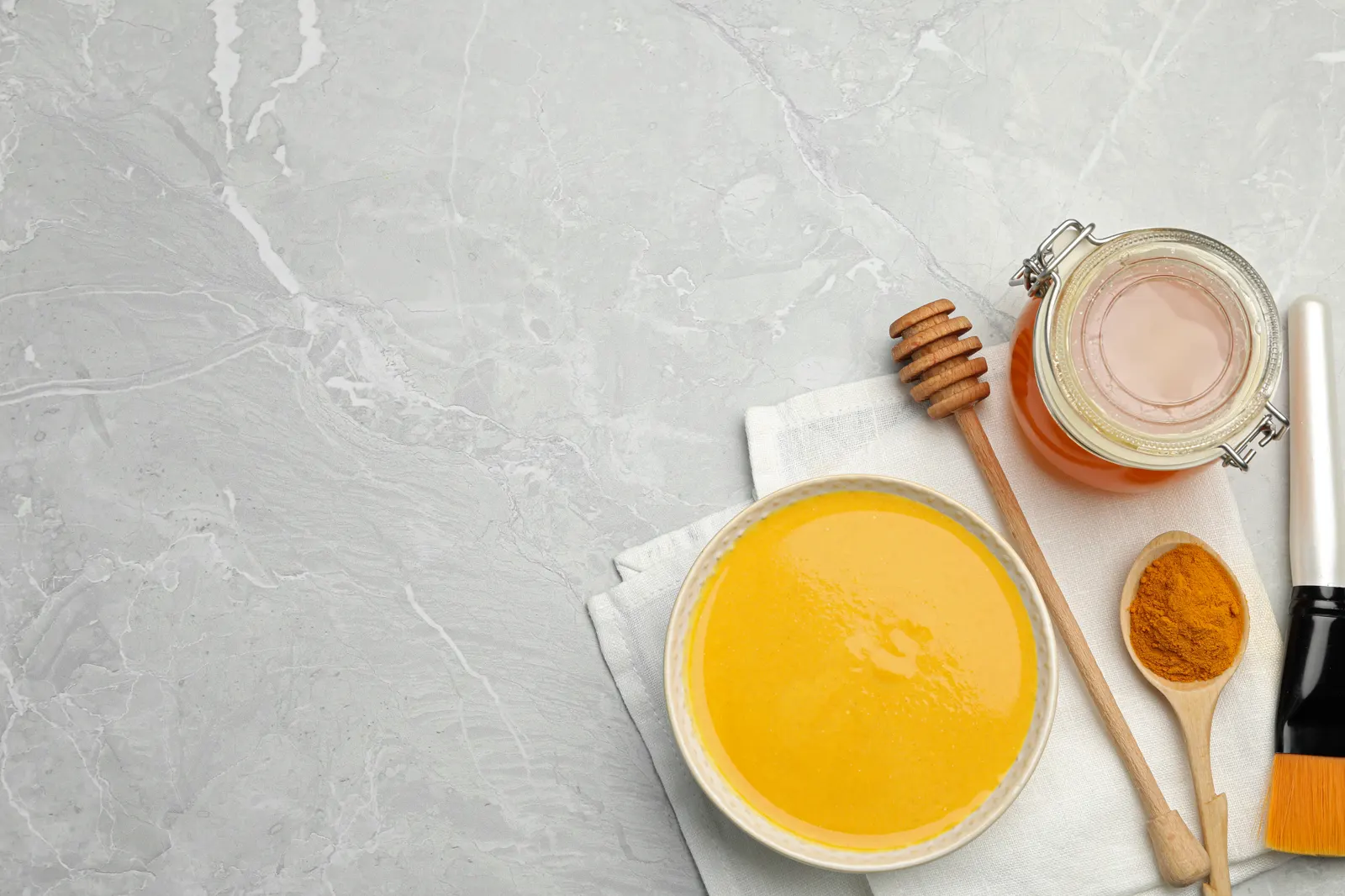
Make it at home: recipes with turmeric
Buying well
Sustainability
India grows most of the world’s turmeric. Investigations in South Asia have found lead chromate added to turmeric to intensify its color — a serious public-health issue. Look for suppliers who test for heavy metals, and for organic or fair-trade certification.
How to choose quality
Buy finely ground, food-grade or cosmetic-grade powder from a supplier who publishes heavy-metal test results. Unusually bright, almost orange-yellow powder at a bargain price is a red flag. For formulations, standardized extracts (curcuminoid %) or tetrahydrocurcumin are more predictable. Store sealed, cool and dark.
The research For professionals
The chemistry, the studies and the evidence by concern, for practitioners, formulators and the curious.
Turmeric rhizome contains a few percent of curcuminoids (curcumin, demethoxycurcumin and bisdemethoxycurcumin), which give the yellow color, plus a volatile oil rich in ar-turmerone and α/β-turmerones. Curcumin is practically insoluble in water, degrades rapidly at neutral to alkaline pH, and is photo-unstable. A widely cited medicinal-chemistry review (Nelson, 2017) argued that curcumin is an unstable, reactive, poorly bioavailable compound that frequently produces false positives in lab assays — a sobering reason to discount many in vitro claims.
Even so, curcumin reproducibly inhibits pro-inflammatory pathways (NF-κB, COX-2, LOX), scavenges free radicals and inhibits tyrosinase in cell systems. Tetrahydrocurcumin, a colorless hydrogenated derivative, keeps the antioxidant and anti-tyrosinase activity without staining.
A 2016 systematic review of turmeric for skin (Vaughn, Phytother Res) found mostly small, heterogeneous studies — oral and topical — with some positive signals for psoriasis, acne, radiation dermatitis and photoaging, but no robust conclusions. A trial of oral curcumin (6 g a day) in 30 women having breast radiotherapy reduced radiation dermatitis severity (Ryan, 2013); later trials, including of topical curcumin, have been mixed. Evidence for turmeric masks specifically is essentially traditional.
Evidence by concern
| Concern | Grade | What the evidence shows |
|---|---|---|
| Dark Spots & Hyperpigmentation | C | Curcuminoids inhibit tyrosinase in vitro, and a small study of a turmeric-extract cream reported modest reduction of facial spots. Raw turmeric stains and can irritate. |
Key studies
Systematic review of turmeric and curcumin for skin: most studies were small and heterogeneous; preliminary positive signals for several conditions, but no firm conclusions.
Vaughn AR, et al. Phytother Res. 2016 Read it in the bibliography Find on PubMedDouble-blind, placebo-controlled trial in 30 women receiving breast radiotherapy: oral curcumin (6 g/day) reduced radiation dermatitis severity.
Ryan JL, et al. Radiat Res. 2013 Read it in the bibliography Find on PubMedMedicinal chemistry review concluding that curcumin is unstable, reactive and poorly bioavailable, and often a false positive in lab screening assays.
Nelson KM, et al. J Med Chem. 2017 Read it in the bibliography Find on PubMed
MythTurmeric masks permanently lighten skin.
EvidenceThere is no good evidence that turmeric masks lighten skin. The temporary glow is partly the yellow tint and gentle exfoliation. For dark spots, sunscreen and evidence-based brighteners do the work; see Dark Spots & Hyperpigmentation.
In tradition
In India, the pre-wedding haldi ceremony anoints bride and groom with turmeric paste, and ubtan masks combine turmeric with chickpea flour. In Morocco, kharkoum is a kitchen spice more than a cosmetic, coloring tagines and harira.
From the first-edition dossier
From study to shelf
Why a rhizome extract, curcumin and a kitchen mask are different.
On this page
What the studies found
Vaughn et al. (2016) PubMed
- Study design
- The review included 18 clinical studies across several skin conditions. Nine studied ingestion, eight topical use, and one both.
- Result
- Ten studies reported a statistically significant improvement in the severity of their particular skin condition compared with their controls.
- Limitations
- Ten positive studies across several conditions and routes are not ten trials of turmeric masks for dark spots. Preparations, comparators and outcomes varied.
Di Lorenzo et al. (2023) PubMed
- Study design
- This review focused on clinical studies of topical turmeric or curcumin for a range of skin conditions.
- Result
- The authors noted that topical studies formed a smaller literature than studies of ingestion and discussed findings from specific formulations.
- Limitations
- A formulated product used for a particular condition provides little basis for estimating the effect of kitchen turmeric powder or a generic cosmetic on pigmentation.
What the color tells you
Curcumin is one of the pigments in turmeric. Yellow residue can temporarily change the appearance of skin. For a finished product’s dark-spot claim, look for measurements made under consistent conditions across several weeks. NCCIH reports that topical curcumin can cause hives or itching.
Checks before you buy
- Identify Curcuma Longa Root Extract or Curcumin on the label and check whether the product is rinsed off.
- Give more weight to controlled comparisons on the finished product than to photos taken in different lighting.
- Avoid a cosmetic that stings or causes hives. Get a new or changing mark checked.
Questions readers ask
Can yellow residue look like a result?
Yes. Pigment on the surface changes its color temporarily. A study of dark spots needs consistent measurement after the residue is removed.
Can I infer the effect from a turmeric supplement study?
Oral and topical exposure differ. Look for evidence on the preparation and application you are considering.
Compare the preparations
Curcumin is one of the colored constituents of turmeric. A root extract, isolated curcumin and turmeric powder differ in composition and delivery. Yellow residue after a mask can change how the skin looks until it washes off.
| Preparation | What to check |
|---|---|
| Turmeric root extract | Check the plant part or species declared and the manufacturer’s specification. |
| Distilled turmeric oil | Check whether the same preparation appears in the study or the formula you are comparing. |
| Curcumin, a named compound | Read this term separately and check the rest of the ingredient list. |
The research
The clinical literature spans oral and topical preparations and several skin conditions. Topical trials are relatively few. Findings from a formulated product with a specific target and dose are difficult to transfer to a different face mask or an unspecified cosmetic extract.
Safety and tolerance
Topical curcumin may cause itching or hives. Stop using a product that triggers a reaction. For a new or changing dark spot, seek a medical assessment.
What to look for on the label
Look for “Curcuma Longa (Turmeric) Root Extract”, “Curcumin” or a comparable declared ingredient. For a claim about visible pigmentation, ask whether that exact product was tested over time.
A real label example
United States ·
KORA Organics Turmeric Brightening & Exfoliating Mask
- Curcuma Longa (Turmeric) Root Extract
- Pumice
- Lavandula Angustifolia (Lavender) Oil
The US mask label names turmeric root extract alongside pumice and lavender oil. It does not declare this selected extract as isolated curcumin.
Sources
- Vaughn et al. (2016) · Review of clinical skin research PubMed
- Di Lorenzo et al. (2023) · Clinical studies on topical curcumin PubMed
- NCCIH · Turmeric usefulness and safety
Continue reading
First published in the original Herbs.Beauty atlas on 11 November 2026, with its sources as checked on that date.
Frequently asked questions
Is turmeric good for your face?
How do I get turmeric stains off my skin?
Does turmeric help acne or acne scars?
Can turmeric cause an allergic reaction on skin?
Cite this page
Herbs.Beauty. Turmeric (Curcuma longa): evidence-based monograph. Updated 26 November 2026. https://herbs.beauty/ingredients/turmeric.html