The ingredient encyclopedia · butter
Cocoa Butter
Theobroma cacao L. (Formerly placed in Sterculiaceae) · Malvaceae
The fat that gives chocolate its melt: firm in the jar, silky on skin, and smelling softly of cocoa.
FR Beurre de cacaoES Manteca de cacaoAR زبدة الكاكاوKakaw (Classic Maya); cacahuatl (Nahuatl)
- How well proven
- CPromising
- Safety
- Low topical risk
- Sun-sensitive
- No
Also known as Theobroma cacao L. (Formerly placed in Sterculiaceae)
FR Beurre de cacaoES Manteca de cacaoAR زبدة الكاكاوKakaw (Classic Maya); cacahuatl (Nahuatl)
What the evidence says
Emollient and occlusive effects are well understood but tested mostly within formulas; randomized trials consistently show no benefit for preventing stretch marks.
- What it does
- Seals in moisture. A firm, occlusive fat that slows water loss from very dry skin, hands, heels and lips — especially useful in cold, dry weather.
- How to use it
- Lip balm · 20–40% of the balm
- Watch out for
- True allergy to cocoa butter is rare; reactions to “cocoa butter” lotions are more often caused by added fragrance.
Checked against 3 cited studies and our safety review · Updated 26 November 2026 · How we grade
Why you’ll love Cocoa Butter
Why you’ll love it
- Seals in moisture on dry hands, heels and lips
- Melts on contact with skin for a clean, silky glide
- Smells of chocolate and keeps for years in the cupboard
Best forVery dry body skin, lips and lotion bars; go lightly on acne-prone faces.
Try it today
A winter hand rescue
- Warm a small piece of pure cocoa butter between your palms until it melts.
- Massage it into the backs of your hands, knuckles and cuticles, focusing on the driest spots.
- Repeat after washing up and before bed, and touch a little onto dry lips.
Good to know: Reactions to “cocoa butter” lotions usually come from added fragrance. And honestly: trials show it won’t prevent stretch marks.
At a glance
| Parts used | Fat pressed from fermented and usually roasted cocoa beans; natural (chocolate-scented) or deodorized |
|---|---|
| Key actives | Stearic acid, Oleic acid, Palmitic acid, Symmetrical triglycerides (POP, POS, SOS), Tocopherols, Phytosterols, Trace polyphenols and methylxanthines (natural grade) |
| INCI names | Theobroma Cacao Seed Butter |
| Skin types | dry, normal, mature |
| Hair & scalp | curly, thick |
| Pairs well with | Shea ButterCoconut OilSweet Almond OilCalendula |
| Evidence grade | CPromising Emollient and occlusive effects are well understood but tested mostly within formulas; randomized trials consistently show no benefit for preventing stretch marks. |
What it does for skin and hair
Seals in moisture
A firm, occlusive fat that slows water loss from very dry skin, hands, heels and lips — especially useful in cold, dry weather.
Structure for balms and bars
Its sharp melting point (about 34–38 °C) gives lip balms and lotion bars firmness at room temperature and a clean melt on skin.
Practically rancid-proof
Very low polyunsaturated content plus natural antioxidants give cocoa butter a shelf life measured in years — a stabilizing base for anhydrous products.
Comforting, simple emollient
A plain, fragrance-free cocoa butter balm can be part of an emollient routine for dry or eczema-prone body skin.
How to use it
Start low, be consistent, and give it four to eight weeks. These are the amounts that work in real products and home recipes.
| Form | Typical use level | Notes |
|---|---|---|
| Lip balm | 20–40% of the balm | Combine with a liquid oil and beeswax or candelilla wax; adapt Shea & Calendula Lip Balm by swapping part of the shea for cocoa butter. |
| Lotion bar or solid body butter | 30–60% of an anhydrous bar | Pair with liquid oils and wax for a bar that glides on skin warmth. Temper (melt fully, cool quickly) to avoid graininess. |
| Whipped body butter | 10–25% of the butter phase | Too much cocoa butter makes whipped butters hard; blend with softer shea butter — see Whipped Shea Body Butter. |
| Creams and lotions | 2–10% of the formula (oil phase) | Adds richness and body to emulsions; balance the formula with the Formula & Cost Calculator. |
Use it safely
Low topical risk
- True allergy to cocoa butter is rare; reactions to “cocoa butter” lotions are more often caused by added fragrance. Patch test if your skin is reactive.
- Cocoa butter is considered moderately to highly comedogenic in older animal tests; avoid heavy use on acne-prone faces.
- Natural cocoa butter smells of chocolate; deodorized grades suit fragrance-free products.
- Grainy or white-bloomed balms are a crystal issue, not spoilage.
- Pregnancy & breastfeeding
- Safe for topical use in pregnancy and breastfeeding, and a pleasant emollient for itchy, stretching skin — but trials show it does not prevent stretch marks. Pregnancy guide
- Phototoxicity
- Not phototoxic at normal use levels.
- Declared fragrance allergens
- None expected
New to an ingredient? Patch test first. Stop and seek advice if you get burning, swelling, blistering or a spreading rash.
Make it at home: recipes with cocoa butter
Buying well
Sustainability
Côte d’Ivoire and Ghana grow roughly 60% of the world’s cocoa, largely on small family farms where poverty is widespread. A 2020 NORC report estimated about 1.56 million children in child labor in cocoa-growing households in those two countries, most in hazardous work. Cocoa expansion has also driven deforestation, and the EU Deforestation Regulation now covers cocoa. Certification (Fairtrade, Rainforest Alliance) and traceable direct-trade or organic sourcing help but do not guarantee child-labor-free supply. See Sustainable & Ethical Botanical Sourcing.
How to choose quality
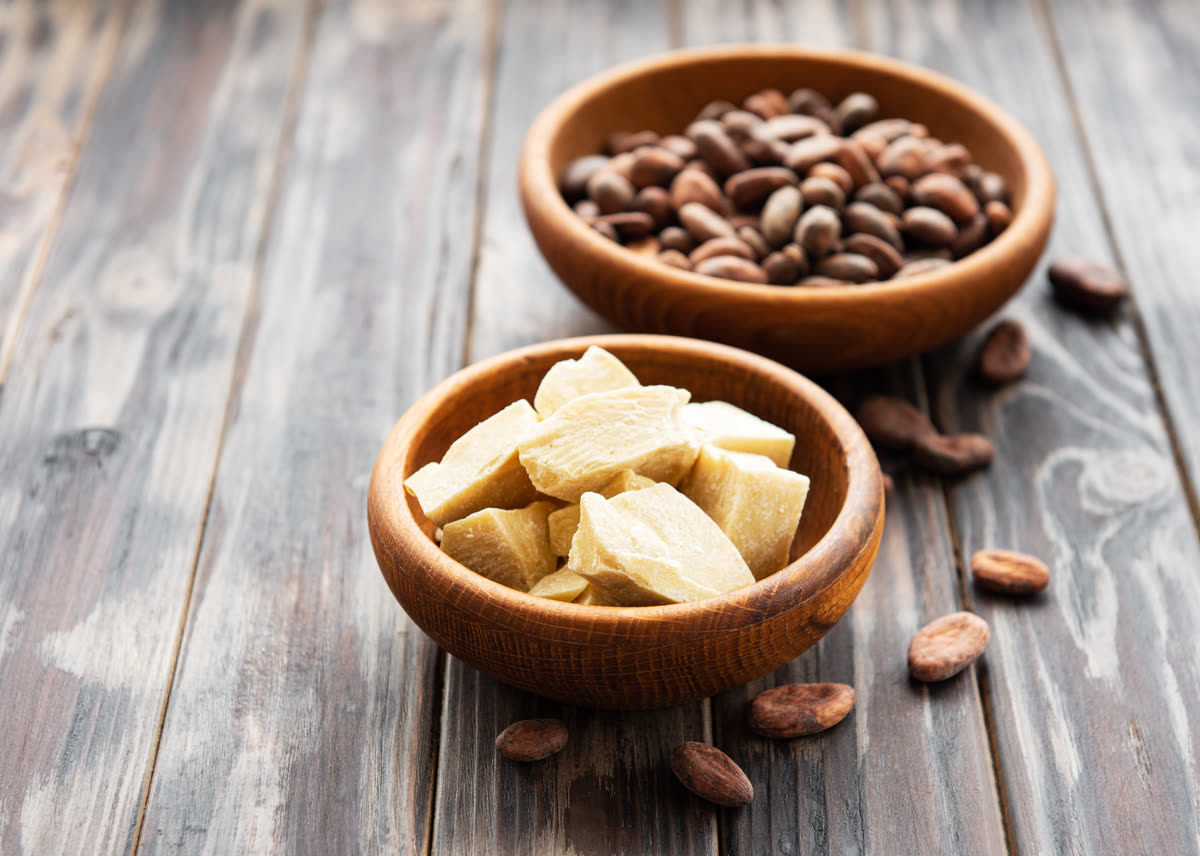
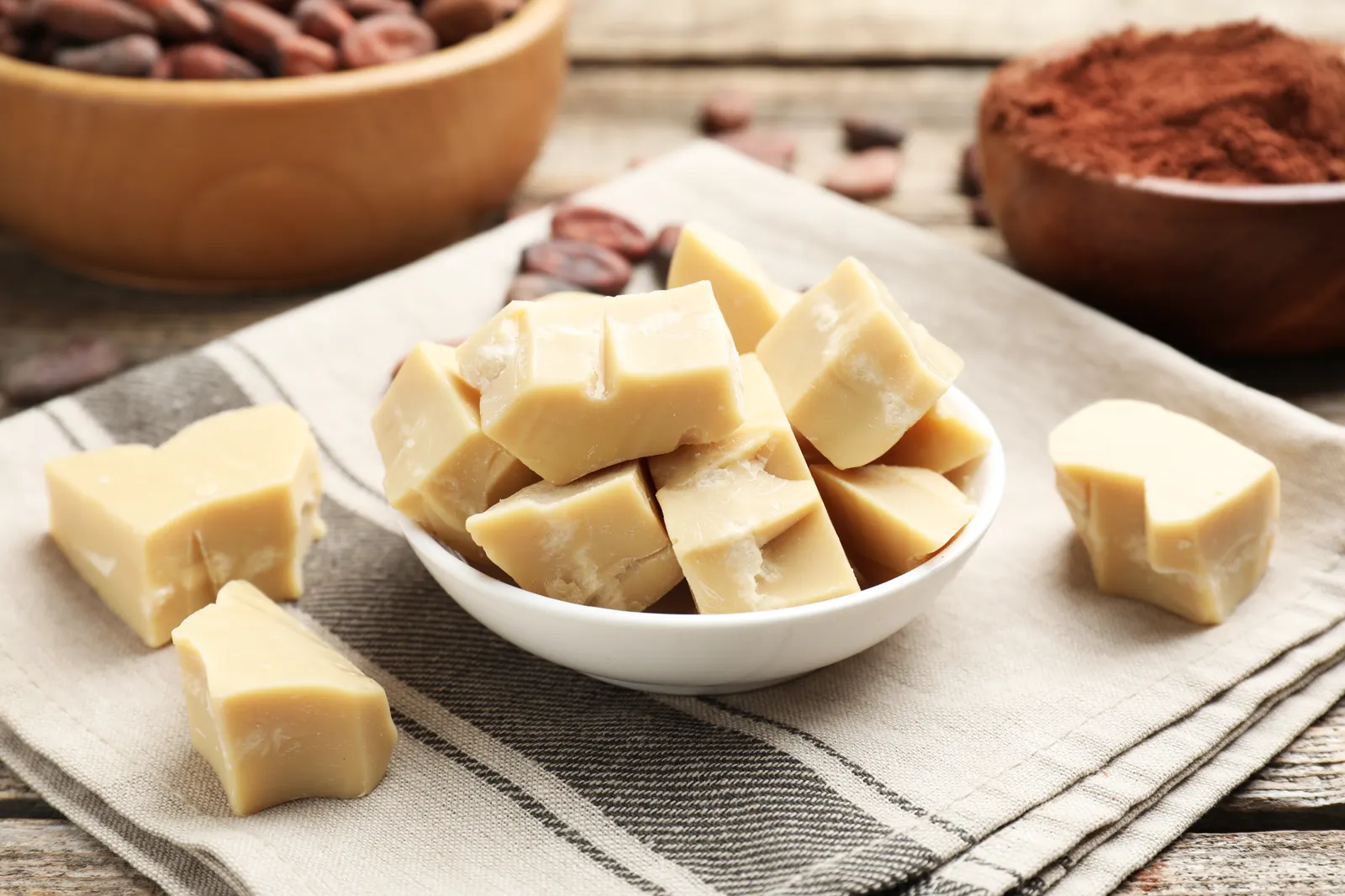
Natural (unrefined) cocoa butter is pale yellow and smells of chocolate; deodorized butter is paler and nearly odorless. Look for 100% cocoa butter (INCI: Theobroma Cacao Seed Butter) — many “cocoa butter” lotions contain it only as a minor ingredient. Food-grade wafers or callets are convenient for weighing. Avoid “cocoa butter substitutes” if you want the real thing. Stored cool and dark, it keeps two years or more.
The research For professionals
The chemistry, the studies and the evidence by concern, for practitioners, formulators and the curious.
Cocoa butter is roughly one-third each of stearic (about 31–37%), oleic (about 32–37%) and palmitic acid (about 24–30%), with only 2–4% linoleic acid. Unusually, most of these fatty acids are arranged in a few symmetrical triglycerides — POP, POS and SOS, with a saturated fatty acid on each end and oleic acid in the middle. This uniform structure explains its sharp melting just below body temperature and its polymorphism: it can crystallize in six forms, of which only one (Form V) gives smooth, glossy chocolate. In cosmetics, slow or uneven cooling produces grainy or bloomed balms; tempering (melting fully, then cooling quickly) prevents it.
With so little polyunsaturated fat, plus tocopherols, cocoa butter is among the most oxidation-resistant natural fats. On skin it acts mainly as an occlusive and emollient, reducing transepidermal water loss and softening rough skin. Natural (undeodorized) cocoa butter retains traces of cocoa polyphenols and methylxanthines, but at levels too low to support antioxidant or “firming” claims.
The stretch-mark evidence is clear and negative. In a double-blind, placebo-controlled trial in Lebanon (Osman and colleagues, 2008), 300 first-time pregnant women applied cocoa butter lotion or a placebo lotion; stretch marks developed at similar rates. A double-blind trial in Jamaica (Buchanan and colleagues, 2010) likewise found no reduction in stretch marks with cocoa butter cream. A Cochrane review of topical preparations for preventing stretch marks in pregnancy (Brennan and colleagues, 2012) found no high-quality evidence that any topical product, cocoa butter included, prevents them.
Key studies
Double-blind, randomized, placebo-controlled trial in 300 first-time pregnant women: cocoa butter lotion did not reduce the development of stretch marks compared with placebo.
Osman H, et al. BJOG. 2008 Read it in the bibliography Find on PubMedDouble-blind randomized trial in Jamaican women: cocoa butter cream applied in pregnancy did not prevent stretch marks compared with placebo.
Buchanan K, Fletcher HM, Reid M. Int J Gynaecol Obstet. 2010 Read it in the bibliography Find on PubMedSystematic review of topical preparations for preventing stretch marks in pregnancy: no high-quality evidence that any topical product, including cocoa butter, prevents them.
Brennan M, Young G, Devane D. Cochrane Database Syst Rev. 2012 Read it in the bibliography Find on PubMed
MythRubbing cocoa butter on your belly prevents stretch marks.
EvidenceTwo double-blind randomized trials found that cocoa butter did not prevent stretch marks, and a Cochrane review found no high-quality evidence for any topical product. Genetics, rapid weight change and hormones drive stretch marks. Cocoa butter can still ease dryness and itch.
In tradition
Cacao was sacred in Mesoamerica, where the Maya and Aztecs drank it as a ceremonial beverage. Cocoa butter later became a household skin and hair balm in the Caribbean, West Africa and Latin America, used on babies, scars, lips and dry hair.
Frequently asked questions
Does cocoa butter prevent stretch marks?
Does cocoa butter fade scars?
Is cocoa butter comedogenic?
Shea butter or cocoa butter: which is better?
Cite this page
Herbs.Beauty. Cocoa Butter (Theobroma cacao L.): evidence-based monograph. Updated 26 November 2026. https://herbs.beauty/ingredients/cocoa-butter.html