The ingredient encyclopedia · herb
Witch Hazel
Hamamelis virginiana · Hamamelidaceae
A cool, crisp swipe of witch hazel makes oily skin feel instantly fresh and tidy.
FR Hamamélis de VirginieES Hamamelis / Avellano de brujaAR بندق الساحرة
- How well proven
- CPromising
- Safety
- Low topical risk
- Sun-sensitive
- No
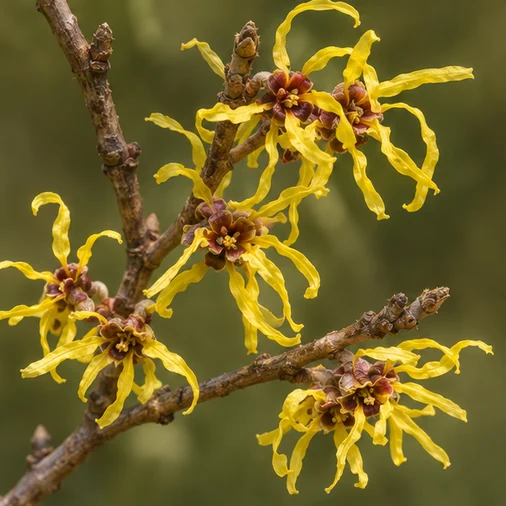
FR Hamamélis de VirginieES Hamamelis / Avellano de brujaAR بندق الساحرة
What the evidence says
Small studies show modest reductions in UV redness and comfort in minor skin irritation, but a randomized trial in eczema found witch hazel cream no better than its vehicle.
- Best supported for
- Acne & Breakouts DOily Skin & Pores D
- How to use it
- Alcohol-free distillate (witch hazel water) · 10–100% of the water phase
- Watch out for
- Check the alcohol.
Checked against 3 cited studies and our safety review · Updated 26 November 2026 · How we grade
Why you’ll love Witch Hazel
Why you’ll love it
- Feels cooling and tightening, like a breath of fresh air
- Takes the edge off redness and razor irritation
- Alcohol-free versions make an easy everyday toner for oily skin
Best forOily or combination skin that loves a fresh, toned feel; not one for dry skin.
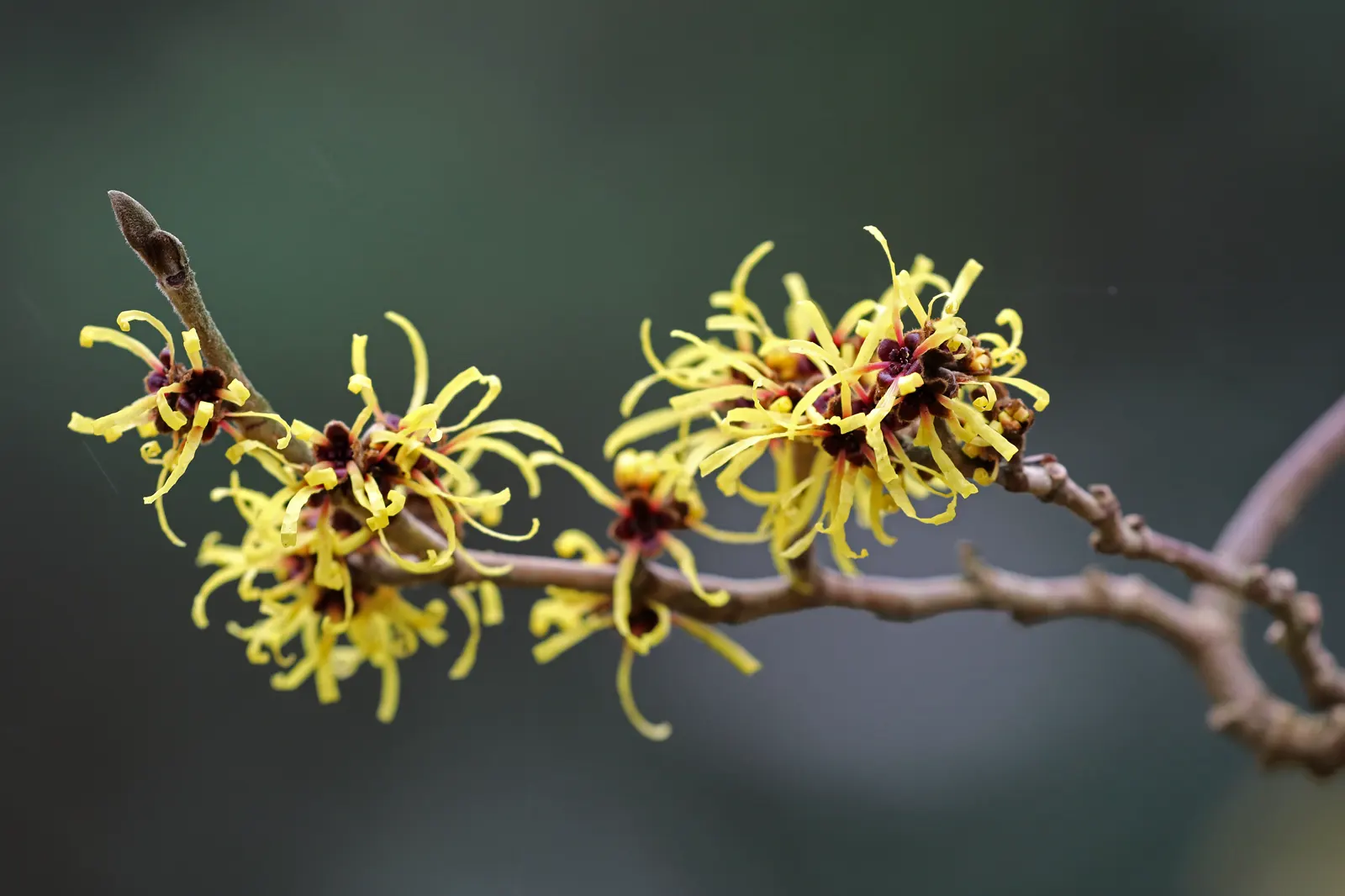
Try it today
A fresh after-shave compress
- Choose an alcohol-free witch hazel water and chill it briefly in the fridge.
- Soak a cotton pad and press it gently onto razor-irritated or oily areas.
- Keep it away from your eyes, and use it no more than once or twice a day.
Good to know: Check the label: many drugstore witch hazels contain about 14% alcohol, which can sting and dry sensitive or eczema-prone skin.
At a glance
| Parts used | Leaves, bark and twigs; steam distillate (“witch hazel water”), tannin-rich water or hydroalcoholic extracts |
|---|---|
| Key actives | Hamamelitannin, Proanthocyanidins (condensed tannins), Gallic acid, Flavonoids, Volatile compounds (in the distillate) |
| INCI names | Hamamelis Virginiana (Witch Hazel) Water Hamamelis Virginiana (Witch Hazel) Leaf Extract Hamamelis Virginiana (Witch Hazel) Bark/Leaf/Twig Extract |
| Skin types | oily, combination, normal |
| Pairs well with | Green TeaAloe VeraDamask RoseCentella Asiatica (Cica) |
| Evidence grade | CPromising Small studies show modest reductions in UV redness and comfort in minor skin irritation, but a randomized trial in eczema found witch hazel cream no better than its vehicle. |
What it does for skin and hair
Feels cooling and tightening
Tannins in extracts precipitate surface proteins and temporarily tighten skin; the alcohol in distillates adds cooling and a degreased feel welcome on oily skin.
Modestly reduces redness
Lotions with 10% witch hazel distillate reduced UV-induced redness in healthy volunteers, though less than hydrocortisone.
Comfort for minor irritation
Witch hazel is approved in the US as an over-the-counter astringent for minor skin irritation and hemorrhoids, and is a traditional European remedy for minor inflammation.
Antioxidant tannins
Hamamelitannin and proanthocyanidins in extracts are strong antioxidants in the lab, with some anti-inflammatory and antiviral activity in cell studies.
How to use it
Start low, be consistent, and give it four to eight weeks. These are the amounts that work in real products and home recipes.
| Form | Typical use level | Notes |
|---|---|---|
| Alcohol-free distillate (witch hazel water) | 10–100% of the water phase | For toners and mists on oily or combination skin. Alcohol-free versions need a broad-spectrum preservative in the bottle and in your formula. |
| Tannin-rich extract (leaf or bark) | 1–5% in toners, gels and creams | This is the genuinely astringent form; higher levels can feel drying. Check compatibility — tannins can darken with iron and precipitate some proteins. |
| Drugstore witch hazel (with ~14% alcohol) | Apply with a pad to oily areas, at most once or twice daily | Avoid on dry, sensitive, eczema-prone or broken skin, and around the eyes. A cooled compress can ease minor itching, insect bites or razor irritation. |
Use it safely
Low topical risk
- Check the alcohol. Many witch hazel products contain about 14% ethanol; frequent use can dry and sting, and worsen eczema or a compromised barrier (The Skin Barrier, Explained).
- Tannin-rich extracts can be drying at high concentration; balance with humectants such as glycerin or aloe vera.
- Allergic contact dermatitis is uncommon but reported. Patch test before use on sensitive skin.
- Do not swallow: tannin-rich preparations can upset the stomach, and the drugstore product contains alcohol.
- Pregnancy & breastfeeding
- Topical witch hazel is considered safe in pregnancy and is commonly used for pregnancy hemorrhoids. Avoid ingesting it. Pregnancy guide
- Phototoxicity
- Not phototoxic at normal use levels.
- Declared fragrance allergens
- None expected
New to an ingredient? Patch test first. Stop and seek advice if you get burning, swelling, blistering or a spreading rash.
Make it at home: recipes with witch hazel
Buying well
Sustainability
Hamamelis virginiana is a common understory shrub of eastern North America, and most commercial material is still harvested from wild and managed stands in the north-eastern US, where it regrows after cutting. It is not threatened. Distillation uses the whole twig, making it a relatively efficient crop.
How to choose quality
Read the INCI list. “Hamamelis Virginiana (Witch Hazel) Water” is the distillate; “Leaf Extract” or “Bark/Leaf/Twig Extract” signals tannins. Look for “alcohol-free” if your skin is dry or sensitive, and check what preservative replaces the alcohol. Store sealed and use within the stated period after opening.
The research For professionals
The chemistry, the studies and the evidence by concern, for practitioners, formulators and the curious.
The chemistry depends entirely on preparation. Leaves and especially bark are rich in tannins — hydrolysable hamamelitannin and condensed proanthocyanidins — plus gallic acid and flavonoids. Water or hydroalcoholic extracts carry these tannins, which bind proteins on the skin surface and in small vessels, producing true astringency. The familiar drugstore product is different: twigs are steam-distilled, and the distillate contains only small amounts of volatile compounds and essentially no tannins. US pharmacopeia-style witch hazel is then mixed with about 14% ethanol as a preservative. Much of its tightening, degreasing feel comes from that alcohol.
Human evidence is modest. In a UV-erythema model, a lotion with 10% witch hazel distillate reduced redness compared with untreated skin (Hughes-Formella, 1998). In a randomized trial in atopic eczema (Korting, 1995), a witch hazel distillate cream was no better than its vehicle, while 0.5% hydrocortisone was clearly better. A large observational study in children with minor skin injuries and irritation found a witch hazel ointment comparable in tolerability and benefit to dexpanthenol (Wolff, 2007), but without randomization. Witch hazel is listed by the European Medicines Agency as a traditional herbal medicine for minor skin inflammation, and is an approved astringent in the US over-the-counter monograph for anorectal products.
For acne, the case is thin: there are no good trials, and alcohol-based toners can irritate the very skin they are meant to calm. Alcohol-free, tannin-containing extracts in a well-formulated toner are the gentler option.
Evidence by concern
| Concern | Grade | What the evidence shows |
|---|---|---|
| Acne & Breakouts | D | Tannins are astringent and anti-inflammatory in vitro; there are no meaningful acne trials, and alcohol-based distillates can irritate. |
| Oily Skin & Pores | D | Tannins give a temporary tightening, matte feel; no good evidence it reduces sebum, and alcohol-containing distillates can irritate. |
Key studies
Randomized trial in atopic eczema: witch hazel distillate cream was not better than its vehicle, whereas 0.5% hydrocortisone cream was superior.
Korting HC, et al. Eur J Clin Pharmacol. 1995 Read it in the bibliography Find on PubMedIn healthy volunteers, a lotion containing 10% witch hazel distillate modestly reduced UV-induced skin redness.
Hughes-Formella BJ, et al. Dermatology. 1998 Read it in the bibliography Find on PubMedObservational study in about 300 children with minor skin injuries, diaper dermatitis or local inflammation: witch hazel ointment was comparable to dexpanthenol for benefit and tolerability.
Wolff HH, Kieser M. Eur J Pediatr. 2007 Read it in the bibliography Find on PubMed
MythWitch hazel shrinks pores and clears acne.
EvidenceIts tightening effect is temporary and pore size is largely genetic. There are no good trials showing witch hazel treats acne, and alcohol-based versions can provoke irritation. Proven options are on the Acne & Breakouts page.
In tradition
Several Indigenous peoples of eastern North America used witch hazel bark decoctions for swellings, sores and aches; settlers adopted it, and distilled “extract” became a staple of American medicine cabinets from the mid-1800s.
From the first-edition dossier
From study to shelf
The difference between a quick astringent sensation and a lasting skin change.
On this page
What the studies found
Korting et al. (1995) PubMed
- Study design
- A 14-day randomized, double-blind, paired study in 72 people with moderately severe atopic eczema compared a hamamelis distillate cream with its own base or 0.5% hydrocortisone.
- Result
- Researchers scored itch, redness and scaling. Hydrocortisone performed better than the distillate cream. The distillate cream showed no advantage over its base.
- Limitations
- This study assessed eczema signs and used a cream. The results do not predict how a cosmetic toner affects visible pores.
Hughes-Formella et al. (1998) PubMed
- Study design
- In 30 healthy volunteers, an experimental UVB test compared an after-sun lotion containing 10% hamamelis distillate with its base and an earlier lotion.
- Result
- The distillate lotion reduced experimentally induced redness more than the other lotions at the measured time points.
- Limitations
- The experiment measured redness after UVB exposure. It did not measure pore size or UV protection. Results depended on the formulation.
Check the exact distillate
Witch hazel water and leaf or bark extracts describe different preparations. The EMA medicinal monograph describes distillates with different ethanol contents. If avoiding ethanol matters to you, check the exact cosmetic and ask the maker about the finished formula when the label leaves it unclear.
EMA · Hamamelis distillate monograph
Checks before you buy
- Check for Hamamelis Virginiana Water and compare it with leaf or bark extract entries.
- Read for ethanol or denatured alcohol and fragrance if these have bothered your skin before. Fatty alcohols such as cetyl alcohol are different ingredients.
- Assess comfort after application. A tight feel alone does not show a long-term benefit.
Questions readers ask
Is witch hazel water always alcohol-free?
Formulations differ. Check the complete ingredient list or ask the manufacturer about the exact product.
Does a traditional-use monograph validate a toner’s pore claims?
Traditional-use monographs cover specific herbal preparations and uses. Pore size is a separate outcome that would require its own measurements.
Compare the preparations
Witch hazel water is a distillate. Leaf and bark extracts are other preparations. Alcohol and fragrance may be present in a toner and can affect how it feels on the skin.
| Preparation | What to check |
|---|---|
| Witch hazel water | Check the plant part or species declared and the manufacturer’s specification. |
| Leaf or bark extract | Check whether the same preparation appears in the study or the formula you are comparing. |
The research
In a 14-day trial in 72 people with moderately severe atopic eczema, witch hazel distillate cream performed similarly to its base cream. Hydrocortisone performed better on the eczema signs measured. The experiment examined eczema and offers no measurement of cosmetic pore size.
Safety and tolerance
If a toner leaves skin stinging or tight, stop and reassess the formula. Persistent eczema warrants a clinician’s advice.
What to look for on the label
Look for “Hamamelis Virginiana (Witch Hazel) Water”, “Leaf Extract” or “Bark Extract”. Read the rest of the label for alcohol and fragrance.
A real label example
United States ·
Thayers Unscented Facial Toner, 12 oz
- Hamamelis Virginiana Bark/Leaf/Twig Extract
- Aloe Barbadensis Leaf Extract
The selected witch hazel entry specifies bark, leaf and twig extract. Match the Unscented toner variant, not a scented toner or the separate mist.
Sources
- Korting et al. (1995) · Controlled eczema study PubMed
- EMA · Witch hazel distillate monograph
- Hughes-Formella et al. (1998) PubMed
- EMA · Hamamelis distillate monograph
Continue reading
First published in the original Herbs.Beauty atlas on 11 November 2026, with its sources as checked on that date.
Frequently asked questions
Is witch hazel bad for your skin?
Does witch hazel help acne?
Can I use witch hazel on my face every day?
What is the difference between witch hazel water and witch hazel extract?
Cite this page
Herbs.Beauty. Witch Hazel (Hamamelis virginiana): evidence-based monograph. Updated 26 November 2026. https://herbs.beauty/ingredients/witch-hazel.html