The ingredient encyclopedia · food
Coffee
Coffea arabica L. (Also Coffea canephora (robusta), which contains roughly twice as much caffeine) · Rubiaceae
Your morning ritual, for your skin: caffeine to de-puff and gourmand grounds for a smoothing body scrub.
FR CaféES CaféAR القهوة (البُنّ)Qahwa (Arabic); bunn, the coffee bean (Arabic, Ethiopian Amharic buna)
- How well proven
- CPromising
- Safety
- Low topical risk
- Sun-sensitive
- No
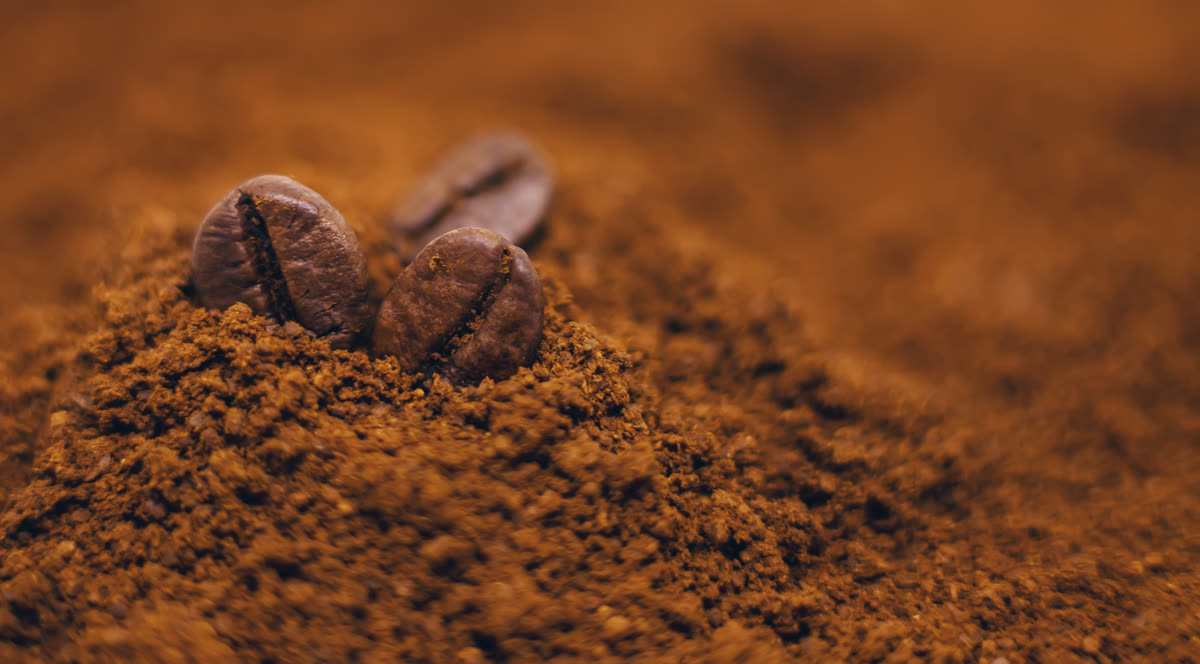
Also known as Coffea arabica L. (Also Coffea canephora (robusta), which contains roughly twice as much caffeine)
FR CaféES CaféAR القهوة (البُنّ)Qahwa (Arabic); bunn, the coffee bean (Arabic, Ethiopian Amharic buna)
What the evidence says
Caffeine penetrates skin well and has plausible mechanisms with small human studies for under-eye and scalp products, but controlled evidence for lasting results — including cellulite — is weak.
- What it does
- Temporarily de-puffs the eye area. Caffeine constricts superficial blood vessels and may reduce fluid puffiness, especially in a chilled gel or roller.
- How to use it
- Caffeine eye gel or serum · 0.5–3% caffeine (warmed or with glycols to stay dissolved above about 2%)
- Watch out for
- Hygiene for used grounds: spent coffee grounds are wet and nutrient-rich — they are literally used to grow mushrooms — and grow mold within days.
Checked against 3 cited studies and our safety review · Updated 26 November 2026 · How we grade
Why you’ll love Coffee
Why you’ll love it
- A chilled caffeine gel briefly de-puffs morning eyes
- An invigorating body scrub that leaves skin feeling smooth
- Gourmand coffee oil makes body balms smell wonderful
Best forPuffy mornings, body exfoliation and coffee lovers; scrubs are not for the face.
Try it today
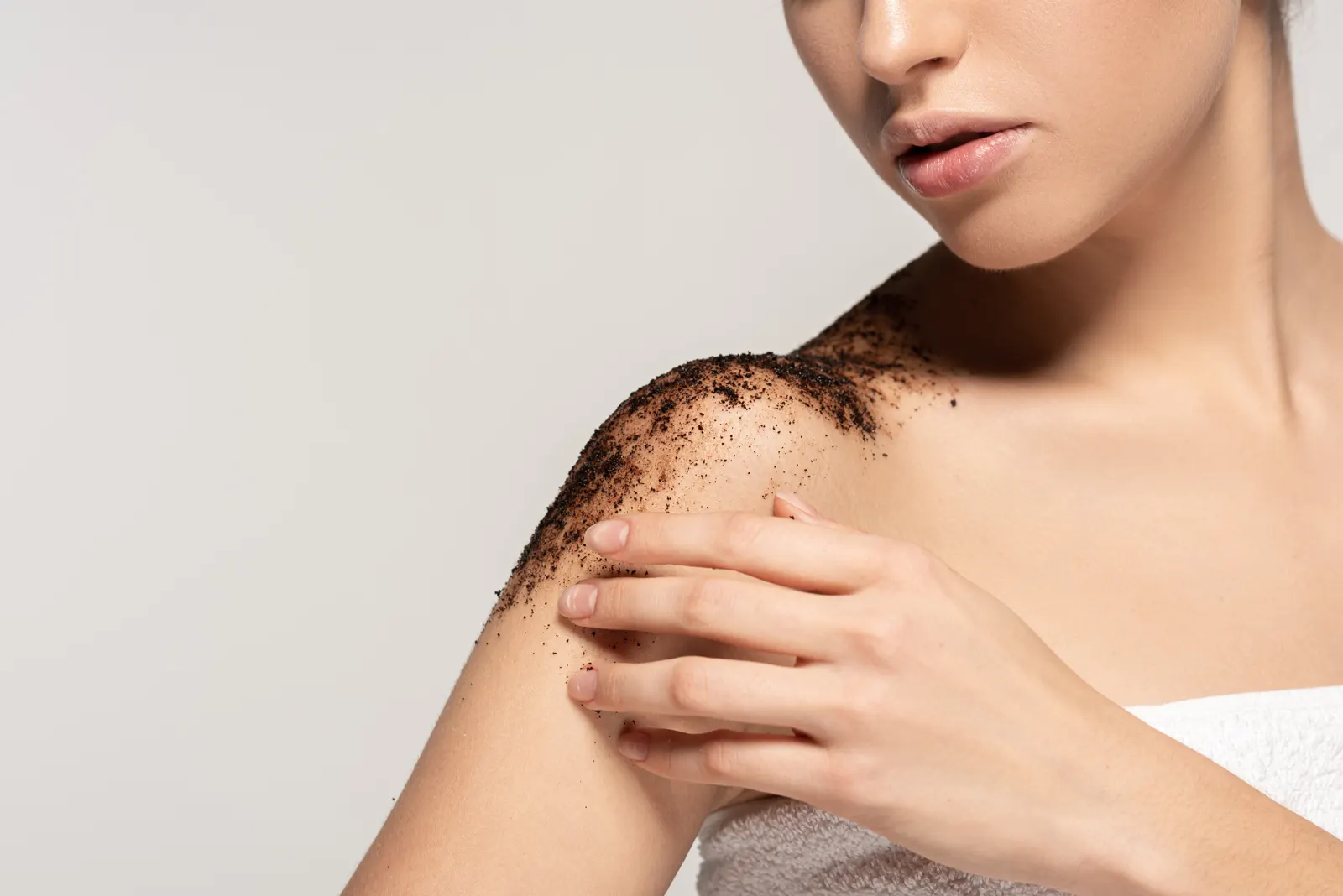
A same-day coffee body scrub
- Mix 1 part finely ground coffee with 1–2 parts oil, such as sweet almond, in a clean bowl.
- Massage gently over damp body skin, avoiding your face, broken skin and freshly shaved areas.
- Wipe excess grounds into the bin, rinse with a drain strainer in place, and discard leftovers.
Good to know: Coffee scrubs feel great but won’t remove cellulite. Watch your step, too: oily scrubs make shower floors slippery.
At a glance
| Parts used | Seeds (“beans”): green or roasted, as oil, extract or ground powder; spent grounds; the coffee cherry fruit (cascara); isolated caffeine |
|---|---|
| Key actives | Caffeine (about 1–1.5% of arabica beans), Chlorogenic acids (high in green beans), Trigonelline, Diterpenes cafestol and kahweol (in the oil), Melanoidins (in roasted coffee) |
| INCI names | Caffeine Coffea Arabica (Coffee) Seed Oil Coffea Arabica (Coffee) Seed Extract Coffea Arabica (Coffee) Seed Powder Coffea Arabica (Coffee) Fruit Extract |
| Skin types | normal, oily, combination, dry |
| Hair & scalp | fine, oily scalp |
| Pairs well with | Green TeaCoconut OilSweet Almond OilCocoa Butter |
| Evidence grade | CPromising Caffeine penetrates skin well and has plausible mechanisms with small human studies for under-eye and scalp products, but controlled evidence for lasting results — including cellulite — is weak. |
What it does for skin and hair
Temporarily de-puffs the eye area
Caffeine constricts superficial blood vessels and may reduce fluid puffiness, especially in a chilled gel or roller. Effects are mild and short-lived, and do not change puffiness caused by fat pads or aging.
An antioxidant-rich ingredient
Coffee extracts, particularly from green beans and coffee cherry, are rich in chlorogenic acids and other polyphenols that are antioxidant in lab tests — a reasonable supporting role in anti-aging formulas.
A satisfying body exfoliant
Coffee grounds in an oil or sugar base make an invigorating body scrub that leaves skin smooth. The smoothness is from exfoliation and oil; any “firming” is temporary.
Scalp care under study
Caffeine stimulated hair follicles in lab studies, and an open-label trial found a caffeine liquid broadly comparable to minoxidil for male pattern hair loss. Evidence is still limited (Thinning Hair & Hair Loss).
How to use it
Start low, be consistent, and give it four to eight weeks. These are the amounts that work in real products and home recipes.
| Form | Typical use level | Notes |
|---|---|---|
| Caffeine eye gel or serum | 0.5–3% caffeine (warmed or with glycols to stay dissolved above about 2%) | Pat a small amount around the orbital bone in the morning; store it in the fridge for extra de-puffing. A chilled green tea compress is a pleasant DIY alternative. |
| Coffee oil in body oils and balms | Green or roasted coffee seed oil: 5–20% of a body oil or balm | Roasted coffee oil adds a gourmand scent; green coffee oil is milder. Blend with cocoa butter or shea butter for a rich body balm. |
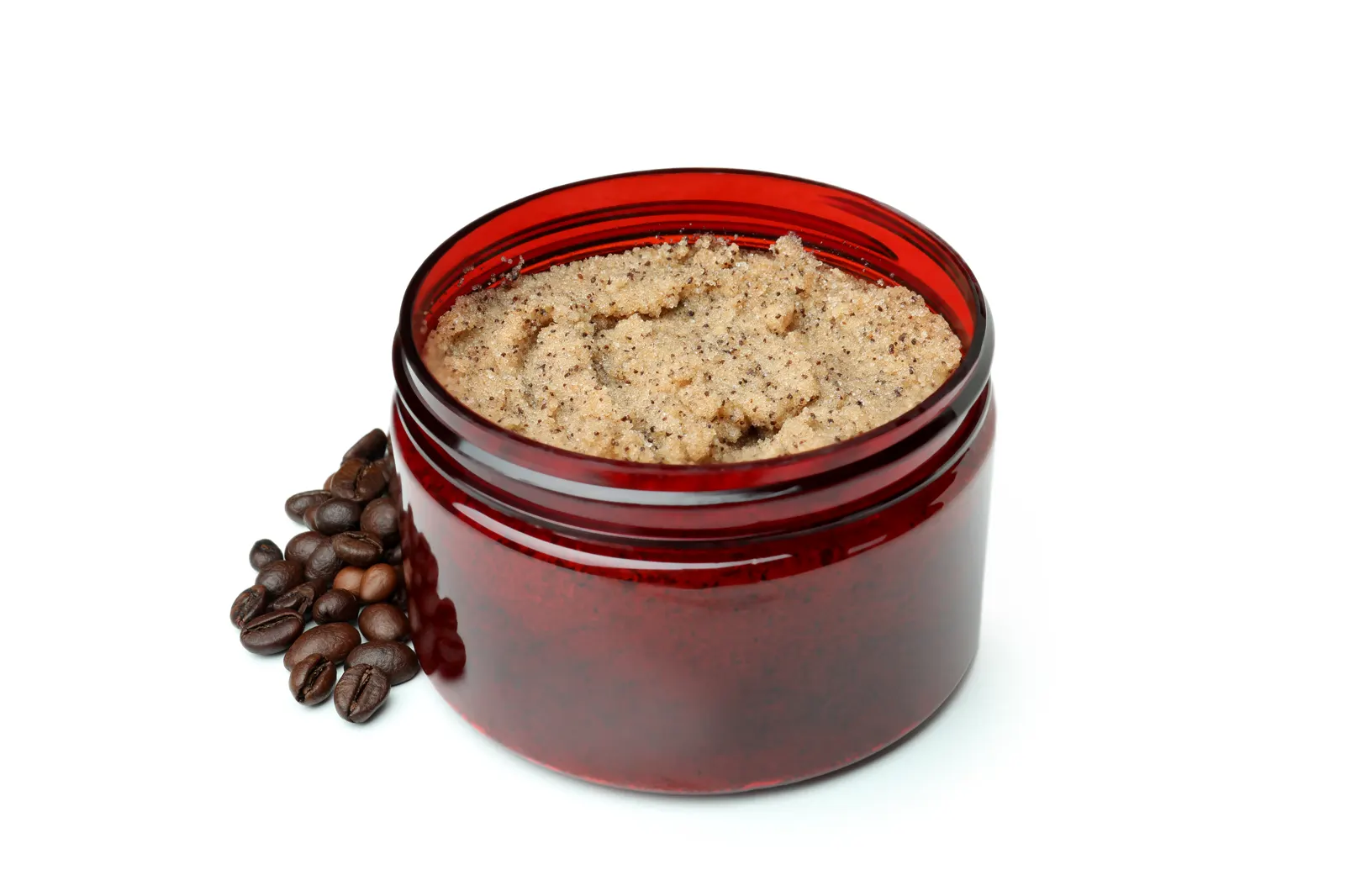
| Coffee body scrub | 1 part finely ground coffee to 1–2 parts oil (e.g. coconut or sweet almond), once or twice a week on the body | Massage gently on damp skin, then rinse. Too harsh for the face. Scoop out with a clean, dry spoon; if water gets in, use it up that day. Wipe off excess grounds into the bin before rinsing, and use a drain strainer. |
Use it safely
Low topical risk
- Hygiene for used grounds: spent coffee grounds are wet and nutrient-rich — they are literally used to grow mushrooms — and grow mold within days. Use them fresh the same day, or spread them thin and dry them completely (a low oven works) before storing in an airtight jar. Discard any batch that smells musty or shows fuzz.
- Drains and showers: coffee grounds do not dissolve and combine with oils to block pipes; oily scrubs also make shower floors slippery and can stain pale grout and towels.
- Do not scrub over broken skin, active acne, sunburn, eczema or freshly shaved areas. Gritty grounds can cause micro-abrasions if used vigorously.
- Topical caffeine is very well tolerated; coffee allergy is rare. Patch test new products (How to Patch Test).
- Pregnancy & breastfeeding
- Topical caffeine and coffee scrubs are considered safe in pregnancy and breastfeeding; skin absorption is small relative to a cup of coffee. Be careful of slippery shower floors. Pregnancy guide
- Phototoxicity
- Not phototoxic at normal use levels.
- Declared fragrance allergens
- None expected
New to an ingredient? Patch test first. Stop and seek advice if you get burning, swelling, blistering or a spreading rash.
Make it at home: recipes with coffee
Buying well
Sustainability
Wild Coffea arabica is assessed as Endangered on the IUCN Red List, and many wild coffee species are threatened by deforestation and climate change, which also threatens farmed coffee in its traditional growing regions. Look for fair-trade or organic certification and shade-grown coffee. Upcycling spent grounds and coffee-cherry pulp keeps valuable material out of landfill — as long as it is dried and handled hygienically (Sustainable & Ethical Botanical Sourcing).
How to choose quality
For de-puffing, look for Caffeine listed in the top half of an eye product’s INCI, ideally in a cooling gel or metal roller. For scrubs, prefer finely ground coffee in an anhydrous (oil or sugar) base with no water. Commercial “upcycled grounds” should be dried, heat-treated and microbially tested; ask the brand. Coffee seed oil should be fresh-smelling and stored cool.
The research For professionals
The chemistry, the studies and the evidence by concern, for practitioners, formulators and the curious.
Coffee beans are the seeds of the coffee cherry. Arabica contains roughly 1–1.5% caffeine (robusta about twice that), along with chlorogenic acids — abundant in green beans and partly broken down by roasting — trigonelline, and in the oil the diterpenes cafestol and kahweol. Roasting creates brown melanoidins and aroma compounds. Green coffee seed oil and roasted coffee oil are both used cosmetically; coffee-cherry extract (from the fruit around the bean) is a newer antioxidant ingredient, often upcycled from coffee processing.
Caffeine is a small, moderately water-soluble molecule (about 2% at room temperature) that crosses the skin readily, partly via hair follicles. It is a methylxanthine: it blocks adenosine receptors and inhibits phosphodiesterase, raising cyclic AMP inside cells. In fat cells in the lab, raised cAMP promotes lipolysis — the rationale for “slimming” creams. In blood vessels, adenosine blockade causes constriction — the rationale for under-eye products. A review by Herman and Herman (Skin Pharmacol Physiol, 2013) sets out these mechanisms and the cosmetic uses built on them.
Cellulite is a structural phenomenon: fat lobules pushing against fibrous bands that tether the skin, more pronounced in women for anatomical reasons. Small studies of caffeine creams report modest reductions in thigh circumference, but most are short, small or uncontrolled, and it is unclear how much caffeine reaches fat tissue. Any visible improvement is likely temporary and partly due to massage and fluid shifts. Coffee scrubs exfoliate and the oil moisturizes, making skin look smoother for a day or so; they do not remove cellulite.
For hair, caffeine counteracted testosterone-induced suppression of hair-follicle growth in organ culture (Fischer, Int J Dermatol, 2007), and an open-label randomized study found a 0.2% caffeine liquid noninferior to 5% minoxidil in men with androgenetic alopecia (Dhurat, Skin Pharmacol Physiol, 2017). That study was unblinded and industry-linked, so minoxidil remains the better-proven choice.
Key studies
Review of caffeine’s mechanisms (adenosine receptor blockade, phosphodiesterase inhibition, antioxidant activity) and cosmetic uses, including anti-cellulite, under-eye and hair-growth products; notes that human evidence is limited.
Herman A, Herman AP. Skin Pharmacol Physiol. 2013 Read it in the bibliography Find on PubMedOrgan culture of human scalp hair follicles from men with androgenetic alopecia: caffeine counteracted testosterone-induced growth suppression. A laboratory study, not a clinical trial.
Fischer TW, et al. Int J Dermatol. 2007 Read it in the bibliography Find on PubMedOpen-label randomized multicenter study in men with androgenetic alopecia: a 0.2% caffeine liquid was noninferior to 5% minoxidil solution over six months. Not blinded or placebo-controlled.
Dhurat R, et al. Skin Pharmacol Physiol. 2017 Read it in the bibliography Find on PubMed
MythCoffee scrubs get rid of cellulite.
EvidenceCellulite comes from the structure of fat and connective tissue under the skin. A coffee scrub exfoliates and the oil moisturizes, so skin looks smoother for a day, and the massage may briefly shift fluid. Caffeine creams show at best small, temporary changes in studies. No scrub removes cellulite.
In tradition
Coffee comes from the highlands of Ethiopia, where the coffee ceremony is a central act of hospitality, and was first cultivated and brewed on a large scale in Yemen, from whose port of Mocha it spread throughout the Arab world and the Ottoman Empire. The Arabic qahwa gave its name to coffee in most of the world’s languages.
Frequently asked questions
Does caffeine eye cream really work for puffy eyes?
Do coffee scrubs help cellulite?
Is it safe to use used coffee grounds on your skin?
Can coffee grounds clog the shower drain?
Cite this page
Herbs.Beauty. Coffee (Coffea arabica L.): evidence-based monograph. Updated 26 November 2026. https://herbs.beauty/ingredients/coffee.html