The ingredient encyclopedia · oil
Camellia Oil (Tsubaki Oil)
Camellia japonica L.; Camellia oleifera C.Abel (Tsubaki oil (C. japonica); tea-seed oil or tea-oil camellia (C. oleifera) — distinct from tea-tree oil and from green-tea seed oil, C. sinensis) · Theaceae
The silky secret of Japanese hair care for centuries: a few drops for glossy, smooth lengths.
FR Huile de camélia (huile de tsubaki)ES Aceite de camelia (aceite de tsubaki)AR زيت الكاميلياTsubaki-abura 椿油 (Japanese); dongbaek-gireum 동백기름 (Korean); cháyóu 茶油 (Chinese, C. oleifera)
- How well proven
- CPromising
- Safety
- Low topical risk
- Sun-sensitive
- No
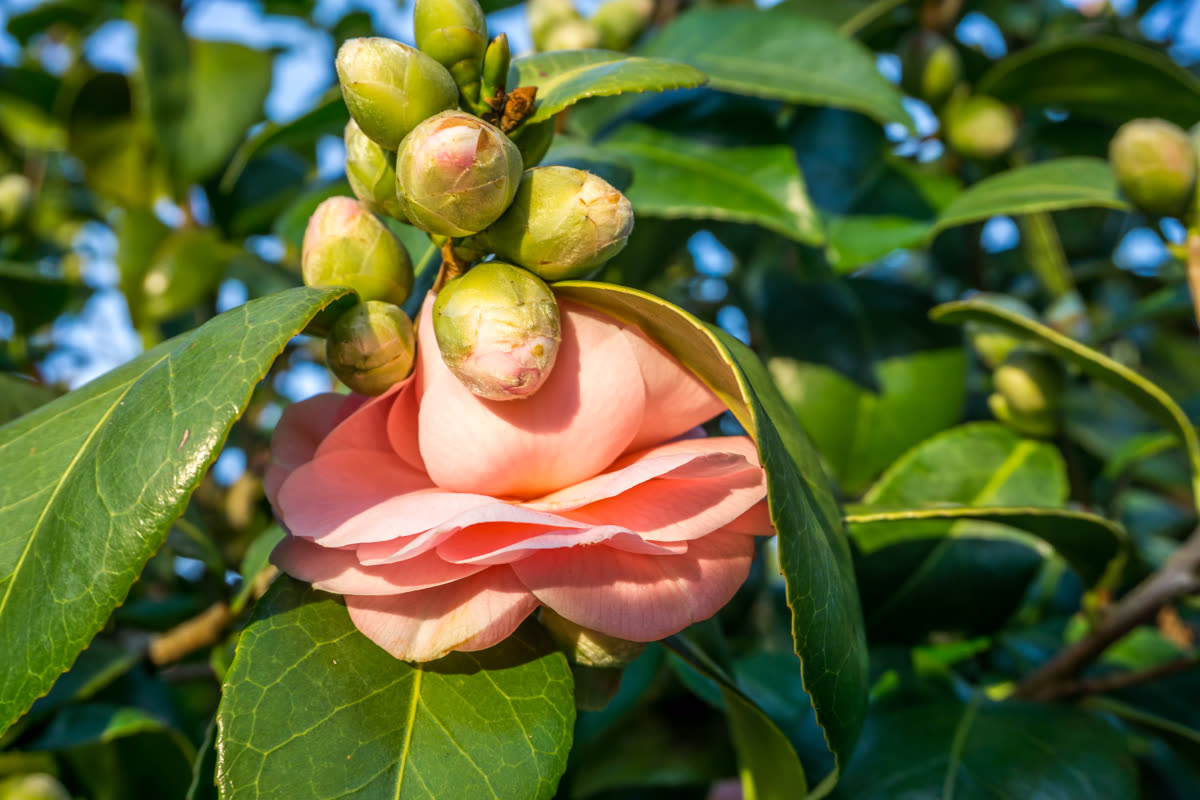
Also known as Camellia japonica L.; Camellia oleifera C.Abel (Tsubaki oil (C. japonica); tea-seed oil or tea-oil camellia (C. oleifera) — distinct from tea-tree oil and from green-tea seed oil, C. sinensis)
FR Huile de camélia (huile de tsubaki)ES Aceite de camelia (aceite de tsubaki)AR زيت الكاميلياTsubaki-abura 椿油 (Japanese); dongbaek-gireum 동백기름 (Korean); cháyóu 茶油 (Chinese, C. oleifera)
What the evidence says
The grade rests on its well-characterized composition and the established behavior of oleic-rich oils as emollients and hair lubricants; clinical studies of camellia oil itself are scarce.
- What it does
- Smooth, glossy hair with less friction. A few drops coat the hair cuticle, reduce combing friction and frizz, and add shine without the heaviness of thicker oils.
- How to use it
- Hair finishing oil · 1–3 drops for short or fine hair; up to 5–6 drops for long, thick or curly hair
- Watch out for
- Allergy is rare.
Checked against 2 cited studies and our safety review · Updated 26 November 2026 · How we grade
Why you’ll love Camellia Oil (Tsubaki Oil)
Why you’ll love it
- Glossier, smoother hair with less frizz and friction
- Silky and fast-absorbing on dry or mature skin
- Stays fresh for a long time in the bathroom cabinet
Best forDry or frizzy hair, dry and mature skin, and gentle cleansing oils.
Try it today
The tsubaki finishing touch
- Warm 1–3 drops of camellia oil between your palms, a few more for long, thick or curly hair.
- Smooth it over the mid-lengths and ends of damp or dry hair, avoiding the roots.
- Start small and add more only if needed; too much looks greasy.
Good to know: Dandruff-prone? Keep oils off your scalp. And don’t confuse it with tea-tree oil: look for Camellia japonica or Camellia oleifera.
At a glance
| Parts used | Seed kernels, cold-pressed or expeller-pressed and usually filtered or refined; flower and leaf extracts are separate ingredients |
|---|---|
| Key actives | Oleic acid (roughly 75–85%), Palmitic acid, Linoleic acid (low, about 5–10%), Tocopherols, Phytosterols and triterpene alcohols, Small amounts of squalene |
| INCI names | Camellia Japonica Seed Oil Camellia Oleifera Seed Oil Camellia Japonica Flower Extract |
| Skin types | dry, normal, mature |
| Hair & scalp | thick, curly, color treated, dry scalp |
| Pairs well with | Rice BranArgan OilSqualaneJojoba |
| Evidence grade | CPromising The grade rests on its well-characterized composition and the established behavior of oleic-rich oils as emollients and hair lubricants; clinical studies of camellia oil itself are scarce. |
What it does for skin and hair
Smooth, glossy hair with less friction
A few drops coat the hair cuticle, reduce combing friction and frizz, and add shine without the heaviness of thicker oils. That is why tsubaki oil has been the finishing oil of Japanese hair care for centuries — see Dry, Damaged & Frizzy Hair.
A stable, silky emollient for dry skin
Its high oleic acid and low polyunsaturated fat content make it fluid, fast-absorbing and slow to oxidize. It softens dry and mature skin and makes a good base for facial oils and balms.
A long-lasting carrier oil
Because it oxidizes slowly, camellia oil keeps well and suits carrier blends and cleansing oils. Compare it with other bases in our Carrier Oils: The Formulator’s Guide.
How to use it
Start low, be consistent, and give it four to eight weeks. These are the amounts that work in real products and home recipes.
| Form | Typical use level | Notes |
|---|---|---|
| Hair finishing oil | 1–3 drops for short or fine hair; up to 5–6 drops for long, thick or curly hair | Warm between the palms and smooth over the mid-lengths and ends of damp or dry hair. Use less than you think — excess looks greasy, especially on fine hair. |
| Pre-wash hair and scalp treatment | 1–2 teaspoons (5–10 mL), 20–60 minutes before shampooing | Massage into lengths (and scalp if dry) before washing. If you are dandruff-prone, keep oils off the scalp: oleic acid can provoke flaking in people sensitive to Malassezia (Dandruff & Itchy Scalp). |
| Face oil or cleansing-oil base | 10–100% of a face oil; 50–80% of a self-emulsifying cleansing oil | Press 2–3 drops onto damp skin after a moisturizer, or blend with a linoleic-rich oil for barrier-compromised skin. In cleansing oils it pairs well with rice bran oil, the other classic Japanese base. |
Use it safely
Low topical risk
- Allergy is rare. Patch test, especially on reactive skin (How to Patch Test).
- High-oleic oils may weaken an already damaged barrier when used heavily; people with atopic or eczema-prone skin may prefer a linoleic-rich oil or a blend.
- As with any oil, heavy use on the scalp can worsen dandruff in susceptible people, and oily products on the face can contribute to breakouts in acne-prone skin.
- Unrefined, food-grade “tea-seed oil” from China is a cooking oil; choose a cosmetic grade with a recent production date for skin and hair.
- Pregnancy & breastfeeding
- Considered safe to use on skin and hair during pregnancy and breastfeeding. Pregnancy guide
- Phototoxicity
- Not phototoxic at normal use levels.
- Declared fragrance allergens
- None expected
New to an ingredient? Patch test first. Stop and seek advice if you get burning, swelling, blistering or a spreading rash.
Buying well
Sustainability
Camellia oleifera is grown on millions of hectares in southern China, mainly as a cooking-oil crop, so cosmetic demand is a by-product of an established agriculture. Japanese tsubaki oil comes from smaller, often hand-gathered harvests on islands such as Izu Ōshima and the Gotō archipelago, where seed collection from windbreak and village camellias is a local heritage industry. Neither species is threatened in cultivation; ask about origin, as cheap “camellia oil” blends are sometimes diluted with other oils.
How to choose quality
Check the INCI: Camellia Japonica Seed Oil for tsubaki, Camellia Oleifera Seed Oil for Chinese tea-seed oil — both are fine. Cold-pressed oils are pale gold with little smell; refined oils are nearly colorless and odorless. Avoid confusing it with tea-tree oil or with Camellia sinensis (green tea) seed oil. Stored cool and dark, it keeps well for 18–24 months.
The research For professionals
The chemistry, the studies and the evidence by concern, for practitioners, formulators and the curious.
Camellia seed oils are dominated by oleic acid, a monounsaturated fatty acid, typically in the range of about 75–85%, with some palmitic acid and only small amounts of polyunsaturated linoleic acid. In that respect they resemble a lighter olive oil or high-oleic sunflower oil. They also carry tocopherols, phytosterols and triterpene alcohols. Unrefined oil from the seed press can contain saponins and bitter compounds; the seed cake left after pressing is rich in tea saponins, which is why it was traditionally used as a natural soap for washing hair and clothes in parts of China. Cosmetic oils are filtered or refined so these are largely removed.
On hair, long-chain triglyceride oils such as camellia mainly coat the cuticle surface: they lower friction between fibers, help seal down lifted cuticle edges, reduce static and frizz and increase shine. A study by Rele and Mohile (J Cosmet Sci, 2003) showed that coconut oil, with its small, saturated lauric-acid triglycerides, penetrates the hair cortex and reduces protein loss, while mineral oil and sunflower oil did not; camellia’s longer, unsaturated chains are expected to behave more like the latter. So camellia is best used as a finishing or pre-wash conditioning oil rather than an internal “repair” — see Hair Science for Natural Hair Care.
On skin, camellia oil is an emollient: it fills gaps between surface cells and leaves a light lipid film. High-oleic oils have one caveat. In a small study, Danby and colleagues (Pediatr Dermatol, 2013) found that topical olive oil disrupted the skin barrier in adult volunteers, whereas sunflower oil did not, a difference attributed partly to oleic acid. Pure oleic acid is used experimentally as a penetration enhancer for the same reason. People with very dry, atopic or barrier-damaged skin may therefore do better with a linoleic-rich oil or a balanced blend.
Lab studies of camellia leaf, flower and seed extracts report antioxidant and anti-inflammatory activity, but there is little human research on the oil itself. Its value is real but ordinary: a stable, elegant, traditional oil, not a treatment.
Key studies
Laboratory study on hair: coconut oil reduced protein loss from damaged and undamaged hair and penetrated the fiber, while mineral oil and sunflower oil did not. Not camellia-specific, but explains why long-chain oils such as camellia act mainly as surface conditioners.
Rele AS, Mohile RB. J Cosmet Sci. 2003 Read it in the bibliography Find on PubMedIn adult volunteers, four weeks of topical olive oil damaged skin-barrier integrity and caused mild redness, whereas sunflower oil preserved it. Relevant to other high-oleic oils such as camellia, which have not been tested directly.
Danby SG, et al. Pediatr Dermatol. 2013 Read it in the bibliography Find on PubMed
MythCamellia oil penetrates and repairs damaged hair from the inside.
EvidenceLong-chain oils like camellia mostly sit on the surface, where they smooth the cuticle and reduce friction — which is genuinely useful. Penetration into the hair cortex has been shown mainly for coconut oil. Damaged hair cannot be “repaired”, only protected and made to look and behave better.
In tradition
In Japan, tsubaki oil has been combed through long hair for centuries and remained the oil of geisha and traditional nihongami hairstyles and of the pomades used to set sumo wrestlers’ topknots. In Korea, dongbaek oil was likewise the classic oil for smoothing braided and chignon hairstyles.
Frequently asked questions
Is camellia oil good for hair?
Is camellia oil the same as tea tree oil or green tea oil?
Does camellia oil clog pores?
What is the difference between tsubaki oil and camellia oleifera oil?
Cite this page
Herbs.Beauty. Camellia Oil (Tsubaki Oil) (Camellia japonica L.; Camellia oleifera C.Abel): evidence-based monograph. Updated 26 November 2026. https://herbs.beauty/ingredients/camellia-oil.html