Hair care · Make it at home
Pure Henna Hair Color
How to dye hair with body-art-quality henna: dye release, strand and patch tests, gray coverage, the indigo two-step, and why to avoid “black henna”.
- Time
- 4–12 h dye release, then 2–4 h on hair
- Level
- Intermediate
- Makes
- 300 g
- Type
- Fresh · single use
- Keeps
- Single use — mix for one application and discard leftover paste
What you need
- Body-art-quality henna powder
- Lukewarm water
- Fresh lemon juice
Formula
| Phase | Ingredient | % | Grams |
|---|---|---|---|
| A | Body-art-quality (BAQ) henna powder, pure Lawsonia inermis leaf100 g for shoulder-length hair; finely sifted, recent harvest, nothing else listed | 33 | 99.00 |
| A | Lukewarm waterAbout 170 g; adjust for a thick-yogurt consistency | 57 | 171.00 |
| A | Fresh lemon juice, strained (or diluted apple cider vinegar)Mild acid aids dye release; use water only if your scalp is sensitive | 10 | 30.00 |
| Total | 100.0 | 300.00 |
Weigh everything on a 0.01 g scale; volume measures are not accurate enough for actives or preservatives. Open in the formula & cost calculator.
Equipment
- Digital scale (1 g)
- Glass, ceramic or plastic bowl (not metal)
- Spatula
- Plastic wrap
- Nitrile gloves
- Applicator brush or bottle
- Hair clips
- Shower cap
- Barrier balm for hairline and ears
- Old towels and clothes
- For the two-step: pure indigo powder (Indigofera tinctoria) and a second bowl
Method
- Choose the right product: body-art-quality henna listing only Lawsonia inermis. Never use “black henna” or any henna promising black, brown or blonde in one step — these contain other dyes or metallic salts (see safety).
- Test a week ahead. Patch test as in our guide: dab a little mixed paste behind the ear or inside the elbow twice daily for 7 days and read it at 48 and 96 hours. Strand test: dye hair from your brush (or a hidden snip) for the full time to preview the color — essential on gray, light, bleached or chemically colored hair.
- Mix: whisk the henna with the lemon juice and enough lukewarm water to make a smooth, thick-yogurt paste. Press plastic wrap onto the surface.
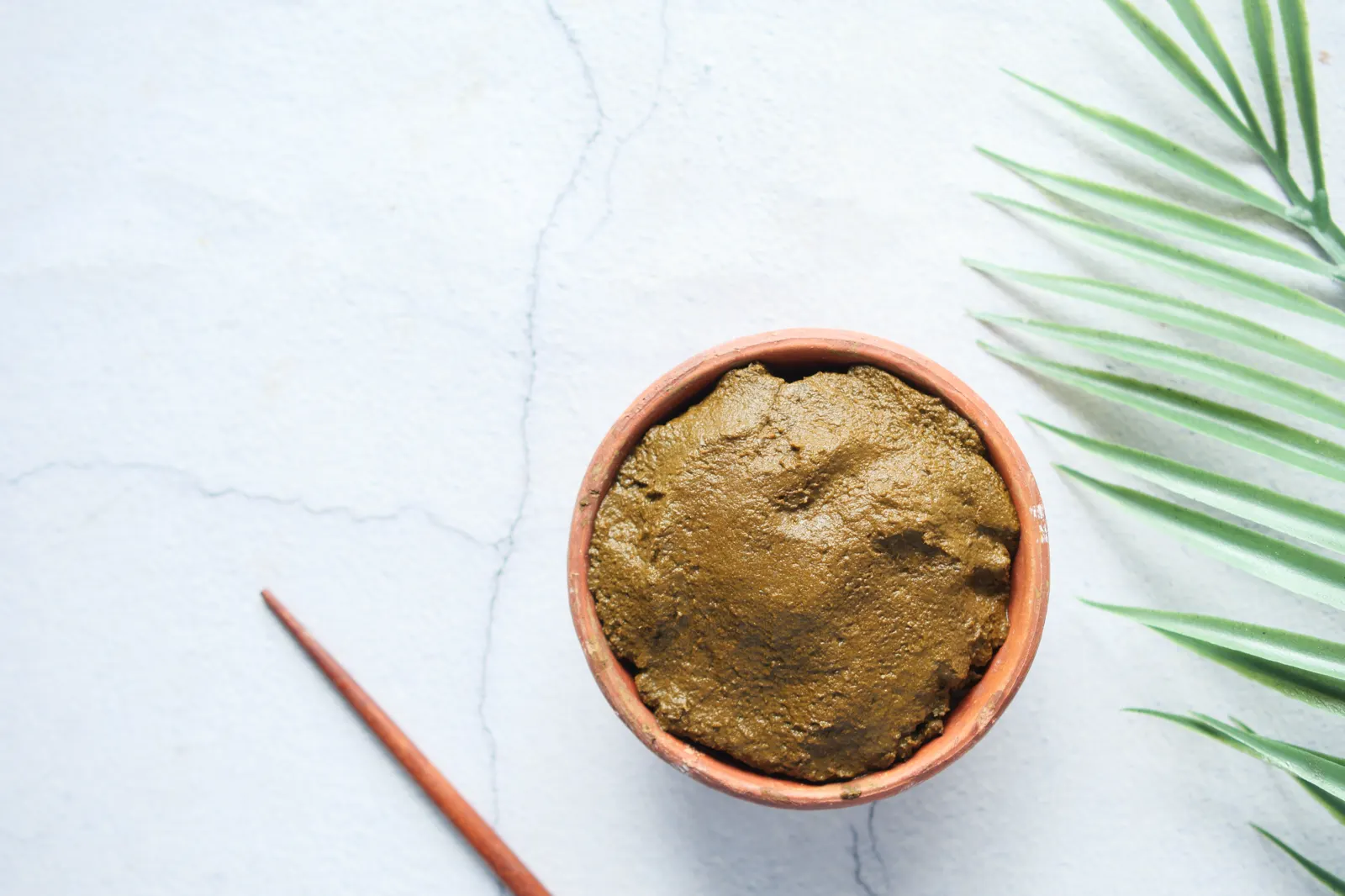
- Dye release: leave at warm room temperature (about 22–26 °C) for 4–12 hours; good BAQ henna often releases in 4–6 hours, and cooler rooms take longer. It is ready when the surface has darkened to brown and a dab on your palm leaves a strong orange stain within a few minutes. Don’t wait for days — the dye then fades.
- Prepare: start with clean, detangled, dry or damp hair without conditioner or oil. Apply barrier balm along the hairline and ears; wear gloves and old clothing.
- Apply in 2–3 cm sections from root to tip, layering the paste thickly and smoothing it down. Pile the hair up and cover with plastic wrap or a shower cap to keep the paste moist and warm.
- Leave 2–4 hours (longer gives deeper color, especially on gray).
- Rinse with plenty of water until it runs clear; a conditioner wash helps remove grit. Skip shampoo for 24–48 hours. The color oxidizes from bright orange to deeper copper-red over 2–3 days.
- Indigo two-step for brown to black: the next day, mix indigo powder with lukewarm water (no acid) to the same consistency and apply immediately — indigo releases its dye within about 15 minutes and loses it within hours. Leave 1–2 hours and rinse with water only.
- Discard leftover paste. For upkeep, apply henna only to new root growth every 4–8 weeks to avoid over-dark ends.
Why it works
Henna leaves contain lawsone (2-hydroxy-1,4‑naphthoquinone), released when the crushed leaf is moistened in a mildly acidic paste. Lawsone binds to keratin on the hair’s surface, giving a translucent red-orange that does not wash out and has to grow out. Because it layers over your own color, results depend on your base: gray or white hair turns bright orange-copper after one application and deepens with repeats; dark hair gains a red-auburn sheen. Henna cannot lighten hair. Adding indigo over henna (two-step) gives brown to near-black, depending on the number of applications.
Safety notes
- Never use “black henna.” Products sold for instant black temporary tattoos or one-step black hair often contain high levels of para-phenylenediamine (PPD), which can cause severe allergic reactions, blistering and scarring, and lifelong sensitization to hair dyes, some textile dyes and some local anesthetics.
- Avoid compound henna containing metallic salts (for example lead, copper or silver compounds): it reacts with peroxide, bleach and permanent dyes and can heat up, smell, discolor and break hair. If you are unsure what is on your hair, soak a few strands in 6% (20-volume) hydrogen peroxide with a few drops of ammonia for 30 minutes; bubbling, warmth, odor or discoloration suggests metallic salts.
- Henna and chemical colors, relaxers or perms can interact unpredictably — always strand test and tell your colorist you use henna.
- G6PD deficiency: henna can trigger hemolysis in people with G6PD deficiency, especially babies and young children. Do not use henna on infants.
- Patch test even with pure henna; true henna allergy is rare but does occur (How to Patch Test). In pregnancy, pure henna has a long traditional record, but avoid any product whose composition you cannot verify.
- Henna stains skin, nails, grout and fabric for days — gloves and old towels are essential.
Read DIY safety & preservation before making water-based products.
Variations
- Cooler red: replace up to 30% of the henna with amla (Indian gooseberry) powder; henna users report cooler, less brassy tones.
- One-step brown: mix henna and indigo (for example 1:1) just before applying. It is quicker, but gray coverage is less even than with the two-step.
- Gloss without red: cassia (Senna italica, sold as “neutral henna”) conditions with only a faint golden tint on light hair.
Featured ingredients
Formulator
Selling what you make? Get the batch record, label template and cost sheet for this formula, plus a regulatory checklist for the EU, UK and US.
See Formulator membership