Head to head
Bakuchiol versus Retinol
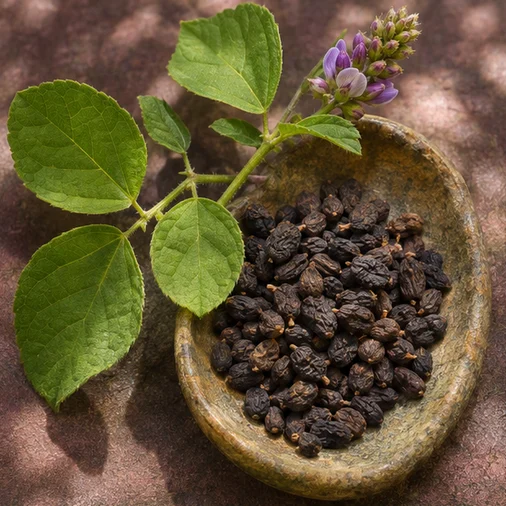 vsRetinolLaboratory active
The verdict
Retinol has decades of evidence behind it and remains the better-proven choice if your skin tolerates it and you are not pregnant or trying to conceive. Bakuchiol matched 0.5% retinol in one small, well-designed 12-week trial with less irritation, so it is a reasonable choice for sensitive skin or for anyone who has given retinoids a fair try and could not get on with them. Neither replaces daily sunscreen.
| Attribute | Bakuchiol | Retinol |
|---|---|---|
| Evidence grade | B — one double-blind RCT (44 people, 12 weeks) plus an earlier open-label study | A for retinoids as a class; retinol itself has several controlled trials in photoaged and naturally aged skin |
| What it is | A meroterpene phenol from babchi seed; not a retinoid and does not bind retinoic acid receptors directly | Vitamin A alcohol; converted in skin to retinaldehyde, then retinoic acid, which acts on nuclear receptors |
| What it does | Small reductions in fine lines and uneven pigmentation; antioxidant; retinol-like gene-expression changes in lab work | Increases epidermal turnover and collagen production over months; improves fine lines, roughness, mottled pigment and comedones |
| Best for | Sensitive or reactive skin, beginners, people who could not tolerate retinoids | Photoaging and fine lines in skin that tolerates it; a step toward prescription tretinoin |
| Typical use level | 0.5–1%, morning and/or night | 0.1–1% in older products; EU now caps face products at 0.3% retinol equivalent (0.05% in body lotions) |
| Irritation | Low; occasional irritation or allergic contact dermatitis | Common at first: dryness, scaling, stinging (“retinization”), usually easing over 2–6 weeks |
| Pregnancy and breastfeeding | Not a retinoid, but no safety studies in pregnancy; “no data” is the honest answer — ask your clinician | Avoid while pregnant, trying to conceive or breastfeeding unless a doctor advises otherwise (oral retinoids cause birth defects; topical use is avoided as a precaution) |
| Sun sensitivity | Photostable; not photosensitizing in normal cosmetic grades | Degrades in light; use at night. Skin can be more sun-prone during use, so daily SPF is essential |
| Cost | Mid to high; raw material is costly | Wide range; effective drugstore options exist |
Choose Bakuchiol if
Choose bakuchiol if your skin is sensitive or reactive, you have tried retinoids patiently and could not tolerate them, or you want a gentle first step for fine lines and uneven tone. Expect modest, gradual change over about three months.
Choose Retinol if
Choose retinol if you want the option with the deepest evidence for fine lines, texture and sun damage, your skin can adapt, and you are not pregnant, trying to conceive or breastfeeding. Start low and slow, use it at night, and wear SPF every day.
The trial everyone quotes
The key study is Dhaliwal and colleagues, published in the British Journal of Dermatology in 2019. Forty-four adults with facial photoaging were randomized, double-blind, to 0.5% bakuchiol cream twice daily or 0.5% retinol cream once daily for 12 weeks. Both groups saw significant reductions in wrinkle surface area and hyperpigmentation, with no statistically significant difference between them. People using retinol reported more facial scaling and stinging.
That is a genuinely useful result, but it has limits worth stating plainly. The trial was small and short. The dosing was not equal (bakuchiol twice a day, retinol once). There was no placebo group, so we cannot say how much of the improvement in either arm came from simply moisturizing and photographing skin carefully for three months. And 0.5% retinol is only one point on a dose range. So the fair reading is “comparable to one retinol concentration in one small study,” not “proven equivalent to retinol.”
Why retinol is still the benchmark
Retinoids are the best-studied topical anti-aging actives in dermatology. Prescription tretinoin (retinoic acid) has been tested in many randomized trials since the 1980s, and it reliably improves fine wrinkles, roughness and mottled pigmentation, with biopsy evidence of new collagen. Retinol is weaker because it needs converting to retinoic acid, but controlled trials in sun-damaged and naturally aged skin show similar effects over months.
The trade-off is tolerability. Many people get a few weeks of dryness, flaking and stinging when they start. Introducing it slowly (two or three nights a week, a pea-sized amount, moisturizer on top) usually solves this. Encapsulated and slow-release formulas help too.
One regulatory change matters in 2026. EU rules (Regulation 2024/996) cap vitamin A in cosmetics at 0.3% retinol equivalent in face and hand products and 0.05% in body lotions, phased in from November 2025. Higher-strength products sold elsewhere are not automatically better: most of the benefit is available at lower, better-tolerated doses used consistently.
What bakuchiol actually is (and is not)
Bakuchiol is a single purified compound. Lab work, including a 2014 study by Chaudhuri and Bojanowski in the International Journal of Cosmetic Science, showed it switches on some of the same genes as retinol in skin models, which is where the “plant retinol” label comes from. But it is structurally unrelated to vitamin A and does not appear to work through the retinoic acid receptors in the same way.
One safety point is easy to miss. Bakuchiol is extracted from babchi seed, which also contains psoralens, potent phototoxic compounds. Cosmetic-grade bakuchiol is purified to remove them. Raw babchi seed oil or whole-seed extracts are not substitutes and can cause severe sunlight-triggered burns and pigment changes. See the full bakuchiol monograph.
Pregnancy: the honest version
Oral retinoids such as isotretinoin cause serious birth defects. Topical retinoids are absorbed far less, but dermatologists and obstetricians advise avoiding them during pregnancy and while trying to conceive because the stakes are high and safety data are thin. That includes retinol, retinyl esters and retinaldehyde.
Bakuchiol is widely marketed as the pregnancy-safe alternative. It is not a retinoid, and topical absorption is likely low, but there are no studies of it in pregnancy or breastfeeding. If you want a well-studied option in pregnancy, azelaic acid and daily sunscreen have better-documented safety. Our Skincare in Pregnancy & Breastfeeding guide covers this in detail.
Starting either one without irritation
Whichever you choose, introduce one new active at a time and give it at least 12 weeks before judging. Photograph your skin in the same window light every month; small changes are easy to miss in the mirror.
- Retinol: begin with a low strength (around 0.1–0.3%) two or three nights a week, applied to dry skin after cleansing. Use a pea-sized amount for the whole face and keep it away from the corners of the nose, the eyelids and the lips. Increase frequency only as your skin settles. If you get dry, apply a plain moisturizer before or after it (“buffering”).
- Bakuchiol: most products are designed for once or twice daily use, morning or night. Because it is photostable, it can go under sunscreen in the morning.
- Avoid stacking irritants in the early weeks: strong exfoliating acids, scrubs and benzoyl peroxide on the same nights as retinol can tip skin into irritation.
- Wear sunscreen every day, whatever you choose. Most visible photoaging is UV damage, and no night-time active can keep up with daily unprotected exposure. See Sun Care & After-Sun.
If you have moderate acne, significant sun damage or melasma, a dermatologist can prescribe tretinoin, adapalene or other treatments that go beyond what either cosmetic ingredient can do. Build a Routine That Works (Minimal & Evidence-Based) shows how to fit actives into a simple routine.
Using them together
Yes; they are compatible, and some products already combine them, although there is little clinical data on the pairing itself. A simple approach: bakuchiol in the morning under sunscreen, retinol two to four nights a week. If your skin becomes red or sore, drop back to bakuchiol alone and see Aging & Photoaging for a full routine.