· Morning · 3 min
The Two-Finger Sunscreen Rule (and When to Reapply)
Most of us apply a fraction of the sunscreen tested on the label. The two-finger rule fixes the dose for face and neck; here is how to reapply, too.
- Time
- 3 min
- Evidence
- AWell proven
- Time
- 3 min
- Evidence
- AWell proven
You’ll need
- A broad-spectrum sunscreen, SPF 30 or higher, that you like enough to wear daily
- A quarter-teaspoon measure (about 1.25 mL)
- Your moisturizer, already applied and settled
Well proven: Randomized trials show daily sunscreen reduces photoaging and some skin cancers; dose-dependence of SPF is well established in lab and human testing.
Formulator’s tip
Skiing or winter hiking? Snow reflects a large share of UV back up at your face, so treat a bright day on the slopes like a summer beach day, including under the chin and nose.
Step by step
- Finish your skincare and give your moisturizer a minute or two to settle.
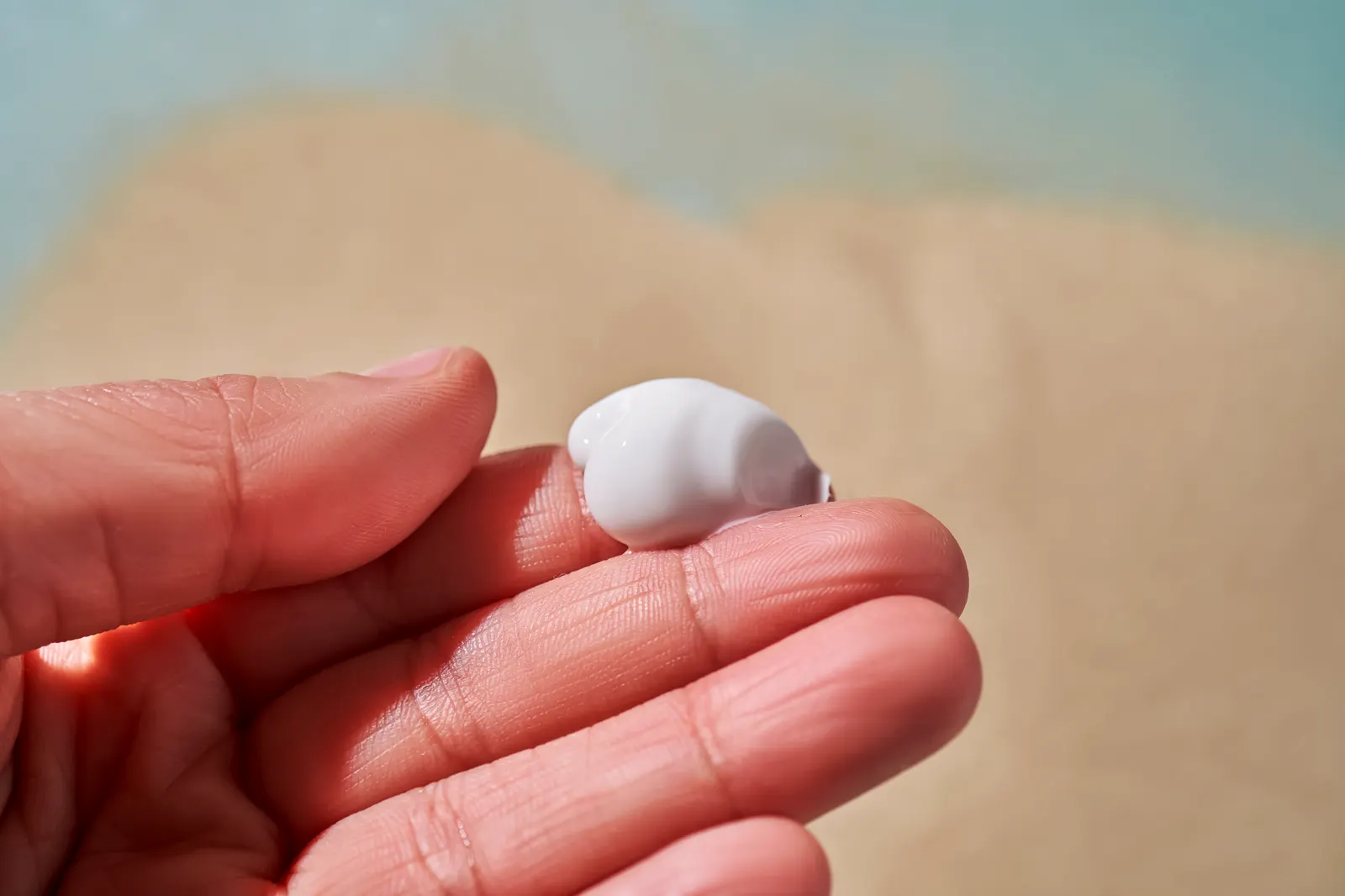
- Squeeze two full strips of sunscreen along the length of your index and middle fingers. For face and neck together, that is your dose.
- Calibrate once: squeeze the same amount into a quarter-teaspoon measure. It should roughly fill it for the face; the neck needs a little more. Notice how much more that is than you usually use.
- Dot it over forehead, cheeks, nose, chin and neck, then spread in two passes rather than one big smear. Do not forget ears, hairline, eyelids (with an eye-safe formula) and the back of the neck.
- Wait about 10–15 minutes before makeup so the film can set evenly.
- Outdoors in strong sun, reapply every two hours and straight after swimming, sweating or towel-drying. On a short-daylight November day mostly indoors, one careful morning application is usually enough.
- Over makeup, a sunscreen stick, cushion or spray can top up, but treat powders and mists as a bonus layer, not your main protection.
Why it works
SPF is tested at 2 mg of product per square centimeter of skin. Studies of real-world use consistently find people apply a quarter to a half of that, and protection falls steeply as the layer thins. Measuring with fingers or a spoon is the simplest fix.
The evidence for daily use is strong. In the Nambour trial in Australia, adults randomized to daily sunscreen showed no detectable increase in skin aging over four and a half years, unlike the discretionary-use group (Hughes and colleagues, Annals of Internal Medicine, 2013), and the same trial earlier reported fewer squamous cell carcinomas (Green and colleagues, The Lancet, 1999). Antioxidant serums with green tea may complement sunscreen but never replace it. More in Sun Care & After-Sun.
Enjoy it safely
- Never make your own sunscreen or add oils, actives or essential oils to a bought one: you cannot measure the SPF at home, and dilution lowers it.
- Babies under six months should be kept out of direct sun with shade and clothing rather than relying on sunscreen.
- If a sunscreen stings your eyes or skin, try a mineral (zinc oxide or titanium dioxide) formula and patch test first.